
Employment Practices Liability (EPLI)
Employee lawsuits are more common, and more expensive, than most owners assume. The average U.S. company faces roughly a 10.5 percent annual chance of an employment claim — over 50 percent in states like California and New Mexico — and about 41 percent of employment claims target small businesses. Defending a claim, even a winning one, commonly runs $75,000 to $125,000, with median settlements near $90,000 and jury cases exceeding $300,000. Employment Practices Liability Insurance, often bundled through a PEO, is the coverage that stands between a claim and the balance sheet.
How Likely Is an Employee Lawsuit?
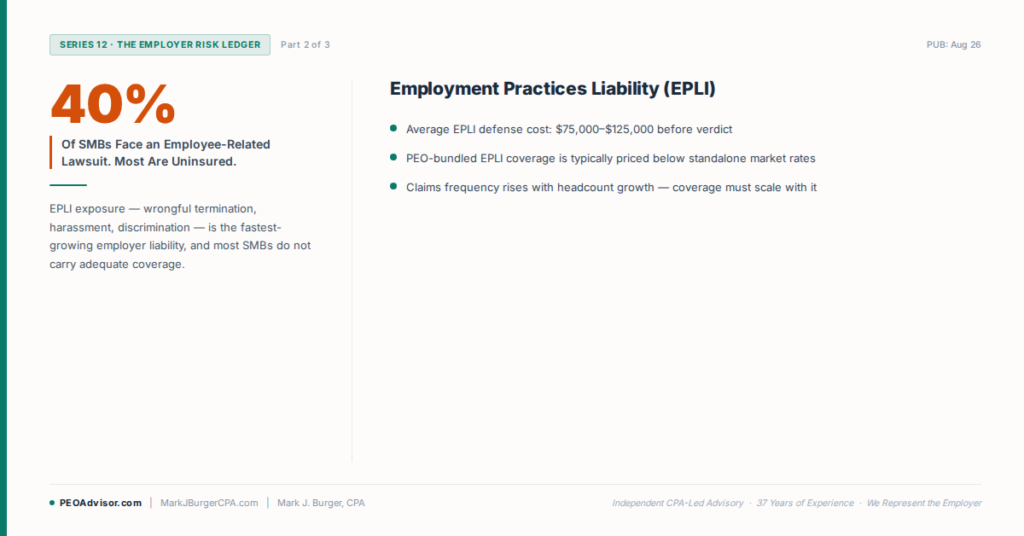
Employment claims are a routine business risk, not a rare event. The average U.S. company faces about a 10.5 percent chance of an employment claim in a given year, and in some states — California and New Mexico among them — the probability exceeds 50 percent. Around 40 percent of small businesses face an employee-related lawsuit at some point. These are not tail risks; they are ordinary exposures that any employer with staff should plan for, regardless of how well it treats its people.
Why Are Small Businesses Disproportionately Targeted?
Size does not protect you — it often does the opposite. About 41 percent of employment-related insurance claims are aimed at small-business employers, who are least likely to have dedicated HR or legal resources to prevent or defend them. The combination of higher exposure and thinner defenses is exactly why the financial impact of a claim falls hardest on smaller companies. Assuming that lawsuits happen only to large employers is one of the more dangerous misconceptions in small-business risk management.

What Does It Cost to Defend an Employment Claim?
The cost of a claim is not just the settlement — it is the defense. Defending an employment claim, even one you win, commonly costs $75,000 to $125,000. Median settlements run around $90,000, and cases that reach a jury can exceed $300,000. Employee litigation cost U.S. companies over $40 million in a recent year in aggregate. For a small business, a single claim without coverage can consume a year of profit — which is why the question is not whether you will prevail, but whether you can afford the fight.
| Want to see your own number? Download our EPLI Readiness Checklist — coverage, exclusions, and PEO-bundling questions to ask before you sign — through a no-cost PEO Advisor assessment. Start the EPLI Readiness assessment |
What Does EPLI Cover?
Employment Practices Liability Insurance is the financial backstop. EPLI covers defense costs and damages for claims such as discrimination, harassment, wrongful termination, and retaliation. Coverage terms, limits, and exclusions vary, so the details matter — but the core function is to keep a routine-but-costly employment claim from landing directly on the business. For employers without it, a single claim is an uninsured, potentially existential expense; with it, the claim becomes a managed event. It is one piece of the larger exposure picture — alongside OSHA, I-9, and wage-and-hour risk — that we build out in a realistic model of what inadequate HR actually exposes your business to.
How Does a PEO Bundle EPLI Coverage?
Many PEOs bundle EPLI, and the prevention that comes with it. A PEO frequently provides or facilitates EPLI coverage as part of its offering, alongside the HR practices — proper documentation, consistent policies, manager training — that reduce the likelihood of a claim in the first place. That combination of prevention and coverage is a tangible differentiator, and one worth confirming: ask a prospective PEO what EPLI it provides, what the limits and exclusions are, and how its HR support reduces claim frequency. Prevention plus coverage is stronger than either alone — see how smart employers eliminate costly HR compliance risk for the broader compliance side of that equation. PEO Company’s guide to the risks of co-employment and how employers can protect themselves covers the contractual and indemnification side worth reviewing before you sign.

This content is educational, not legal or insurance advice. EPLI terms, limits, and exclusions vary by policy; confirm specific coverage with the carrier or PEO. Statistics are illustrative and current as cited; verify at publish.
Unsure whether you are covered for an employee claim? Contact Mark I Burger, CPA to review your EPLI and HR risk.

- What is EPLI? Employment Practices Liability Insurance covers defense costs and damages for employment claims such as discrimination, harassment, wrongful termination, and retaliation. Terms, limits, and exclusions vary by policy. Its core function is to keep a routine-but-costly employment claim from landing directly on the business, turning a potentially existential expense into a managed, insured event.
- How likely is an employee lawsuit? More likely than most owners assume. The average U.S. company faces about a 10.5 percent annual chance of an employment claim, exceeding 50 percent in states like California and New Mexico, and roughly 40 percent of small businesses face an employee-related lawsuit at some point. These are ordinary business exposures that any employer with staff should plan for, regardless of how well it treats employees.
- Why are small businesses targeted by employment claims? About 41 percent of employment-related insurance claims target small businesses, which are least likely to have dedicated HR or legal resources to prevent or defend them. The combination of meaningful exposure and thin defenses concentrates the financial impact on smaller employers. Assuming lawsuits happen only to large companies is a dangerous and common misconception in small-business risk management.
- How much does an employment lawsuit cost? Defending a claim, even a winning one, commonly runs $75,000 to $125,000. Median settlements are around $90,000, and jury cases can exceed $300,000. For a small business without coverage, a single claim can consume a year of profit. The cost is driven as much by defense as by settlement, which is why the ability to afford the fight matters more than the odds of prevailing.
- Does a PEO provide EPLI? Many PEOs provide or facilitate EPLI as part of their offering, alongside the HR practices — documentation, consistent policies, manager training — that reduce claim likelihood. That combination of prevention and coverage is a tangible differentiator. Confirm with a prospective PEO what EPLI it provides, the limits and exclusions, and how its HR support reduces claim frequency.
- Is EPLI worth it for a small business? For most employers with staff, yes, because employment claims are a routine risk, small businesses are disproportionately targeted, and even winning costs six figures. EPLI converts that exposure into a managed, insured event. Pairing coverage with strong HR practices — often available together through a PEO — reduces both the frequency and the impact of claims.
About the author. Mark J. Burger, CPA, advises small and mid-sized businesses on strategic workforce and co-employment decisions through GuidePoint PEO LLC. His analysis draws on decades of CPA practice and hundreds of PEO cost assessments.


