
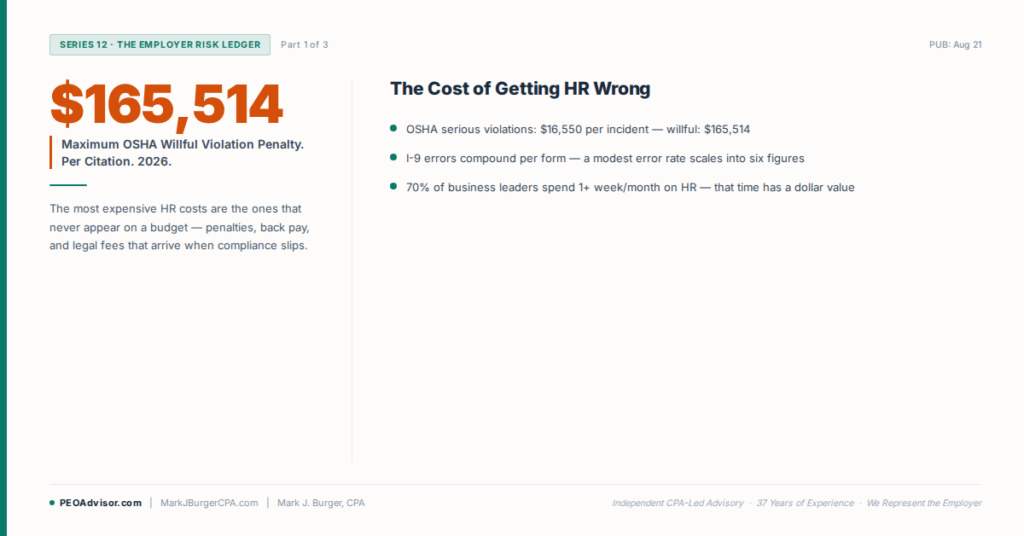
The most expensive HR costs are the ones that never appear on a budget. In 2026, a single willful or repeated OSHA violation can reach $165,514, a serious violation $16,550, and I-9 paperwork errors run into the hundreds to low thousands of dollars per form. Add wage-and-hour liability and the administrative drag — according to Paychex research, about 70 percent of business leaders spend more than a week a month on HR — and the true exposure of running without adequate support dwarfs the cost of the support itself. This article builds that number honestly.
Why Don’t Employers Budget for Compliance Penalties?
Compliance risk is real money, priced probabilistically and ignored until it lands. Because a penalty is a chance, not a line item, owners rarely price it — until it arrives. An honest accounting of HR treats the risk of getting it wrong as a cost, not just the cost of doing the work. The figures below are current 2026 maximums and ranges, and while not every business faces every one, a single serious event can exceed a year of HR investment. That asymmetry is the whole point of building the model. Our companion piece builds a full financial exposure model across OSHA, I-9, and EPLI risk for a hypothetical 50-employee company, if you want to see this taken further.
How Much Are OSHA Safety Violations in 2026?
Workplace-safety penalties are among the largest single exposures. For 2026, OSHA penalties reach $16,550 per serious or other-than-serious violation and $165,514 per willful or repeated violation. For any business with physical work — trades, manufacturing, care, hospitality — a safety lapse is not a paperwork issue; it is a six-figure risk per willful citation. Safety programs and proper documentation are the controls, and they are exactly the kind of infrastructure a capable PEO brings to employers that could not build it alone.
What Are the Penalties for I-9 and Employment Verification Errors?
Verification errors compound because the penalty is per form. I-9 paperwork violations draw civil penalties in the hundreds to low thousands of dollars per form, with higher exposure for knowing or repeated violations, and federal enforcement priorities have increased scrutiny. Because the fine is per form, a modest error rate across a growing or distributed workforce scales into a meaningful number. Accurate verification at onboarding is a cheap control against an expensive, easily overlooked exposure.
Want to see your own number? Download our Employer Exposure Worksheet — build your own risk number across every category — through a no-cost PEO Advisor assessment. Contact Mark J. Burger, CPA and Start the Employer Exposure Worksheet assessment
Why Is Wage-and-Hour Liability So Risky?
Misclassification and off-the-clock work create multiplying liability. Classifying an employee incorrectly as exempt, or allowing off-the-clock work, produces back-pay, penalty, and legal exposure that multiplies across every affected employee and every pay period. These are among the most common employment claims precisely because they flow from everyday management decisions. Consistent, correct wage-and-hour practices — and the compliance support to maintain them — are the difference between a controlled cost and a class-wide liability. PEO Company’s guide to mitigating co-employment risk when using a PEO covers the contractual and monitoring side of that protection in more depth.

How Much Does the Administrative Drag on HR Actually Cost?
Even without a penalty, inadequate HR is expensive in time. According to Paychex research, roughly 70 percent of business leaders report spending more than one week per month on HR tasks. That is leadership time diverted from revenue, and it is a real, recurring cost that belongs in the model alongside penalty risk. When you add the value of that time to the probability-weighted penalty exposure, the true cost of running without adequate HR support is far larger than the visible spend — which is the case for fixing it. That case only gets stronger for employers managing multi-state compliance obligations, where the administrative drag compounds by jurisdiction.
Want your real HR exposure number? Start a conversation with Mark J. Burger CPA, for a no-cost risk audit across every category.

- How much can HR mistakes cost a business? Far more than an HR salary. In 2026, a single willful or repeated OSHA violation can reach $165,514 and a serious violation $16,550, I-9 errors run hundreds to low thousands per form, and wage-and-hour mistakes multiply across employees. Adding the administrative drag — about 70 percent of leaders spend over a week a month on HR — the true exposure of inadequate HR often dwarfs the cost of covering it.
- What is the maximum OSHA penalty in 2026? For 2026, OSHA penalties reach $16,550 per serious or other-than-serious violation and $165,514 per willful or repeated violation. For any business with physical work, a safety lapse is a six-figure risk per willful citation, not a paperwork issue. Safety programs and documentation are the controls, and they are infrastructure a capable PEO can provide to employers that could not build it alone.
- How much are I-9 violations for employers? I-9 paperwork violations draw civil penalties in the hundreds to low thousands of dollars per form, with higher exposure for knowing or repeated violations. Because the penalty is per form, a modest error rate across a growing or distributed workforce compounds into a meaningful figure. Accurate verification at onboarding is a low-cost control against an easily overlooked, scalable exposure.
- Why is wage-and-hour liability so risky? Because misclassification and off-the-clock work create back-pay, penalty, and legal exposure that multiplies across every affected employee and pay period, and both flow from everyday management decisions. These are among the most common employment claims. Consistent, correct wage-and-hour practices, supported by real compliance help, are the difference between a controlled cost and a class-wide liability.
- How do I calculate my HR risk exposure? Build a model across categories: probability-weighted OSHA penalties for your industry, I-9 error exposure per form, wage-and-hour liability across your workforce, and the value of leadership time spent on HR. Summing these produces a realistic exposure figure that is usually far larger than visible HR spend, and it becomes the business case for adequate support or a PEO.
- Can a PEO reduce my compliance risk? A PEO brings safety programs, accurate onboarding and verification, wage-and-hour compliance support, and change monitoring that reduce the likelihood and size of penalties. It does not eliminate liability, but it lowers exposure across the categories that drive it and absorbs the administrative drag. For employers that cannot build this infrastructure alone, the risk reduction is a core part of the value.
This content is educational, not legal or tax advice. Penalty figures are 2026 federal maximums and change with annual adjustments; verify current amounts before relying on them.


