
A 2026 Small Business HR Compliance Cost Model
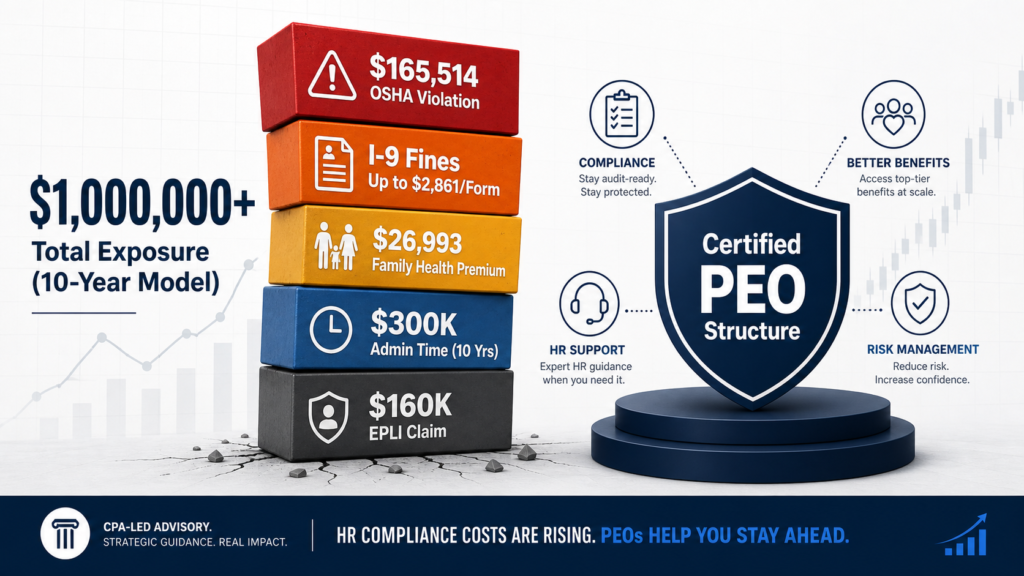
| HR Risks: What the Numbers Actually Say in 2026 A PEO will help exposures like a willful OSHA violation carries a maximum penalty of $165,514. The average employer-sponsored family health plan now costs $26,993 per year, according to the 2025 Kiser Family Foundation (KFF) Employer Health Benefits Survey. And as of March 2026, ICE quietly reclassified dozens of common Form I-9 errors as substantive violations subject to immediate fines, with no Federal Register notice and no public announcement. These three facts frame the financial environment that small and mid-sized employers are navigating right now. |
After 37 years reviewing employer contracts, HR structures, and compliance programs across hundreds of businesses, the pattern is consistent. Small business HR compliance costs are not a line item most owners track systematically — and that is precisely where the exposure accumulates. Small and mid-sized employers do not fail because they ignore compliance. They fail because they do not have a systematic framework to manage it. And that gap carries a price that compounds quietly over time until it becomes acute. MarkJBurgerCPA.COM
This post builds a realistic financial exposure model for an employer operating without a well-structured PEO relationship. The goal is not to create alarm. The goal is to quantify what inaction actually costs, so that the business case for a certified PEO partnership becomes clear and defensible.
What Is the True Cost of Operating Without Adequate HR Infrastructure?
The question deserves a structured answer, not a generalized one. The exposures fall into five distinct categories, each with documented, citable financial ranges that reflect 2026 conditions.
1. Workplace Safety and OSHA Penalty Exposure
OSHA adjusts civil penalties annually for inflation. The 2026 penalty schedule sets the maximum fine for a willful or repeated violation at $165,514 per violation. Serious violations carry a maximum of $16,550 per violation. Failure to abate a cited hazard adds up to $16,550 per day beyond the abatement deadline.
For context: OSHA penalties have increased more than 80 percent since 2015, and 2026 marks their highest level in the agency’s history. The minimum penalty for a willful violation is now $11,524 — even after applying every available reduction. There is no discretionary floor below that amount.
For a small employer without a formal safety program, a single worksite inspection following an incident can generate multiple citations across multiple categories. The aggregate exposure in that scenario routinely exceeds $100,000 before any civil litigation from the injured worker or their family.
One additional development in 2026 is worth noting: the OSHA Walkaround Rule is now in effect. Third-party representatives, including union advocates and outside safety professionals, may now accompany OSHA inspectors during workplace visits. Employers should know who can walk through their facility before an inspection arrives.
What a Certified PEO Provides in This Area IRS-certified and ESAC-accredited PEOs typically include workplace safety program support, OSHA compliance resources, and access to risk management professionals as part of their standard service offering. The time to establish that infrastructure is before an incident occurs, not after a citation is issued.
2. Form I-9 Employment Eligibility — A Changed Landscape in 2026
2026 Enforcement Alert: ICE Reclassified Common I-9 Errors On March 16, 2026, ICE updated its Form I-9 Inspection fact sheet, quietly reclassifying more than ten categories of common errors from correctable technical violations to substantive violations subject to immediate fines. The change was made with no Federal Register notice and no public announcement. Errors that previously triggered a 10-business-day correction window now carry immediate penalty exposure of $288 to $2,861 per form.
The civil penalty schedule for I-9 paperwork violations, as adjusted under the Federal Civil Penalties Inflation Adjustment Act effective January 2, 2025, sets fines at $288 to $2,861 per form for substantive violations on a first offense. Repeat offenses carry escalating ranges. Knowingly hiring an unauthorized worker carries a separate penalty structure reaching $28,619 per worker for third and subsequent offenses.
ICE has also dramatically accelerated enforcement activity. Audit rates in 2026 are running at roughly ten times the pace of 2024. The One Big Beautiful Bill Act has funded 10,000 additional enforcement officers. The combination of higher penalty exposure, faster enforcement timelines, and a broader definition of what constitutes a substantive violation has fundamentally changed the risk profile for employers who have not conducted a recent I-9 audit.
Consider a company with 50 employees that has not conducted a formal I-9 audit. If a government review identifies substantive deficiencies across 30 forms, the exposure ranges from $8,640 to $85,830 for paperwork violations alone — under the new reclassification framework, not counting any knowing-hire violations.
The compounding factor: I-9 violations are preventable. Properly structured PEOs administer the complete employment eligibility verification process, maintain compliant records, and manage E-Verify enrollment as part of their standard onboarding administration.
3. Employee Benefits Premium Overpayment
According to the 2025 KFF Employer Health Benefits Survey, the average annual employer-sponsored premium for family coverage reached $26,993, up 6 percent from 2024. For small employers purchasing coverage in the individual small-group market, rates are consistently higher than what is accessible through a PEO’s large-group purchasing pool.
Based on the analysis of employer benefit structures conducted through my advisory practice, small employers with fewer than 100 employees frequently overpay per enrolled employee annually compared to equivalent coverage available through a certified PEO’s benefit platform. For a company with 50 employees where 30 carry family coverage, that annual overpayment ranges from $60,000 to $150,000.
This is not a theoretical savings estimate. It reflects the structural advantage that certified PEOs hold through aggregate purchasing power. The same mechanism that allows a 50-person company to access benefit options comparable to what a Fortune 500 organization would offer. Small employers at KFF’s survey benchmark of $26,993 in family premiums are paying for coverage that is often more expensive and less competitive than what a certified PEO’s benefit pool provides.
A Note on Premium Trend Family premiums have risen 24 percent over the last five years, according to KFF. Each year that an employer delays a PEO evaluation, the premium differential compounds. A conservative 5-year delay on a 50-person company with 30 family plan enrollees can represent $450,000 or more in premium overpayment.
4. Administrative Time Burden on Leadership
Paychex research indicates that 70 percent of business and HR leaders spend more than one week per month managing HR-related tasks. For small companies, this time does not belong to a dedicated HR staff member. It belongs to owners, CFOs, COOs, and senior managers who could otherwise focus on revenue-generating activities.
If two senior leaders at a 50-person company each spend 10 hours per month on HR administration — payroll inquiries, benefits questions, compliance research, employee relations matters — and their blended compensation rate is $125 per hour, the annual cost of that administrative burden is $30,000. Over a decade, the cumulative cost approaches $300,000 in diverted executive attention.
That figure is conservative. It does not include the opportunity cost of growth initiatives not pursued, client relationships not developed, or strategic planning not executed because leadership capacity was occupied with administrative functions that a PEO would otherwise manage.
5. Employment Practices Liability Exposure
Industry data consistently shows that 41.5 percent of employee-related lawsuits target private companies with fewer than 100 employees, according to research compiled by industry insurance sources. The Insurance Information Institute places the median jury award in an EPLI case at $125,000. Settlement figures from the Hiscox Guide to Employee Lawsuits document an average combined defense and settlement cost of $160,000 for cases that proceed through resolution.
The most common claim categories include wrongful termination, discrimination, harassment, and wage and hour violations. In my experience reviewing employer compliance structures, the majority of these claims arise not from intentional misconduct but from inconsistent policies, undocumented management decisions, and the absence of trained HR professionals who can identify risk before it escalates into a formal complaint.
A certified PEO provides access to HR professionals, employment handbook support, manager training resources, and pre-termination review processes. This does not eliminate all employment liability. But it changes the structure of risk management fundamentally — from reactive to preventive.
The Aggregate Exposure Model: A 50-Employee Company Over Ten Years
The table below consolidates the five categories into a composite exposure model for a hypothetical 50-employee company operating without a structured PEO relationship. The figures reflect 2026 penalty schedules, current KFF premium benchmarks, and published EPLI claim data.
| Exposure Category | Potential Exposure | Source |
| Willful OSHA Violation (single) | Up to $165,514 per violation | OSHA 2026 penalty schedule |
| I-9 Paperwork Violations (50 forms) | $14,400 – $143,050 | DHS / ICE 2026 penalty schedule |
| Benefits Premium Overpayment (50 employees, family coverage, 10 yrs) | $180,000 – $300,000+ | KFF Employer Health Benefits Survey 2025 |
| EPLI Claim (average defense + settlement) | $125,000 – $217,000+ | Hiscox / Insurance Information Institute |
| HR Administrative Burden (2 leaders, 10 years) | ~$300,000–$500,000 in diverted executive time | Paychex HR leadership research |
| TOTAL MODELED EXPOSURE | $1,000,000+ | Composite model |
The composite model is not presented as a prediction. It is a framework. Not every company will encounter a willful OSHA violation or an EPLI claim in any given year. But the model reflects documented, citable financial consequences that are real, that occur with statistical regularity across the SMB market, and that compound in ways that are difficult to reverse once they materialize.
The more useful question is not whether these events are likely. It is whether the cost of preventing them is proportionate to the exposure they represent. Viewed through that lens, the calculation is rarely close.
Which PEO Capabilities Address Which Category of Exposure?
Not every PEO addresses every risk category with equal depth. The quality of a PEO’s compliance support, benefits platform, and HR advisory services varies significantly between providers. That variation is precisely why the evaluation process matters and why independent advisory is more valuable than a vendor-recommended comparison.
When evaluating a PEO’s ability to address the five exposure categories outlined above, employers should assess the following:
- Safety and OSHA compliance: Does the PEO provide dedicated risk management resources, safety program templates, and workers’ compensation coverage? How are claims managed and what is the PEO’s claim history?
- Form I-9 and onboarding compliance: Does the PEO administer the complete I-9 process under the 2026 ICE reclassification framework, maintain compliant records, and provide active E-Verify enrollment? Remote document verification procedures matter now more than before.
- Benefits purchasing power: What is the PEO’s total covered employee count for underwriting purposes? Is the PEO IRS-certified (CPEO status) and ESAC-accredited? These designations reflect financial stability and compliance standards that are directly relevant to benefits access.
- HR administrative support: What is the dedicated support model — shared service center, dedicated account manager, or a combination? What is the documented response time standard for employer inquiries?
- Employment practices guidance: Does the PEO provide access to employment law resources, employee handbook development, manager training, and pre-termination review support? These resources directly reduce EPLI claim frequency.
These are not questions that vendors are motivated to answer with full transparency in a sales context. They are questions that an independent advisor asks on the employer’s behalf, before the sales process begins.

What Employers Should Do With This Information
The purpose of building this financial model is to create clarity, not anxiety. Business owners make better decisions when risk is quantified and structured, not generalized. The following steps represent a practical response to the exposure framework outlined above.
- Conduct a compliance gap assessment. Identify which of the five exposure categories represents your highest current risk based on your industry, headcount, and state footprint. This is the starting point for a meaningful PEO evaluation.
- Audit your Form I-9 records before an ICE inspection does it for you. The March 2026 reclassification has expanded what constitutes an immediately fineable violation. Identifying and correcting errors before an audit is the most effective way to reduce your exposure under the current enforcement framework.
- Compare your current benefits costs against PEO group rates. The premium differential is quantifiable. A CPA-level analysis of your current benefits spending against what a certified PEO’s benefit platform provides will produce a concrete, defensible return-on-investment figure.
- Require IRS certification and ESAC accreditation. Work with Certified Professional Employer Organizations (CPEOs) and ESAC-accredited providers. These designations reflect financial stability, compliance standards, and operational accountability that matter when selecting a long-term HR partner.
- Engage an independent advisor before entering the PEO evaluation process. Independent advisory ensures that the PEO you select is driven by your specific risk profile and operational needs, not by vendor incentives or referral arrangements.
How PEOAdvisor.com Can Help
PEOAdvisor.com is an independent, CPA-led advisory service that helps employers identify which certified PEO in the market best addresses their specific risk profile. We analyze your industry, headcount, state compliance footprint, and the exact categories of financial exposure outlined in this post.
We do not represent any PEO vendor. Our guidance is based on what is best for your organization. Our role is to help you understand what the market offers, identify IRS-certified and ESAC-accredited providers, and match their capabilities to your operational and compliance requirements.
Before you schedule a PEO sales call, know what you need and know which providers are genuinely capable of delivering it.
| Start with an Independent PEO Strategy Consultation We will review your current HR structure, map your compliance exposure by category against the 2026 regulatory environment, and identify the certified PEO partners best equipped to address your specific risk profile. There is no obligation and no vendor involvement in the assessment process. Book your no-cost strategy consultation: PEOAdvisor.com |
- How do I know which PEO actually covers all five of these risk categories — and covers them well? Not all PEOs address every category with equal depth. The quality of a PEO’s safety program, I-9 administration, benefits platform, HR support model, and employment practices resources varies significantly between providers — and vendors are not motivated to highlight their gaps in a sales conversation. The most reliable approach is to work with an independent advisor who evaluates providers against your specific risk profile before the sales process begins. That is precisely what PEOAdvisor.com does. We map your exposure by category and identify IRS-certified, ESAC-accredited providers whose capabilities align with your operational needs — at no cost to you.
- What does a PEO actually cost, and does the savings on benefits and compliance outweigh the fee? PEO fees typically range from $1,000 to $1,500 per employee per year, or are structured as a percentage of payroll. For most small and mid-sized employers, the benefits premium savings alone — which can run $3,000 to $5,000 per enrolled employee annually compared to small-group market rates — offset a significant portion of that fee. When you add the administrative time recovered, the compliance infrastructure provided, and the EPLI risk reduction, the return on investment is typically positive for companies with 25 or more employees. A CPA-level analysis of your current HR and benefits spend will produce a defensible number specific to your situation. That analysis is the starting point for every PEOAdvisor.com engagement.
- We already have a PEO — does this apply to us? Yes — and in some respects it applies more directly. Having a PEO does not guarantee that all five exposure categories are covered adequately. Many employers in existing PEO relationships have never formally audited whether their provider’s safety program, I-9 administration, benefits platform, and HR support model are performing to standard. Renewal time is when that gap typically surfaces — often through a rate increase or a compliance issue that a well-structured agreement would have prevented. If you are in an existing PEO relationship and have not conducted an independent performance review in the past 12 to 24 months, that review is worth scheduling before your next renewal cycle. PEOAdvisor.com provides independent PEO performance reviews and renewal benchmarking as part of our advisory services.


