
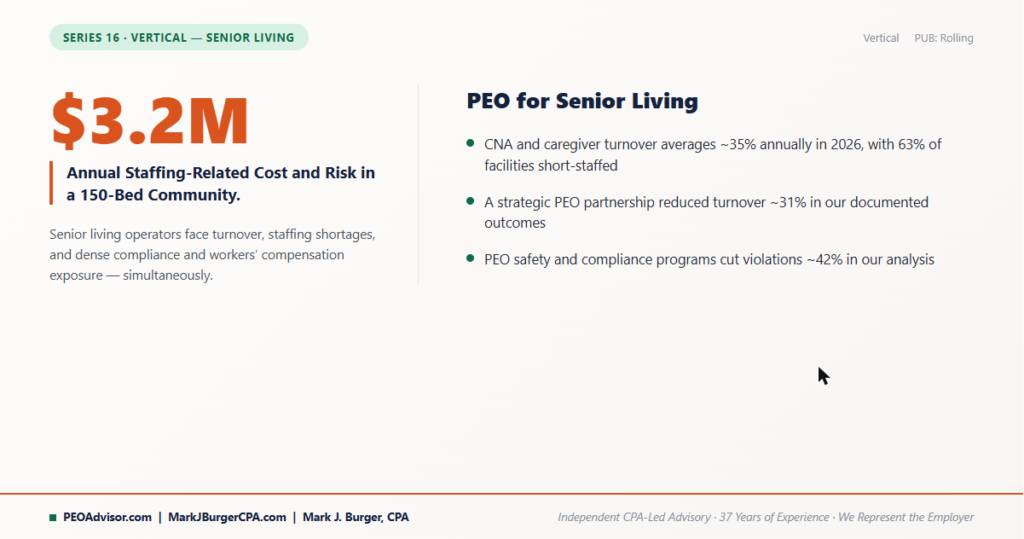
Senior living runs on staffing, and the numbers are punishing: the average 150-bed community faces roughly $3.2 million in annual staffing-related costs and risks, and senior living communities still report about 35 percent average turnover, with 63 percent of assisted-living facilities experiencing a staff shortage and 87 percent struggling to hire, according to 2026 senior living industry workforce data. In our analysis, communities that moved to a strategic PEO partnership documented about a 31 percent reduction in turnover, a 42 percent decrease in compliance violations, and average annual savings near $487,000. For an operator, consistent staffing is not an HR nicety — it is the operating model.
What Does the Senior Living Staffing Crisis Actually Cost?
Care quality and financial survival both hinge on the same problem: staffing. In our analysis of senior living operations, the average 150-bed community carries about $3.2 million in annual staffing-related costs and risks, up sharply since 2019. According to 2026 senior living industry workforce data, the sector still reports roughly 35 percent average turnover, with the highest churn among nurses and aides, and a majority of facilities reporting shortages and hiring difficulty. Clinical roles such as CNAs and RNs remain the hardest to fill, and every unfilled shift pressures both care and cost. A PEO built for senior living — explained in our plain-English primer on what a PEO actually is — is built to absorb exactly this kind of structural staffing burden.

What Is Driving Senior Living Staffing Costs?
Turnover dominates the cost, with compliance close behind. For a representative 150-bed facility, turnover expenses can approach $892,000 a year — driven by high departure rates at roughly $8,200 per exit — alongside significant wage-and-hour and staffing-ratio compliance penalties, workers’ compensation from physical work, and agency-staffing premiums used to cover gaps. Every HR mistake compounds this exposure; our broader model of what inadequate HR actually costs an employer walks through the same penalty categories in more detail. Each of these is a direct target for a PEO built to stabilize a care workforce, and turnover is where the largest recoverable dollars sit.
Not sure where your staffing dollars are going? Download our Senior Living PEO Value Worksheet — model turnover, compliance, and staffing cost — through a no-cost PEO Advisor assessment. Start the Senior Living PEO Value Worksheet assessment
How Does a PEO Stabilize the Senior Living Workforce?
According to NAPEO, businesses that use a PEO grow about twice as fast as comparable businesses that do not use one, and NAPEO also reports roughly 12 percent lower employee turnover and a 50 percent lower likelihood of going out of business. A PEO attacks retention and staffing directly, not just administratively. Through co-employment, a senior-living-focused PEO supports scalable recruiting and onboarding, delivers competitive benefits that aid retention in a field where compensation and culture drive turnover, and provides HR infrastructure that a single community could not build — the same scalable approach PEO Company documents in its analysis of PEO staffing and compliance solutions for senior living. In our documented outcomes, that combination reduced turnover by about 31 percent — the single most valuable result, because lower turnover reduces agency reliance, protects care continuity, and lifts survey performance.
Does a PEO Help With Senior Living Compliance and Workers’ Compensation?
Care settings carry dense compliance and real injury exposure. Senior living faces wage-and-hour rules, staffing-ratio requirements, and physical-work injury risk that generate both penalties and workers’ compensation cost. A PEO focused on the sector brings safety and risk-management programs, wage-and-hour compliance support, and — in our analysis — about a 42 percent decrease in compliance violations. Reducing injuries and violations lowers cost while protecting residents and staff, which is exactly the alignment operators need.

What Should a Senior Living Operator Look for in a PEO?
Fit means a PEO that understands 24/7 care, not a generalist. The right partner understands round-the-clock scheduling, clinical staffing, care-sector compliance, and the benefits that retain caregivers. Ask what comparable communities a provider serves and how it has moved turnover, agency reliance, and compliance for them. Because the stakes are care quality and margin together, an independent evaluation comparing providers on documented senior-living capability is the dependable way to match — our guide to identifying quality PEO providers and true strategic partners walks through how to run that evaluation.
Operate a senior living community? Contact Mark J. Burger, CPA to model your staffing cost and match a PEO built for care.
Figures cited in this article reflect PEO Advisor’s proprietary analysis of senior living operations and are illustrative benchmarks, not guarantees; results vary by community. 2026 sector turnover and staffing-shortage figures are cited industry estimates — verify current figures before relying on them. This content is educational, not legal or tax advice.

- How does a PEO help senior living facilities? A PEO supports scalable recruiting and onboarding, delivers competitive benefits that aid caregiver retention, provides workers’ compensation and safety programs, and absorbs HR and compliance. In our analysis, senior living communities that partnered with a PEO documented about a 31 percent reduction in turnover, a 42 percent decrease in compliance violations, and average annual savings near $487,000.
- What is the turnover rate in senior living? Senior living reports roughly 35 percent average annual turnover, with the highest churn among registered nurses, certified nursing assistants, and dining staff, according to 2026 industry workforce data. About 63 percent of assisted-living facilities report a staff shortage and 87 percent report hiring difficulty, with CNAs and RNs the hardest roles to fill. Turnover is the sector’s dominant cost and risk.
- Can a PEO reduce senior living staffing costs? Yes, primarily by reducing turnover, which is the largest staffing cost. A representative 150-bed community can carry turnover expenses approaching $892,000 a year. By improving retention through competitive benefits and stronger HR support, and by cutting compliance and workers’ compensation cost, a PEO in our analysis produced average annual savings near $487,000 for participating communities.
- What should a senior living operator look for in a PEO? Look for documented senior-living experience: understanding of 24/7 scheduling, clinical staffing, care-sector compliance, and caregiver-retention benefits. Ask what comparable communities the provider serves and how it has improved their turnover, agency reliance, and compliance. A generalist PEO unfamiliar with round-the-clock care is a weaker fit than one built for the sector.
- How does reducing turnover improve care quality? Lower turnover means fewer unfilled shifts, less reliance on unfamiliar agency staff, and greater continuity of caregivers who know residents — all of which improve care quality and survey performance. Because staffing stability underlies both care and cost, the retention gains a PEO delivers translate directly into better outcomes for residents, not just savings for the operator.
- Does a PEO take over clinical staffing decisions? No. Under co-employment, a PEO handles payroll, benefits, HR, and compliance as the administrative employer, while senior living leadership retains full control over clinical staffing, care planning, and resident-care standards. The PEO provides administrative infrastructure and workforce support, not clinical oversight — a division of labor that returns HR time to leadership without transferring authority over care.


