
A Professional Employer Organization (PEO) lets a small business share employer responsibilities through a contractual arrangement called co-employment: the PEO handles payroll, benefits, and much of HR compliance under its own tax identification, while you keep full control of your people and your business. It is not a staffing agency, it does not take over your company, and it is not only for large employers. Businesses that use a PEO grow faster, retain more employees, and are less likely to fail — which is why understanding what a PEO actually is matters before you dismiss or choose one.
What Is a PEO, Exactly?
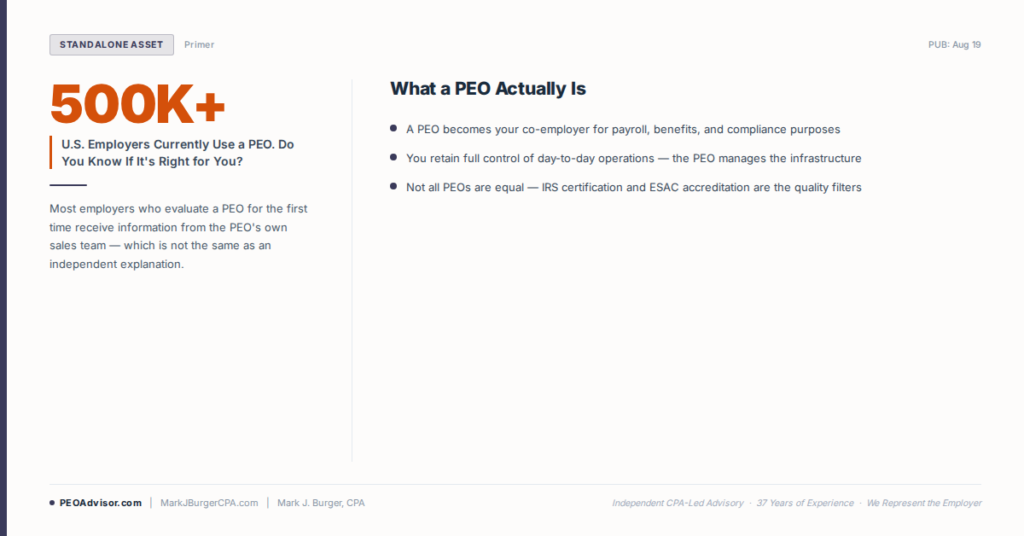
A PEO is a partner that shares specific employer responsibilities with you. Through a Professional Employer Organization, your business and the PEO enter a co-employment relationship: the PEO becomes the administrative employer for payroll, taxes, and benefits, reporting under its own tax identification, while you remain the worksite employer who runs the business and manages the people. It is a division of labor, not a transfer of ownership. That single idea — shared, defined responsibilities — is the whole concept.
What Does a PEO Do?
A PEO takes over the administrative machinery of employment. In practice, a PEO processes payroll and files employment taxes, sponsors and administers health and retirement benefits, provides HR and compliance support, and often bundles workers’ compensation and access to large-group benefits a small business could not obtain alone. It gives a small employer the HR infrastructure of a large one, delivered as a service, so leadership can spend its time on the business rather than on administration. For a closer look at how that division of labor actually works day to day, see PEO Company’s breakdown of the strategic co-employment business advantage.
What Do You Keep Control Of With a PEO?
You retain full control of your company and your team. Hiring, firing, pay, promotions, how the work is organized, and the direction of the business all remain yours. The PEO does not run your operation or make your decisions; it administers the payroll, benefits, and compliance that follow from them. Retaining this control is not only the reality of the model — it is part of what keeps you the employer of your people in every way that matters day to day.
| Not sure where to start? Speak with Mark J.Burger, CPA and start your a no-cost PEO Advisor assessment. Start the First-Timer’s PEO Guide assessment |
What Are the Biggest Misconceptions About PEOs?
Most hesitation about PEOs rests on ideas that are simply not true. Three misconceptions dominate. First, that you lose control — you do not; you keep direction of the business while the PEO handles administration. Second, that a PEO is only for large companies — in fact the sweet spot is roughly 10 to 150 employees, and smaller businesses often gain the most. Third, that it is just outsourced payroll — a PEO is broader, spanning benefits, compliance, workers’ compensation, and HR support. A fourth worry, cost, is best answered by comparing the all-in figure against the true cost of doing HR yourself, which is often higher than owners assume.

What Is the Difference Between a Certified and Non-Certified PEO?
One distinction is worth knowing from the start. A Certified PEO (CPEO) has met IRS requirements and is solely liable for the federal employment taxes on the wages it pays, so if it failed to remit, the IRS could not pursue you — a protection a non-certified PEO does not carry. Certification is a meaningful screen, though not the whole decision. Knowing the term lets you ask the right question early: is this PEO IRS-certified? For a fuller framework on separating a genuinely certified, strategic partner from the rest of the market, see our guide to identifying quality PEO providers and true strategic partners.
Is a PEO Right for Your Business?
The honest answer depends on your size, needs, and goals. A PEO tends to fit a growing business that wants competitive benefits, relief from HR administration and compliance, and the leverage of scale — especially between about 10 and 150 employees or across multiple states. It fits less well for a very small employer below plan minimums or a large organization wanting full control of custom benefits. The way to know is to compare the all-in cost and value of a PEO against your current approach — ideally with an independent advisor who has no stake in the answer. Our overview of PEO solutions for small and mid-sized businesses is a good next stop if you want to see how that fit plays out across different company sizes.

New to PEOs and want a straight answer? Contact Mark J Burger, CPA for a no-cost, independent explanation of whether one fits your business.
- What is a PEO? A Professional Employer Organization (PEO) is a firm that shares specific employer responsibilities with a business through co-employment. The PEO acts as the administrative employer for payroll, taxes, and benefits under its own tax identification, while the business remains the worksite employer that runs operations and manages people. It gives small employers large-company HR infrastructure delivered as a service.
- Does using a PEO mean I lose control of my business? No. You retain full control of hiring, firing, pay, promotions, how work is organized, and the direction of the business. The PEO only administers the payroll, benefits, and compliance that follow from your decisions. Co-employment is a division of labor, not a transfer of ownership or management, and retaining that control keeps you the employer of your people day to day.
- Is a PEO just outsourced payroll? No. Payroll is one part, but a PEO is broader — it sponsors and administers benefits, provides HR and compliance support, often bundles workers’ compensation, and gives access to large-group benefits a small business could not obtain alone. It provides the HR infrastructure of a large employer as a service, well beyond what a standalone payroll provider offers.
- Is a PEO only for large companies? No — the opposite is often true. The PEO sweet spot is roughly 10 to 150 employees, and smaller businesses frequently gain the most because they feel benefits and compliance pressure acutely and lack the scale to solve it alone. Very small employers may hit plan participation minimums, but PEOs are fundamentally a small-and-mid-sized-business solution, not a large-company one.
- What is the difference between a PEO and a CPEO? A Certified PEO (CPEO) has met IRS certification requirements and is solely liable for the federal employment taxes on wages it pays, so a client is held harmless if it fails to remit. A non-certified PEO does not carry that statutory protection. Certification is a meaningful screen for financial reliability, though service fit, benefits, and industry capability still need separate evaluation.
- How do I know if a PEO is right for my business? A PEO tends to fit a growing business of roughly 10 to 150 employees that wants competitive benefits, relief from HR administration and compliance, or multi-state support. It fits less well for a very small employer below plan minimums or a large organization wanting full custom control. Compare the all-in cost and value against your current approach, ideally with an independent advisor.


