
Executive Summary
Healthcare practices, senior living operators, and charter and private schools carry three burdens at once: dense, changing compliance; constant staffing volatility; and pressure to offer competitive benefits on thin margins. A PEO built for regulated care absorbs credential-adjacent HR, multi-jurisdiction compliance, and large-group benefits access, freeing clinical and academic leaders to focus on care and instruction. The right match is industry-specific. A generalist PEO that has never handled a 24/7 care schedule or a school calendar is not the same fit, and in a sector where turnover alone can cost a facility six figures a year, that fit is the whole decision.
The Shared Burden of Regulated Care
Care and education settings face compliance density that generalist businesses do not. Overlapping federal, state, and local rules govern employment in these fields, and they change often. Layer in high turnover, shift or seasonal staffing, and workforces that expect real benefits, and the HR load becomes a genuine drain on leaders whose expertise is clinical or academic, not administrative. A professional employer organization consolidates payroll, benefits, and compliance so that leadership time returns to patients, residents, and students. For a broader primer on how co-employment works, see our plain-English primer on what a PEO actually is.
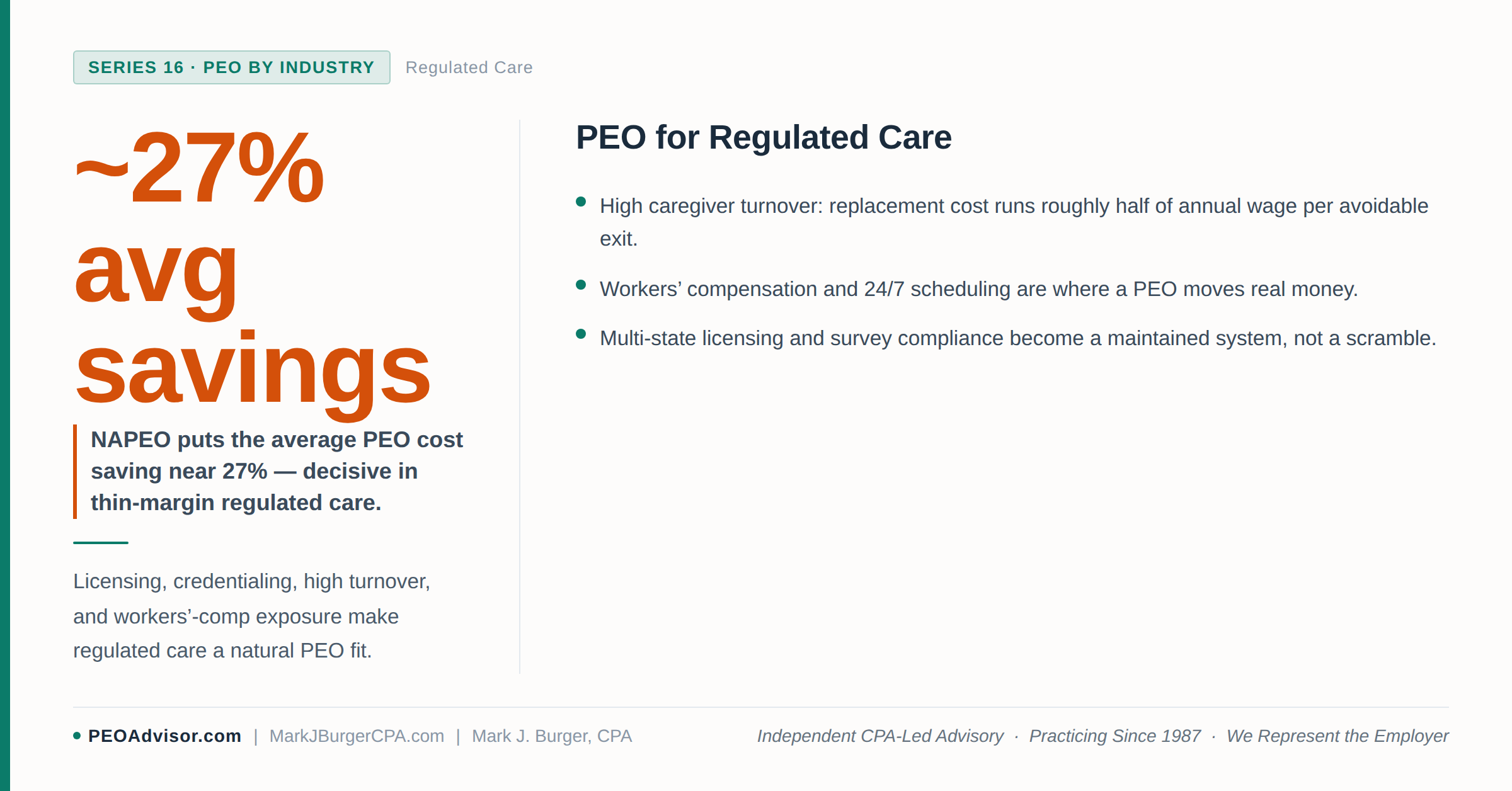
The scale of the model is no longer marginal. According to the National Association of Professional Employer Organizations (NAPEO), roughly 523,000 businesses now use a PEO, in an industry NAPEO research associates with average cost savings near 27 percent, driven by consolidated purchasing across HR staff, health benefits, workers’ compensation, and unemployment insurance. In regulated care, where benefits and workers’ compensation are among the largest controllable costs, that consolidation is felt directly.
How Does a PEO Help a Medical or Dental Practice?
Medical and dental practices gain the most from benefits leverage and compliance relief. Independent practices and groups compete for clinical talent against hospitals and larger systems, and a PEO’s large-group purchasing can deliver benefits those practices could not access alone. It also absorbs the day-to-day HR and compliance work — onboarding, handbooks, and multi-state rules for practices with several locations — that pulls physicians and office managers away from patient care. For an OB-GYN group or a multi-site practice, the financial and time advantages are concrete.
Why Do Senior Living Facilities Use PEOs?
Senior living lives or dies on staffing and scheduling. Assisted living and senior care operators run 24/7 with chronic staffing pressure, high turnover, and workers’ compensation exposure from physical work. A PEO focused on this sector supports scalable recruiting and onboarding, competitive benefits to aid retention, and workers’ compensation and safety programs suited to the risk — the same scalable approach PEO Company documents in its analysis of PEO staffing and compliance solutions for senior living. In a labor-constrained field, the ability to staff consistently and retain caregivers is not an HR nicety. It is the operating model, and it carries a dollar figure that owners rarely put on paper. For a deeper look at this vertical alone, see our full analysis of PEO for senior living and its staffing crisis.
The Staffing Math That Drives the Decision
Worked example (illustrative). The strongest case for an industry-fit PEO in senior living is not the administrative fee. It is turnover. A widely used planning lens values the cost of replacing a departed employee at roughly one-half of that employee’s annual wage, once recruiting, onboarding, overtime backfill, and lost productivity are counted. Consider an assisted-living operator with 80 direct-care staff at an average wage of $38,000.
| 80-caregiver facility | Before retention support | After PEO retention support (illustrative) |
|---|---|---|
| Direct-care headcount | 80 | 80 |
| Annual turnover rate | 50% | 40% |
| Departures per year | 40 | 32 |
| Replacement cost per departure (~½ of $38,000) | $19,000 | $19,000 |
| Annual replacement cost | $760,000 | $608,000 |
| Avoided cost | — | ~$152,000 / yr |
The point is the order of magnitude, not the exact figure. In regulated care, the retention and benefits levers a PEO pulls tend to dwarf the line-item fee. A structured onboarding process, competitive health coverage, and a workers’ compensation program tuned to caregiving work do not merely tidy the back office. They change how many people walk out the door, and each departure in this sector is expensive.
| Not sure where your regulated-care staffing dollars are going? Get a no-cost, industry-specific read on your turnover, compliance, and benefits cost through the PEO Advisor assessment. Start the Regulated-Care PEO Fit assessment |
Can Charter and Private Schools Use a PEO?
Yes. Schools carry an unusual mix of compliance, calendar, and benefits demands. Charter and private schools must manage employment compliance, background and credential-adjacent requirements, and a workforce that expects strong benefits, all on a school-year rhythm and often a constrained budget. A PEO gives smaller schools access to large-group benefits that help attract and retain educators, and offloads the administrative and compliance work that distracts school leaders from their mission. Innovative schools increasingly treat a PEO as core operating infrastructure rather than an outsourced convenience — our full analysis of PEO for charter schools and the administrative cost it solves walks through that math in more depth.
Matching the Right PEO: Generalist vs. Industry-Fit
Industry experience is the differentiator, not the brochure. A PEO that understands 24/7 scheduling, school calendars, credential-adjacent onboarding, and the specific compliance regimes of care and education will serve you far better than a generalist. The table below shows where that difference shows up in practice.
| Capability | Generalist PEO | Regulated-care-experienced PEO |
|---|---|---|
| Scheduling | Standard workweek assumptions | 24/7 shift and school-calendar aware |
| Onboarding | Generic template | Credential-adjacent (background and license-tracking support) |
| Workers’ compensation | Blended rate | Class codes and safety programs tuned to care work |
| Benefits | Large-group access | Large-group access tuned to caregiver and educator retention |
| Compliance monitoring | Multi-state basics | Care- and education-specific employment rules tracked |
| Turnover support | Limited | Structured recruiting and retention pipelines |
Ask what comparable clients a provider serves, how it handles your staffing pattern, and whether its benefits and compliance support are genuinely tuned to your field. The independent way to find that match is to compare providers on documented industry capability rather than accept the first pitch — our guide to identifying quality PEO providers and true strategic partners walks through how to run that evaluation.

Case in Point
Case in point (illustrative). A 90-bed assisted-living operator signed a generalist PEO on the strength of a low administrative fee. The provider treated the facility like any office employer: a standard onboarding packet, a blended workers’ compensation rate, and no retention support tuned to caregiving. Turnover stayed near half the direct-care staff each year, and the replacement cost quietly ran past $700,000 annually. At renewal, the operator moved to a PEO with senior-living experience that brought structured onboarding, a safety program built for lifting and transfer injuries, and benefits designed to hold caregivers. Avoidable turnover fell by roughly ten points within a year, saving an estimated $150,000 — many times the difference in fee. Nothing about the payroll changed; only the fit did. This scenario is illustrative and does not describe an identifiable client.
How a CPA Evaluates a PEO for Regulated Care: A Step-by-Step
- Measure your real turnover. Pull trailing-twelve-month departures by role, not a general impression, and separate avoidable from unavoidable.
- Price the turnover. Apply a replacement-cost lens (roughly one-half of annual wage) to size the cost a retention program could reduce.
- Test the industry fit. Confirm the provider handles your staffing pattern — 24/7 shifts or a school calendar — and offers credential-adjacent onboarding.
- Examine workers’ compensation and benefits. Verify class codes, safety programs, and benefit plans are tuned to care or education work, not blended generic rates.
- Weigh fit against fee and term. A modest fee saving is not worth a poor industry fit when turnover is the larger number. Read the term and exit language before signing.
The organizations that achieve the strongest results in regulated care do not shop on administrative fee alone. They price the staffing problem first, then choose the provider whose experience actually addresses it. Fit is the whole decision. Price is a line item.
Run a practice, facility, or school? Request a complimentary regulated-care PEO match from Mark J. Burger, CPA, and compare providers on documented industry experience, not the first pitch.
NAPEO industry data (roughly 523,000 businesses using a PEO; approximately 27 percent average cost savings) is real and attributed. The turnover/replacement-cost worked example and the senior-living case in point are illustrative and do not describe an identifiable client. This content is educational, not legal, tax, or insurance advice.
Frequently Asked Questions
How does a PEO help a medical or dental practice?
A PEO gives independent practices large-group benefits purchasing to compete for clinical talent against hospitals, and absorbs day-to-day HR and compliance — onboarding, handbooks, and multi-state rules for multi-location practices. That frees physicians and office managers from administrative work and improves the practice’s ability to attract and retain staff. The benefit is both financial and time-based.
Why do senior living facilities use PEOs?
Senior living operators run 24/7 with chronic staffing pressure, high turnover, and workers’ compensation exposure from physical work. A PEO supports scalable recruiting and onboarding, competitive benefits for retention, and workers’ compensation and safety programs suited to the risk. Because each avoidable departure can cost roughly half a worker’s annual wage to replace, consistent staffing and caregiver retention make the right PEO especially valuable.
Can charter and private schools use a PEO?
Yes. Charter and private schools manage employment compliance, credential-adjacent onboarding, and a workforce expecting strong benefits, all on a school-year calendar and often a tight budget. A PEO gives smaller schools access to large-group benefits that help attract and retain educators and offloads administrative and compliance work, letting school leaders focus on their educational mission.
What should regulated-care employers look for in a PEO?
Look for documented experience with your specific setting — 24/7 scheduling, school calendars, credential-adjacent onboarding, and your field’s compliance regime. A generalist PEO that has never handled a care schedule or a school year is a weaker fit than one tuned to your industry. Ask what comparable clients a provider serves and how it handles your staffing pattern.
Do PEOs help with healthcare and education compliance?
A PEO absorbs much of the employment-compliance burden — handbooks, notices, multi-state rules, and change monitoring — that is especially heavy in care and education. It does not replace clinical licensure or academic accreditation, but it handles the HR and payroll compliance layer that surrounds them, reducing the administrative load on leaders whose expertise is clinical or academic.
Is a PEO worth it for a small practice or school?
Often, yes, because smaller organizations feel benefits and compliance pressure most acutely and lack the scale to solve it alone. A PEO delivers large-group benefits, compliance infrastructure, and recovered leadership time that a small practice or school could not build in-house. The decision should be modeled on your specific costs and needs, but the fit for small regulated-care employers is frequently strong.
About the author. Mark J. Burger, CPA, advises small and mid-sized businesses on strategic workforce and co-employment decisions through GuidePoint PEO LLC. His analysis draws on a CPA practice dating to 1987 and hundreds of PEO cost assessments.


