
Executive Summary
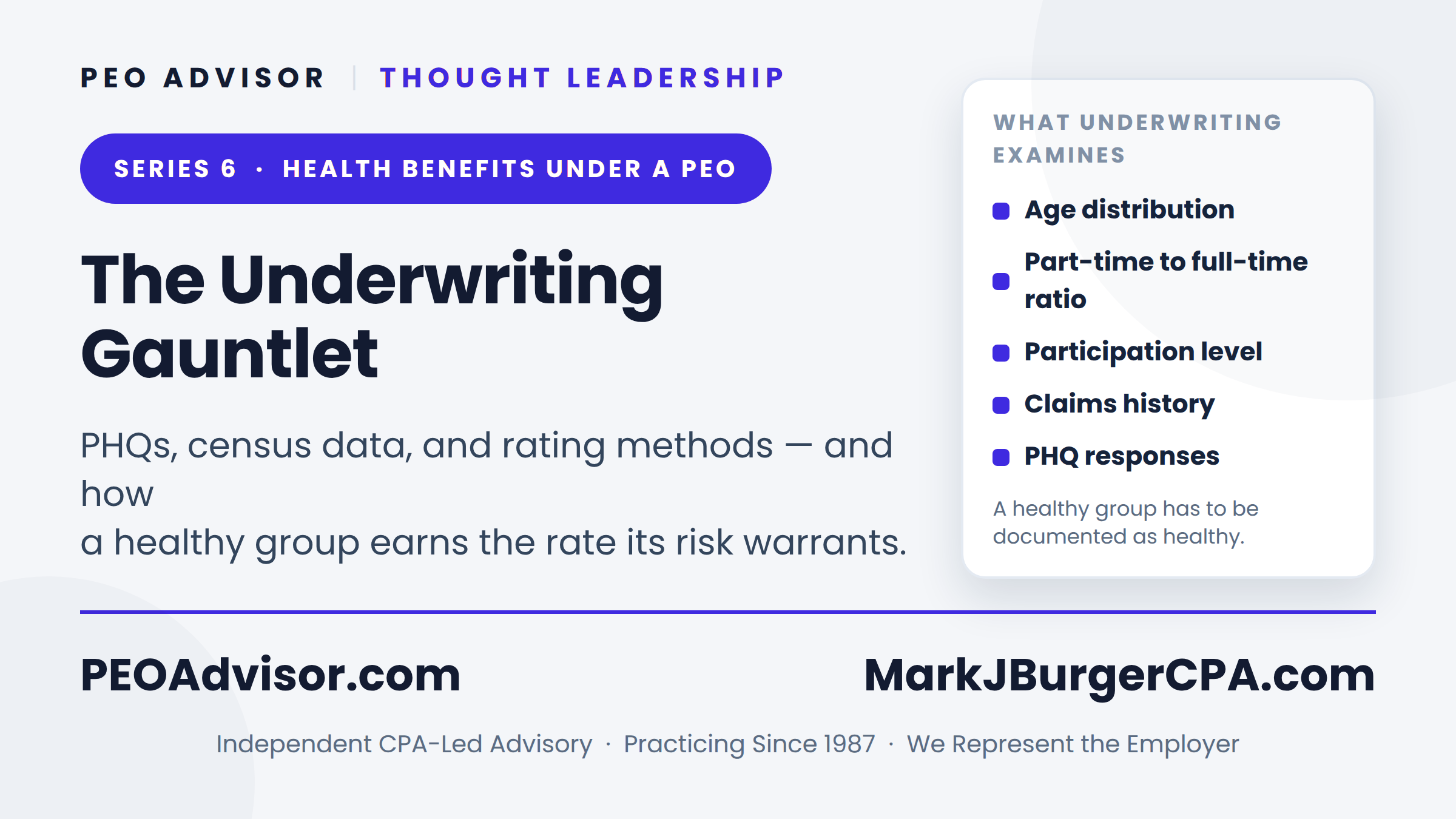
Access to a PEO master health plan is not automatic. It runs through underwriting. Expect participation and personal health questionnaires, often required when a renewal exceeds 20 percent, along with detailed census and dependent data. Underwriters weigh age distribution, full-time versus part-time mix, industry and claims. Some master plans also set minimum participation thresholds that exclude the smallest groups. Knowing what underwriting actually examines, and preparing your data for it, is how a healthy group earns the rate it deserves.
Why Does a PEO Underwrite at All?
Pooled coverage only works if the pool is priced to its risk. A master plan pools many employers, so the PEO and its carrier must understand the risk each new group brings before adding it. Underwriting is how they do that. It is the gate to the first of the three coverage routes under a PEO. For a healthy group this is an opportunity, not a threat: the better your risk profile is documented, the stronger your position for a favorable rate. The mistake is treating underwriting as a formality and submitting incomplete or unflattering data that understates a genuinely good group.
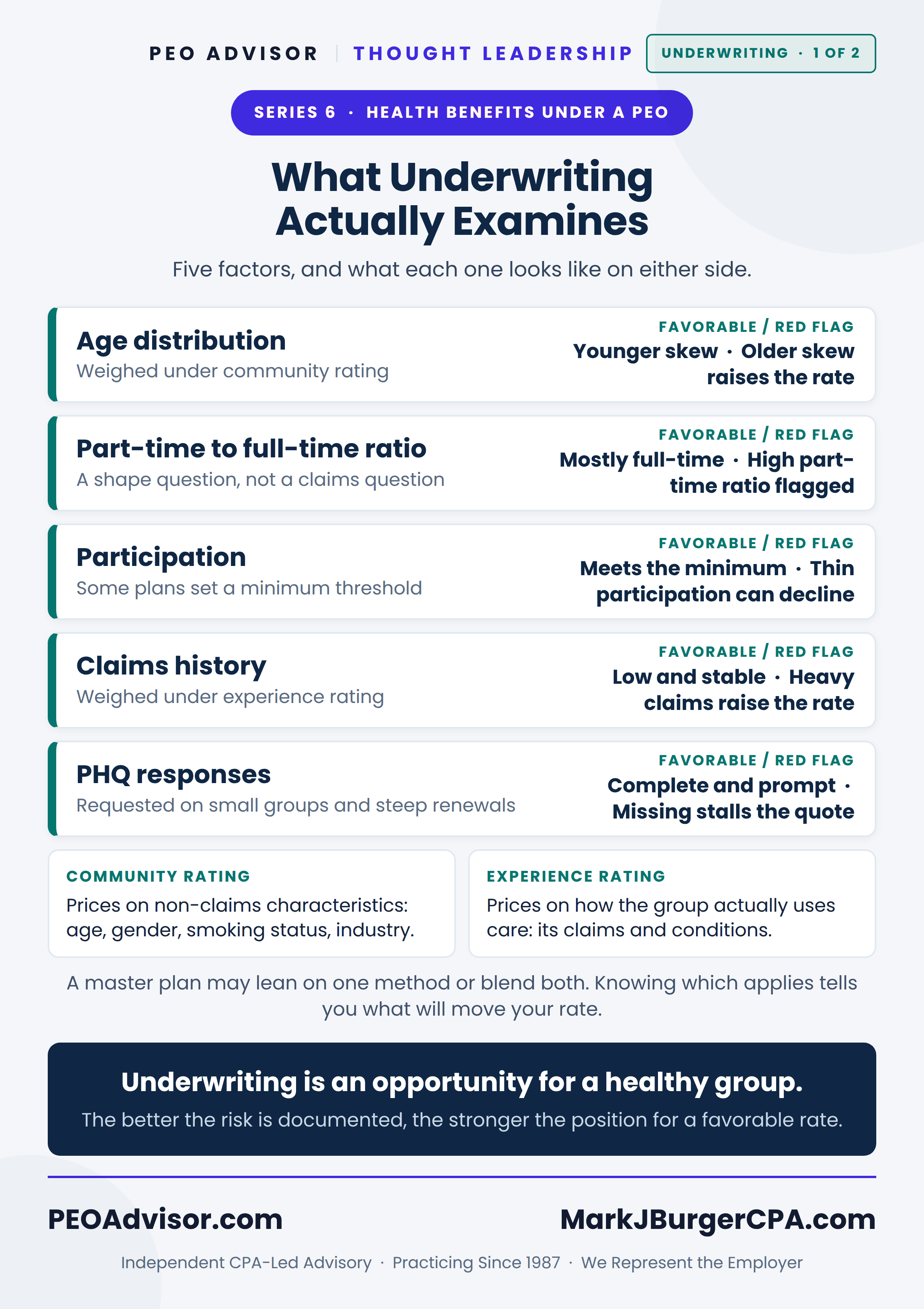
| What underwriting examines | Favorable | Red flag / risk |
|---|---|---|
| Age distribution | Younger skew | Older skew → higher rate |
| Part-time to full-time ratio | Mostly full-time | High part-time ratio flagged |
| Participation | Meets the minimum threshold | Thin participation → decline |
| Claims history (experience rating) | Low and stable | Heavy claims → higher rate |
| PHQ responses | Complete and prompt | Missing → stalls or conservative pricing |
What Are PHQs, and When Do They Appear?
Participation and personal health questionnaires are the underwriter’s closest look at your group. PHQs collect health information from employees to help price or approve coverage. They surface most often in two situations. The first is smaller groups, where individual health has an outsized effect on the pool. The second is steep renewals: when an increase runs above roughly 20 percent, some PEOs will not quote their master plan without questionnaires completed. A steep renewal is also the moment to push back on the renewal itself. Treat PHQs seriously. Complete, accurate responses gathered promptly keep a healthy group’s application moving and support the rate its risk warrants.
What Census and Dependent Data Do Underwriters Need?
Clean, complete census data is the backbone of every quote. Underwriters need an accurate employee census — ages, ZIP codes, coverage tiers — and, frequently, dependent data. Gaps or errors here delay quotes and can produce conservative, unfavorable assumptions. Note that some carriers and PEOs require you to request dependent census information specifically, and it may not appear in standard reports; confirm what is needed early. Accurate data is not only a compliance step, it is advocacy: it lets a healthy group be seen as healthy.
How Do Community Rating and Experience Rating Differ?
Two rating methods weigh your group differently, and both may be in play. Community rating prices risk on non-claims characteristics — age, gender, smoking status, industry. Experience rating prices on how the group actually uses care — its claims and conditions. A PEO master plan may lean on one or blend both. Understanding which is being applied tells you what will move your rate: a healthy claims history helps most under experience rating, while a favorable demographic and industry profile matters more under community rating.
Can Presentation Change the Rate? A Worked Example
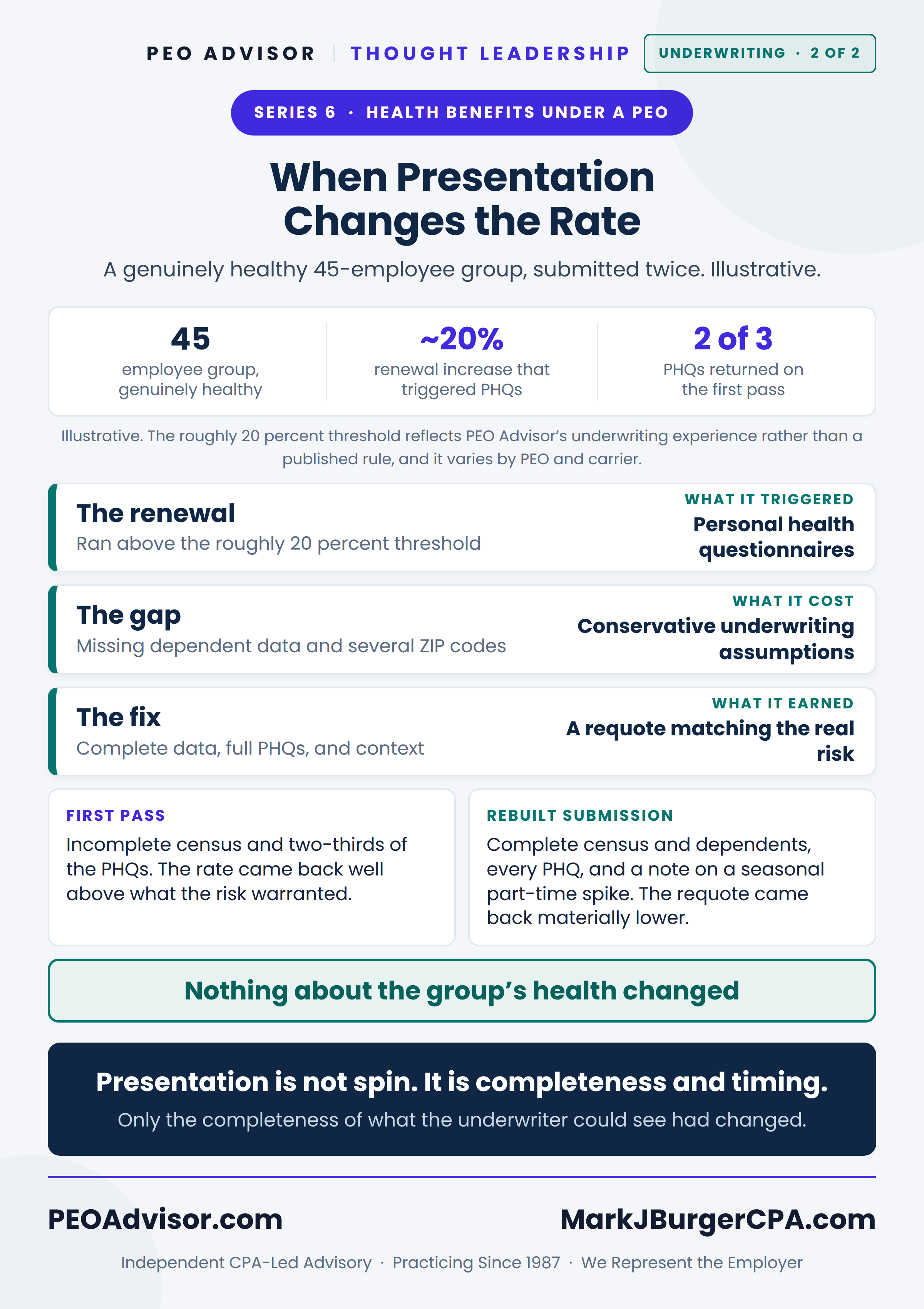
A genuinely healthy 45-employee group faced a renewal above the ~20 percent threshold, which triggered PHQs. On the first pass it submitted an incomplete census, missing dependent data and several ZIP codes, and gathered only two-thirds of the PHQs. The underwriter filled the gaps with conservative assumptions. The rate came back well above what the group’s real risk warranted.
The submission was then rebuilt: complete census and dependent data, full PHQ responses, and a short note explaining a seasonal part-time spike. The requote came back materially lower. Nothing about the group’s health had changed. Only the completeness of what the underwriter could see. The figures are illustrative, and the roughly 20 percent threshold reflects PEO Advisor’s underwriting experience rather than a published rule.
What Red Flags Trigger a Denial?
Modern underwriting looks past claims to the shape of the group. Underwriters examine age distribution, the ratio of part-time to full-time employees, and overall participation — not just the applying group’s history but how it fits the broader pool. An older age skew, a high part-time ratio, or thin participation can raise red flags that lead to a higher rate or a decline. Some master plans also set minimum participation thresholds that exclude the smallest micro-groups entirely. Knowing these triggers in advance lets you address or explain them rather than be surprised by them.
Case in Point
A 12-person micro-group applied for a PEO master plan and was declined. The reason was not its health. It fell below the plan’s minimum participation threshold, with only half its eligible employees electing coverage.
Rather than conclude it was uninsurable, the employer reframed the decision around structure. It modeled a level-funded arrangement and an ICHRA, both of which fit a group its size. It adopted the option that gave predictable cost while keeping the PEO for payroll and administration. The master plan had never been the only route. This scenario is illustrative and does not describe an identifiable employer.

How Do You Prepare for Underwriting? A Step-by-Step
- Assemble an accurate employee census: ages, ZIP codes, coverage tiers.
- Request and confirm dependent census data early, since it may not be in standard reports.
- Gather PHQ responses completely and promptly, especially on steep renewals or small groups.
- Confirm you meet the plan’s minimum participation threshold before applying.
- Prepare context for age skew, part-time ratios, or anything an underwriter may flag.
Presentation is not spin; it is completeness and timing. Working the underwriting process actively — closing data gaps, anticipating questions, and explaining anything unusual — turns a strong underlying risk into a strong quote.
If the renewal still comes in too high, Part 3 of this series, surviving a bad health renewal, walks through the response options in order.
Preparing a group for PEO underwriting?
Have Mark J. Burger, CPA package your data for the best possible rateFrequently Asked Questions
What is a PHQ in PEO health underwriting?
A participation or personal health questionnaire collects health information from employees to help price or approve master-plan coverage. PHQs appear most often for smaller groups, where individual health strongly affects the pool. They also appear on steep renewals: when an increase exceeds roughly 20 percent, some PEOs will not quote without questionnaires completed. Prompt, accurate responses keep a healthy group’s application moving.
What data does a PEO need to quote health coverage?
Underwriters need an accurate employee census – ages, ZIP codes, and coverage tiers – and frequently dependent data. Some carriers require dependent census information to be requested specifically, and it may not appear in standard reports. Complete, accurate data prevents delays and conservative assumptions, and lets a genuinely healthy group be priced as one.
What is the difference between community and experience rating?
Community rating prices risk on non-claims characteristics such as age, gender, smoking status, and industry. Experience rating prices on how the group actually uses care – its claims and conditions. A PEO master plan may use one or blend both. A healthy claims history helps most under experience rating, while favorable demographics help under community rating.
Why would a PEO decline to cover my group?
Modern underwriting looks beyond claims at the shape of the group. An older age distribution, a high part-time-to-full-time ratio, or thin participation can raise red flags leading to a higher rate or a decline. Some master plans also set minimum participation thresholds that exclude the smallest micro-groups. Knowing these triggers lets you address or explain them in advance.
How can a healthy group get a better PEO health rate?
Submit accurate, complete census and dependent data. Gather PHQ responses promptly and fully. Confirm you meet participation requirements, and provide context for anything unusual on paper. Working the process actively, by closing data gaps and explaining a seasonal part-time spike, turns a strong underlying risk into a strong quote.
Do small businesses always qualify for a PEO master plan?
Not always. Some master plans set minimum participation thresholds that exclude the smallest micro-groups, and underwriting factors like age distribution and part-time ratios can affect eligibility. Confirm the plan’s participation requirements and underwriting expectations before assuming access, and consider level-funded or ICHRA alternatives if a master plan is not available.