
Executive Summary
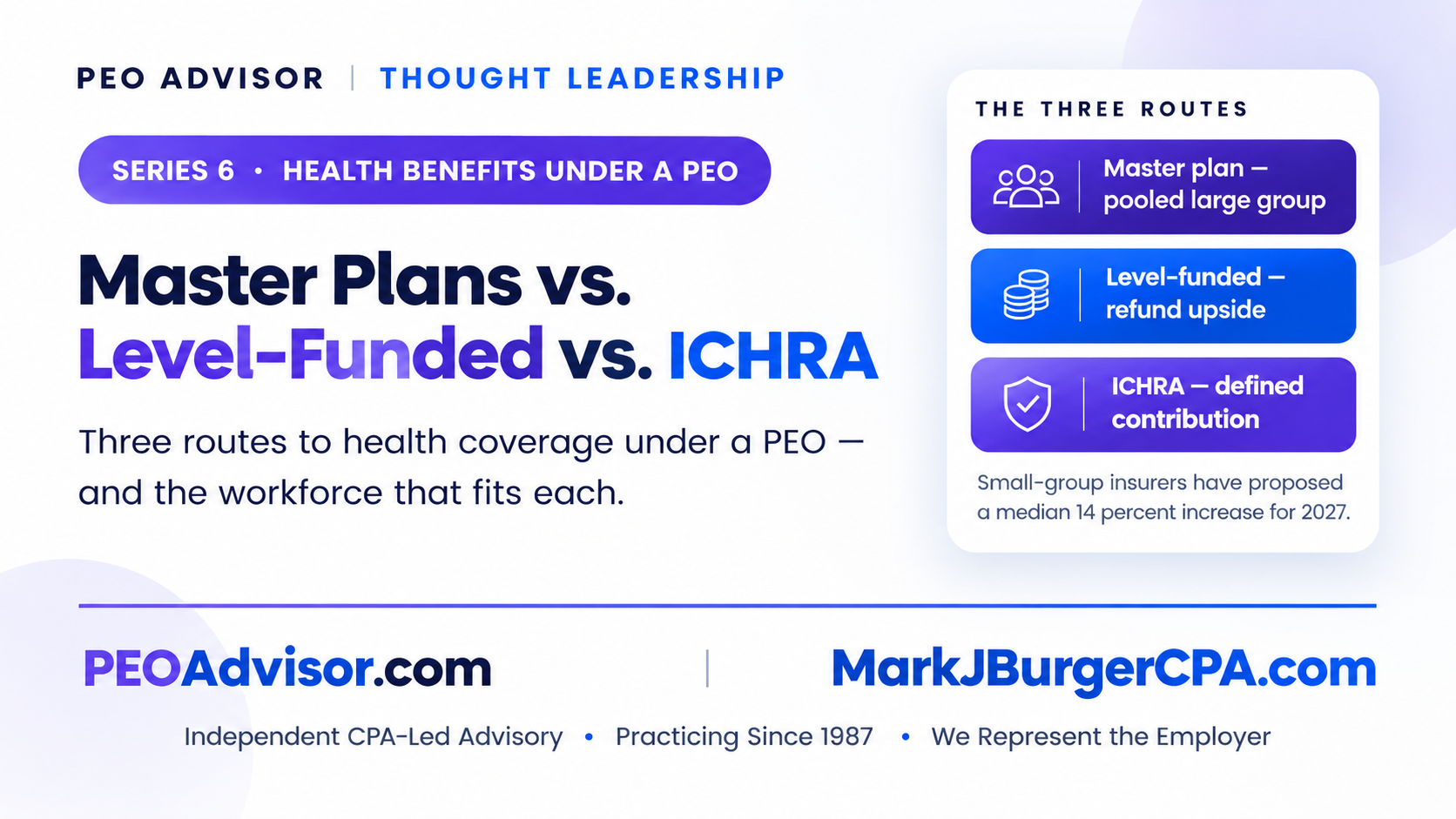
A PEO gives you three main paths to employee health coverage, and they behave very differently. A master health plan pools your employees into the PEO’s large group to reach large-group rates. A level-funded plan blends a predictable monthly cost with the upside of a refund when claims run low. An ICHRA funds employees to buy their own individual-market coverage. Small-group insurers have proposed a median 14 percent increase for 2027, the steepest in more than a decade. ICHRA adoption has grown roughly 50 percent year over year. Choosing the right route is an active decision, not a default.
Why Does the Coverage Route Matter Now?
A hard market makes the coverage structure a financial decision, not a formality. For 2027, small-group insurers have filed a median proposed increase of 14 percent. That is up from a median 11 percent for 2026, and it is the steepest proposed increase the small-group market has seen in more than a decade. The figures come from the Peterson-KFF Health System Tracker’s analysis of filings from 295 insurers across all fifty states. They are proposed rates, not final approved rates.
The pool itself is also shifting. As healthier groups leave the fully insured market for level-funded, self-funded, and ICHRA alternatives, the remaining insured pool tends to get sicker and costlier. That dynamic is adverse selection. It means the structure you choose affects not only this year’s price but your exposure to the pool’s drift. Picking a route deliberately is how you stay ahead of it.
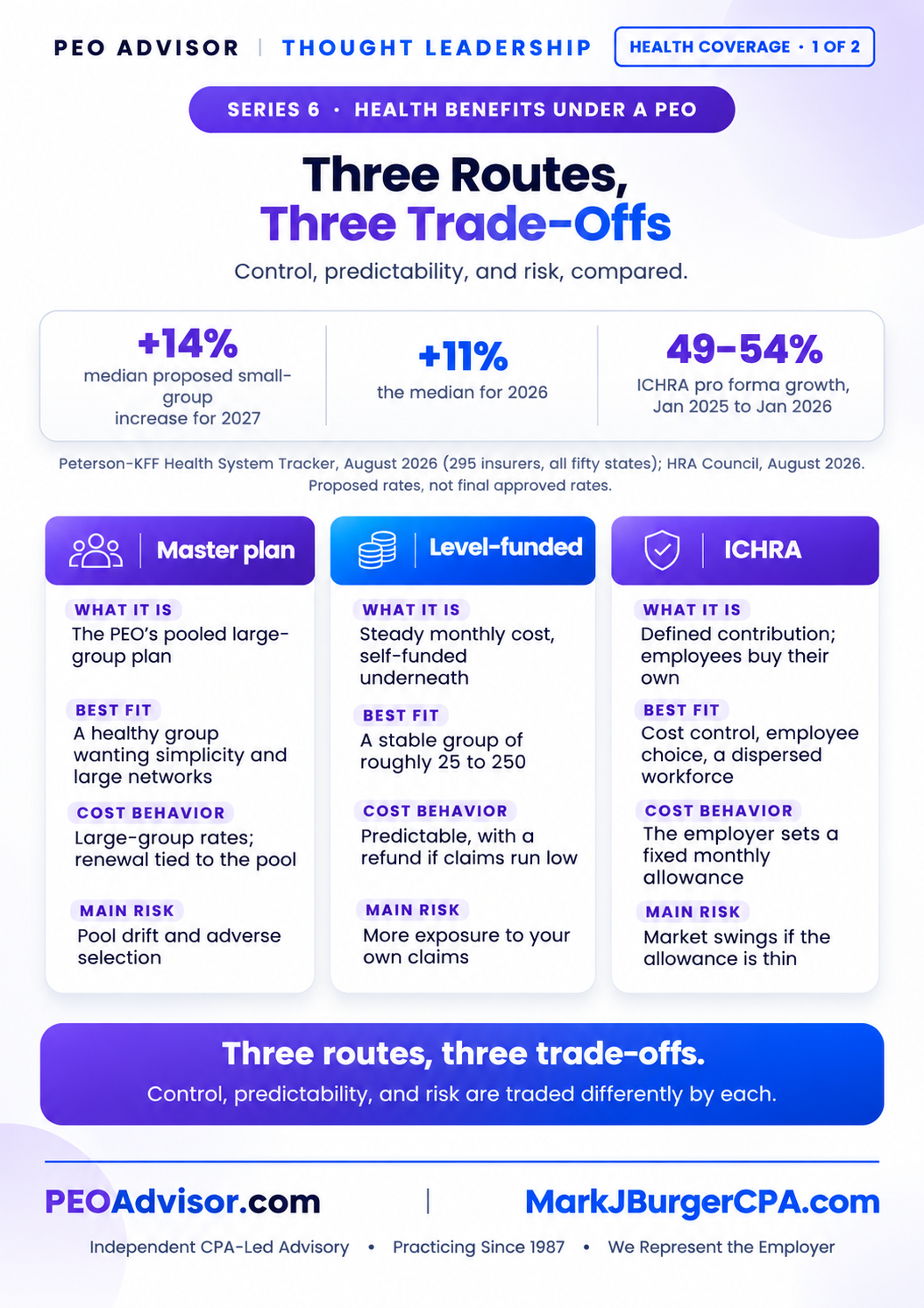
| Dimension | Master plan | Level-funded | ICHRA |
|---|---|---|---|
| What it is | PEO’s pooled large-group plan | Steady monthly cost, self-funded underneath | Defined contribution; employees buy individual coverage |
| Best fit | Healthy group wanting simplicity and large networks | Stable group of ~25–250 | Cost control + employee choice; dispersed workforce |
| Cost behavior | Large-group rates; renewal tied to the pool | Predictable, with a refund if claims run low | Employer sets a fixed monthly allowance |
| Data transparency | Limited | Claims-data transparency | Individual market (employer sees allowance only) |
| Main risk | Pool drift / adverse selection | More exposure to your own claims | Market swings if the allowance is thin |
How Does a PEO Master Health Plan Work?
A master plan buys small groups into large-group economics. A PEO master health plan is a group medical plan written by a national carrier in the PEO’s name, with each client added as a participating employer. Carriers include Aetna, UnitedHealthcare, Cigna, Humana, and Blue Cross Blue Shield. Pooling many small employers into one large risk pool lets the plan offer rates and plan choices usually reserved for much larger companies. The trade-off is that access runs through underwriting. The pool’s overall health also influences your PEO renewal. Both are the subjects of the next two articles in this series, starting with the underwriting gauntlet and continuing with surviving a bad health renewal.
How Does a Level-Funded Plan Work?
Level-funded sits between fully insured and self-funded. A level-funded plan charges a steady monthly amount like a fully insured plan. Underneath, the structure is self-funded, so when claims run below projections the employer can receive a refund. It typically suits employers of roughly 25 to 250 employees. It also provides claims-data transparency a fully insured plan does not. The appeal is predictability with upside. The consideration is that a group with heavy claims does not capture the refund, and takes on more visibility into its own risk.
How Does an ICHRA Work?
An ICHRA flips the model from group plan to defined contribution. With an Individual Coverage Health Reimbursement Arrangement, the employer sets a monthly allowance. Employees purchase their own individual-market coverage and are reimbursed up to that amount. It gives the employer firm control over cost. It gives employees choice of plan and network.
Adoption has risen sharply. The HRA Council’s August 2026 report puts pro forma ICHRA growth at roughly 49 to 54 percent for January 2025 to January 2026. Employers of six to forty-nine employees were up 128 percent on an aggregate basis. More telling for a small employer: more than two-thirds of the small businesses offering an ICHRA in 2026 had previously offered no health coverage at all. The arrangements that succeed pair a generous allowance with clear employee guidance.
What Is the Choice Worth? A Worked Example
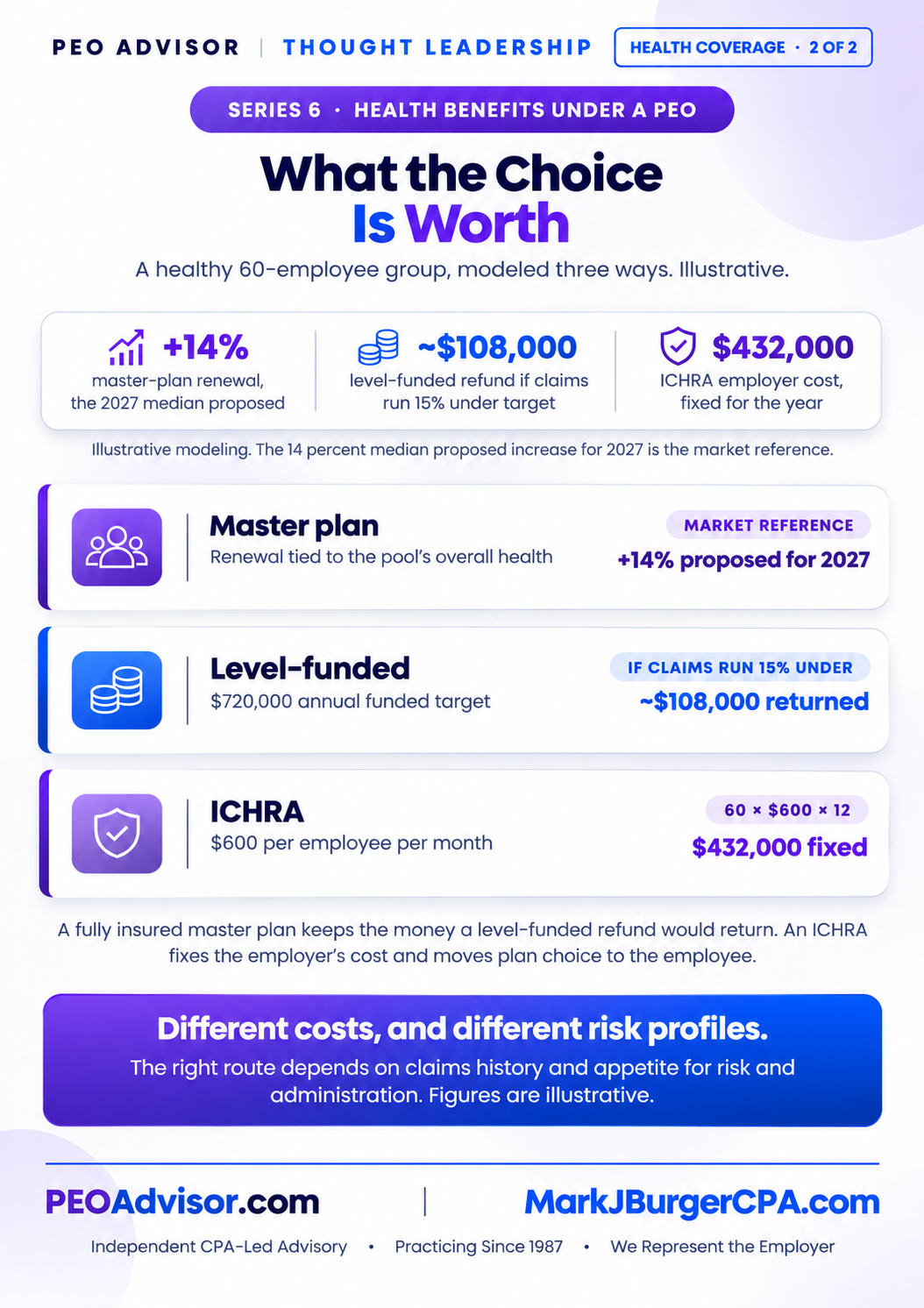
A healthy 60-employee group is quoted a master-plan renewal up about 14 percent, the 2027 median proposed increase. Modeled as level-funded, its low claims history projects a potential refund. If claims run 15 percent under a $720,000 annual funded target, that is roughly $108,000 returned — money a fully insured master plan keeps. Modeled as an ICHRA at a $600 per-employee monthly allowance, employer cost is fixed at 60 × $600 × 12 = $432,000.
The three routes produce different costs and, just as important, different risk profiles. The right one depends on the group’s claims history and its appetite for risk and administration. The figures are illustrative. The 14 percent median proposed increase for 2027 is the market reference.
How Do You Choose Between the Three Routes?
The right route follows your workforce profile, not the trend of the moment. A healthy group that wants simplicity and large-group networks often fits a master plan. A stable group of 25 to 250 that wants transparency and refund potential leans level-funded. An employer that wants cost control and employee choice, or that has a geographically dispersed or diverse workforce, may find an ICHRA fits best. Size, claims profile, geography, and appetite for risk and administration all point toward one route over another.
Where Does the PEO Fit Each Route?
A PEO can deliver or coexist with all three. The master plan is the PEO’s own pooled offering. Level-funded coverage may be available through the PEO or arranged alongside it. An ICHRA can run alongside a PEO relationship, sometimes through a white-labeled provider, with the PEO continuing to handle payroll, tax, and administration. The coverage decision and the PEO decision are related but separable, and a good adviser evaluates them together rather than assuming the master plan is the only option.
Case in Point
A healthy, stable 80-employee professional firm had been on a PEO master plan. It accepted double-digit renewals for two years running, assuming the pooled plan was its only option. When it finally modeled a level-funded arrangement, its own low claims history projected a meaningful refund the master plan had been quietly keeping. The claims-data transparency let it see exactly what it was paying for. It moved to level-funded, kept the PEO for payroll and administration, and captured a refund in the first year. The coverage and the PEO were separable all along.

What Should You Model Before Deciding? A Step-by-Step
- Profile your group: age distribution, claims history, and full-time versus part-time mix.
- Compute total employer cost under each route, including administration, not just premium.
- Compare employee out-of-pocket exposure and network adequacy under each option.
- Test refund potential (level-funded) and allowance adequacy (ICHRA) against realistic claims.
- Map how each route interacts with your PEO relationship and renewal timeline.
Weighing a master plan, level-funded, or ICHRA?
Have Mark J. Burger, CPA model all three against your workforceFrequently Asked Questions
What is a PEO master health plan?
A PEO master health plan is a group medical plan written by a national carrier in the PEO’s name. Each client is added as a participating employer. Carriers include Aetna, UnitedHealthcare, Cigna, Humana, and Blue Cross Blue Shield plans. Pooling many small employers into one large risk pool can secure large-group rates and broader plan options, though access runs through underwriting.
What is a level-funded health plan?
A level-funded plan charges a steady monthly amount like a fully insured plan but is self-funded underneath, so the employer can receive a refund when claims run below projections. It typically suits employers of about 25 to 250 employees and provides claims-data transparency. The upside is predictability with refund potential; the risk is more exposure to a group’s own claims.
What is an ICHRA?
An Individual Coverage Health Reimbursement Arrangement lets an employer set a monthly allowance. Employees use it to buy their own individual-market coverage and are reimbursed up to that amount. It gives the employer cost control and employees plan choice. The HRA Council puts pro forma adoption growth at roughly 49 to 54 percent for January 2025 to January 2026. More than two-thirds of small businesses offering an ICHRA in 2026 had previously offered no coverage at all.
Which health coverage route is best under a PEO?
It depends on your workforce. A healthy group wanting simplicity and large networks often fits a master plan; a stable 25-to-250 group wanting transparency and refunds leans level-funded; an employer wanting cost control and employee choice may prefer an ICHRA. Size, claims profile, geography, and appetite for risk and administration determine the best fit.
Can I use an ICHRA with a PEO?
Yes. An ICHRA can operate alongside a PEO relationship, sometimes through a white-labeled provider, while the PEO continues handling payroll, tax filing, and administration. The health-coverage decision and the PEO decision are related but separable, so an ICHRA does not require leaving a PEO. A good adviser evaluates coverage and PEO structure together.
Why are small businesses moving away from traditional group plans for 2027?
Small-group insurers have proposed a median 14 percent increase for 2027. Healthier groups are shifting to level-funded, self-funded, and ICHRA alternatives to control cost and capture transparency or refunds. As they leave, the remaining fully insured pool tends to get sicker and costlier. That is adverse selection, and it pushes still more groups to reconsider their structure.