

Executive Summary
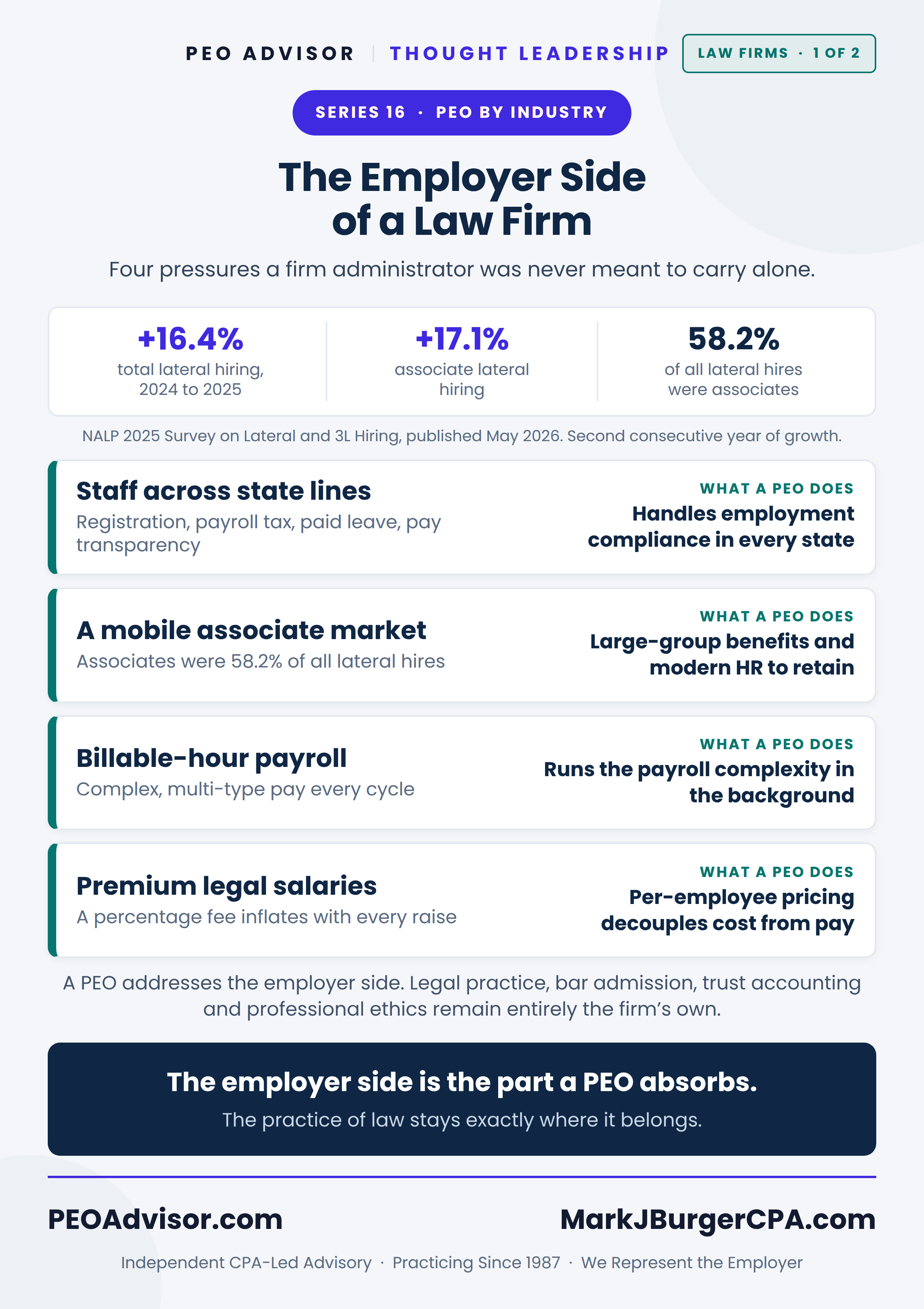
Law firms have become distributed, competitive, high-wage employers. Attorneys, paralegals and staff now sit across state lines. Competition for them is intensifying: total lateral hiring rose 16.4 percent from 2024 to 2025, and associate lateral hiring rose 17.1 percent, according to NALP’s 2025 Survey on Lateral and 3L Hiring, published May 2026. That means real competition for people, and payroll and compliance complexity a firm’s administrator was never meant to carry alone. A PEO gives a firm competitive benefits, multi-state compliance, and modern HR — with per-employee pricing that fits high legal salaries.
Why Is the Modern Law Firm a Multi-State Employer?
Remote and hybrid work turned firms into distributed employers with new obligations. A typical firm now employs attorneys, paralegals, billing staff and administrators across multiple states and schedules. Each out-of-state professional brings that state’s payroll, tax and employment-law obligations. The multi-state series in this library maps the landscape. For a firm whose administrator handles HR alongside everything else, that distributed footprint is a compliance exposure hiding in plain sight.
| Firm challenge | The exposure | What a PEO does |
|---|---|---|
| Distributed workforce across state lines | Multi-state payroll, tax, leave, pay transparency | Handles employment compliance across every state |
| Talent competition (lateral hiring +16.4%, NALP) | Attrition of attorneys and staff | Large-group benefits and modern HR to retain |
| High legal salaries | A percentage fee inflates with raises and bonuses | PEPM decouples cost from compensation |
| Billable-hour payroll | Complex, multi-type pay | Handles the payroll complexity in the background |
How Competitive Is the Market for Legal Talent?
Retention is now a defining challenge, and flexibility and benefits drive it. NALP’s 2025 Survey on Lateral and 3L Hiring, published May 2026 recorded a 16.4 percent rise in total lateral hiring from 2024, the second consecutive year of growth. Associate lateral hiring rose 17.1 percent and accounted for 58.2 percent of all lateral hires. Associates are the people most likely to move, and often the ones a firm most needs to keep.
In that market, competitive benefits, wellbeing support and flexibility are retention infrastructure, not perks. A PEO gives a firm the large-group benefits and professional HR that help keep the people competitors are actively recruiting.
Why Is the Pricing Model the Decision? A Worked Example
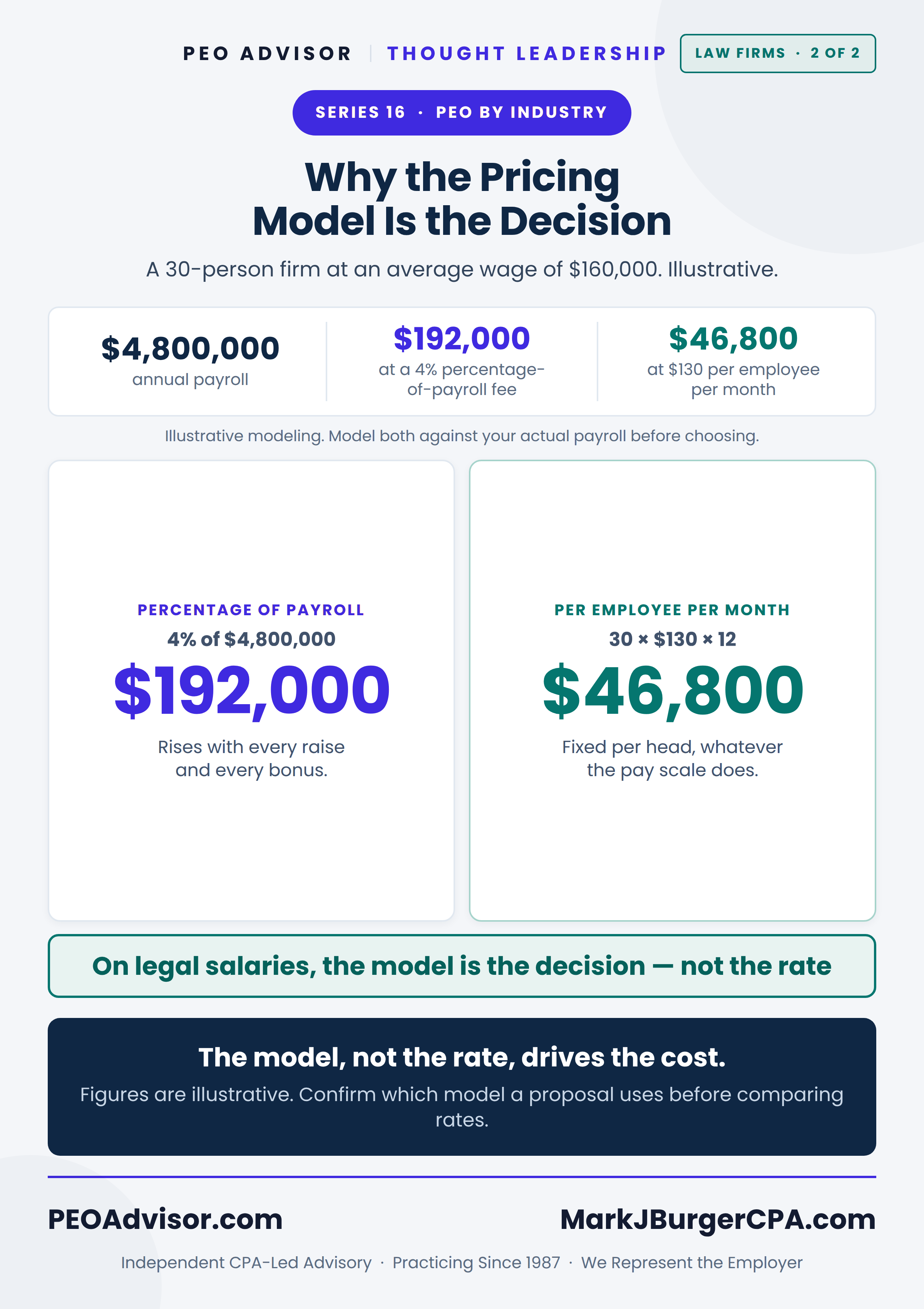
A 30-person firm with an average wage of $160,000 runs about $4.8 million in payroll. At a 4 percent percentage-of-payroll administrative fee, that is $192,000 a year. At $130 per employee per month it is 30 × $130 × 12 = $46,800.
On premium legal salaries the model, not the rate, is the decision. A percentage fee rises with every raise and bonus. A fixed per-head fee does not. A firm paying legal-market compensation usually fares better on per-employee-per-month, which decouples administrative cost from the pay scale. The figures are illustrative. The pricing series in this library shows the break-even math, and you should model both against your actual payroll before choosing.
How Does a PEO Handle Compliance for a Distributed Firm?
Firms need employment compliance handled quietly across every state. A law firm carries the standard multi-state employment obligations: registration, payroll tax, paid leave and pay transparency. Add billable-hour payroll complexity and strict confidentiality expectations. A PEO suited to firms handles the employment-compliance layer across all your states, accurately and in the background, so a growing distributed team does not become a liability.
It does not touch legal practice or ethics compliance, which remain the firm’s own. The distinction matters at a firm more than almost anywhere. The same administrator who tracks a filing deadline may also hold client confidences. Separating the employment-compliance burden from the practice lets each be done properly.
Case in Point
A litigation boutique that had always worked from one office let attorneys and paralegals go remote across three states after a hiring push. Within a year the firm’s administrator was quietly out of compliance in two of them. The gaps were a missed state registration and an out-of-date paid-leave policy. The firm had also lost two associates to competitors with richer benefits and remote flexibility.
It brought in a PEO with documented capability in its states. That cleaned up the multi-state employment compliance, upgraded the benefits to a large-group catalog, and moved the firm to per-employee pricing suited to its salaries. The compliance exposure closed and the benefits gap narrowed. This scenario is illustrative and does not describe an identifiable firm.

How Do You Choose a Law-Firm-Ready PEO? A Step-by-Step
- Weigh benefits depth. Evaluate the modernity and breadth of the benefits catalog — it leads retention for firms.
- Confirm multi-state capability. Require documented capability in the specific states where your people sit.
- Insist on the right pricing model. Confirm per-employee-per-month or model it against percentage for your high wages.
- Check professional-services experience. Ask how it has served and retained staff at comparable firms.
- Assess technology and service. Verify the platform handles billable-hour and multi-type payroll cleanly.
- Evaluate independently. Because benefits and compliance lead for firms, compare providers on those dimensions rather than a single demo.
Run or manage a law firm?
Have Mark J. Burger, CPA match a PEO on benefits, compliance, and pricing fitFrequently Asked Questions
How does a PEO help a law firm?
A PEO gives a firm competitive large-group benefits that aid retention. It handles multi-state employment compliance for distributed attorneys and staff. It provides modern HR and payroll for billable-hour and complex pay, and offers per-employee pricing suited to high legal salaries. It addresses the employer side of the firm, leaving legal practice and ethics compliance to the firm itself.
Do law firms have multi-state compliance obligations?
Increasingly, yes. Most firms now employ attorneys, paralegals and staff across state lines, and each out-of-state professional brings that state’s payroll, tax and employment-law obligations. For a firm whose administrator handles HR alongside other duties, that distributed footprint is a real compliance exposure a PEO can manage.
Which PEO pricing model is best for a law firm?
Per-employee-per-month usually fits high-wage firms better than percentage of payroll, because a percentage fee rises with every raise and bonus while a fixed per-head fee does not. A firm paying premium legal salaries can pay materially more under a percentage model. Confirm which model a proposal uses and model both against your actual payroll before deciding.
Can a PEO help a law firm retain staff?
Yes. NALP recorded total lateral hiring up 16.4 percent from 2024 to 2025, with associate lateral hiring up 17.1 percent and making up 58.2 percent of all lateral hires. In a market that mobile, competitive benefits, wellbeing support and flexibility are retention infrastructure. A PEO provides the large-group benefits and professional HR that help firms keep the people competitors are actively recruiting.
Does a PEO handle legal or ethics compliance for a firm?
No. A PEO handles the employer side – employment compliance, payroll, benefits, and HR across your states. Legal-practice obligations, bar admission, trust accounting, and professional-ethics compliance remain entirely the firm’s responsibility. The value of a PEO is absorbing the employment and HR complexity that a distributed, high-wage firm carries, not the practice of law.
What should a law firm look for in a PEO?
Evaluate benefits catalog depth and modernity, documented multi-state capability in your specific states, technology and service quality, professional-services experience, and a pricing model suited to high wages. Ask how the provider has served and retained staff at comparable firms. Because benefits and compliance lead for firms, an independent evaluation on those dimensions is the reliable approach.