As of August 2026.
Executive Summary
With M&A accelerating across a fragmented industry, the odds that your PEO is acquired keep rising — and an acquisition can change your service team, technology platform, rates, and contract terms. This analysis translates the deal wave into practical client impact: what typically changes after a PEO is acquired, why the first post-deal renewal deserves scrutiny, how to read the signals of a book-cleaning, and the concrete steps that protect your business through a transition you did not choose.
Why Does PEO Consolidation Matter to Your Contract Now?
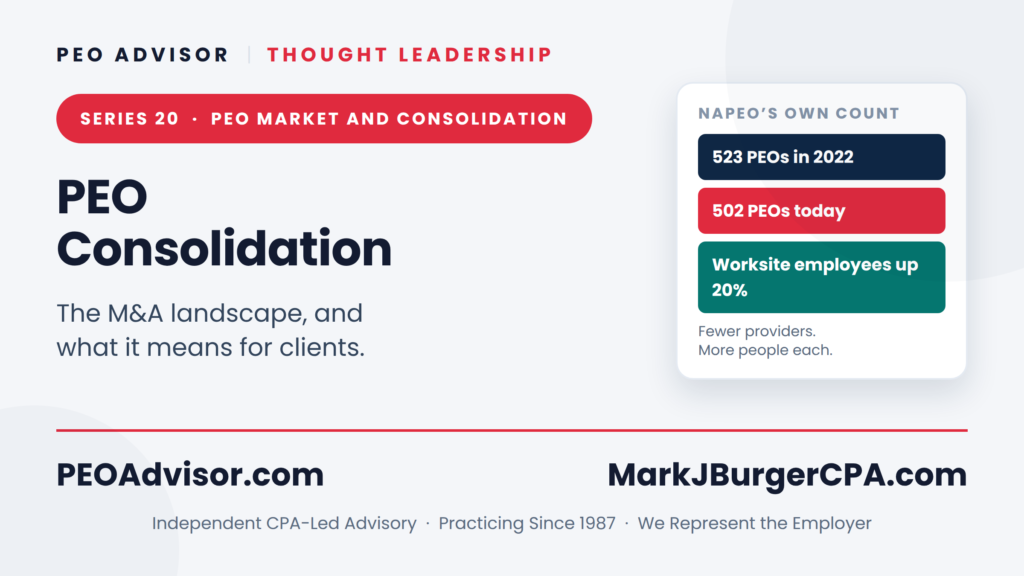
The deal wave makes acquisition a client-level issue, not just industry news. With more than 500 PEOs, a long tail ripe for roll-up, and acquisitive platforms closing dozens of deals a year, a large share of businesses on a regional or mid-tier PEO will see their provider change hands. Consolidation is no longer abstract; it is a probability to plan for. Understanding what an acquisition changes — and preparing for it — is now part of managing a PEO relationship responsibly. For the deal landscape driving it, see our analysis of the PEO M&A landscape and what it means for clients.
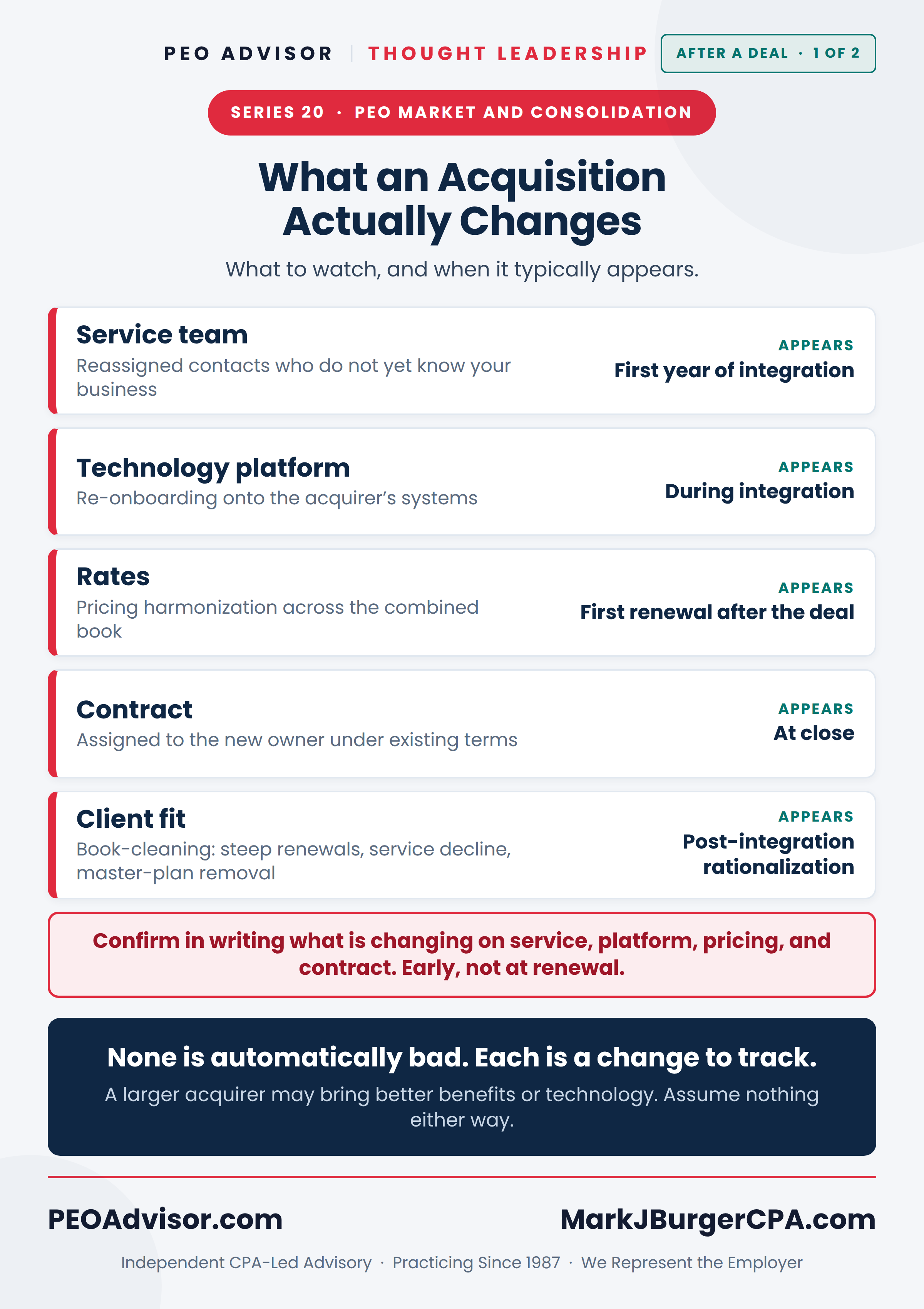
| What a deal changes | What to watch | When it typically appears |
|---|---|---|
| Service team | Reassigned contacts who do not yet know your business | First year of integration |
| Technology platform | Re-onboarding onto the acquirer’s systems | During integration |
| Rates | Pricing harmonization across the combined book | First renewal after the deal |
| Contract | Assigned to the new owner under existing terms | At close |
| Client fit | Book-cleaning: steep renewals, service decline, master-plan removal | Post-integration rationalization |
What Changes When Your PEO Is Acquired?
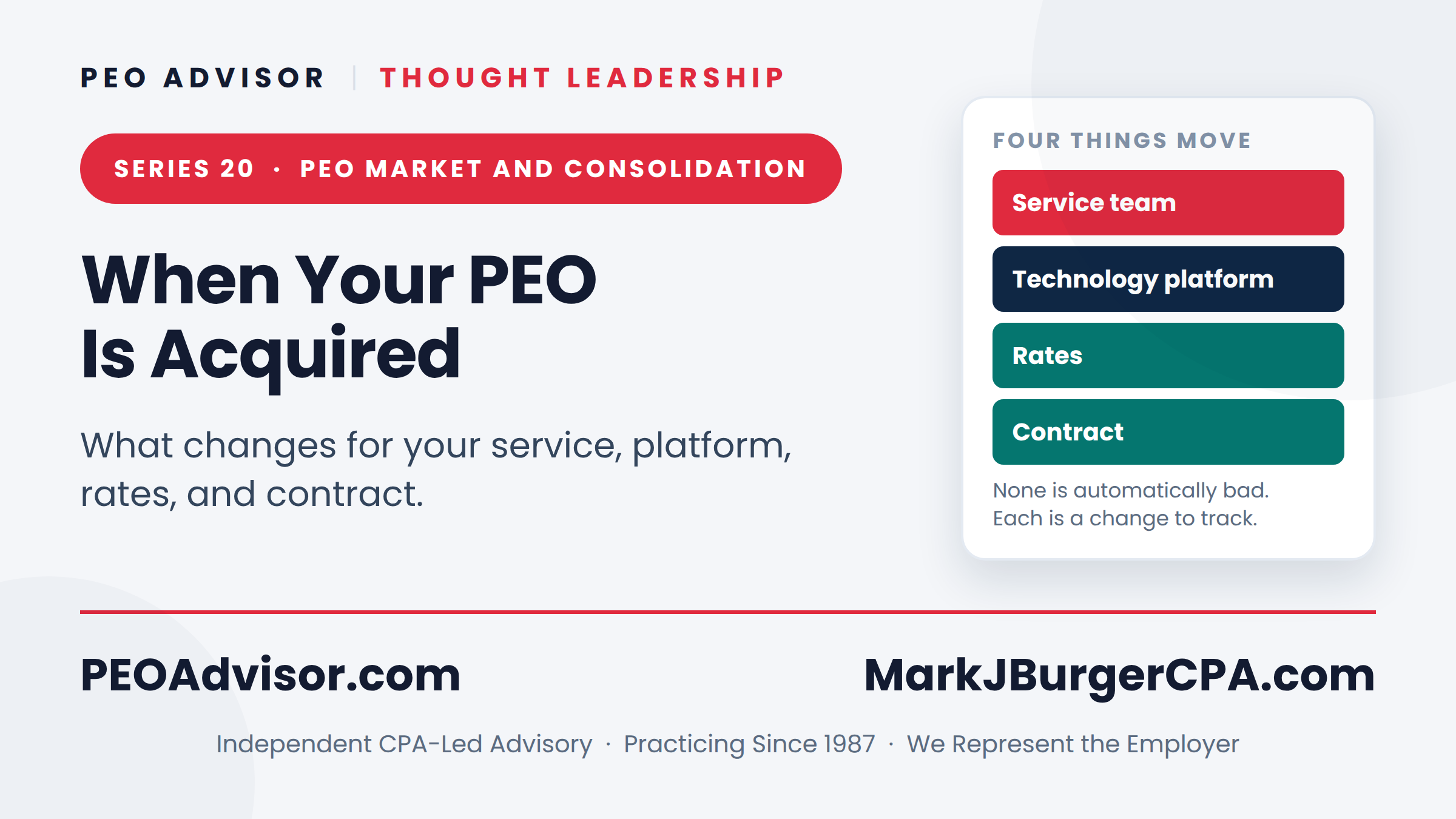
Four things commonly move after a deal. Your service team may change as roles consolidate and contacts are reassigned; your technology platform may migrate to the acquirer’s systems; your rates may reset as pricing is harmonized; and your contract may be assigned to the new owner under its terms. None of these is automatically bad — a larger acquirer may bring better benefits or technology — but each is a change to track rather than assume away. Confirm what is changing, in writing, early. A review of how industry consolidation affected PEO clients in 2025 traces the same pattern.
| Was your PEO just acquired, or could it be? Get a no-cost read on what an ownership change could mean for your rates, service, and contract, through the PEO Advisor assessment. Start the PEO assessment |
What Happens at the First Renewal After a Deal?
Pricing harmonization usually shows up at the first renewal, so scrutinize it. After an acquisition, the combined entity often aligns pricing, making your first post-deal renewal the most likely place for a rate change. Apply full renewal discipline: break the number into its components, request the medical loss ratio, and benchmark against the market, as the anatomy of a PEO renewal details. A merger is precisely when an unexamined renewal can carry an increase you did not anticipate.
What Can the First Renewal Cost? A Worked Example
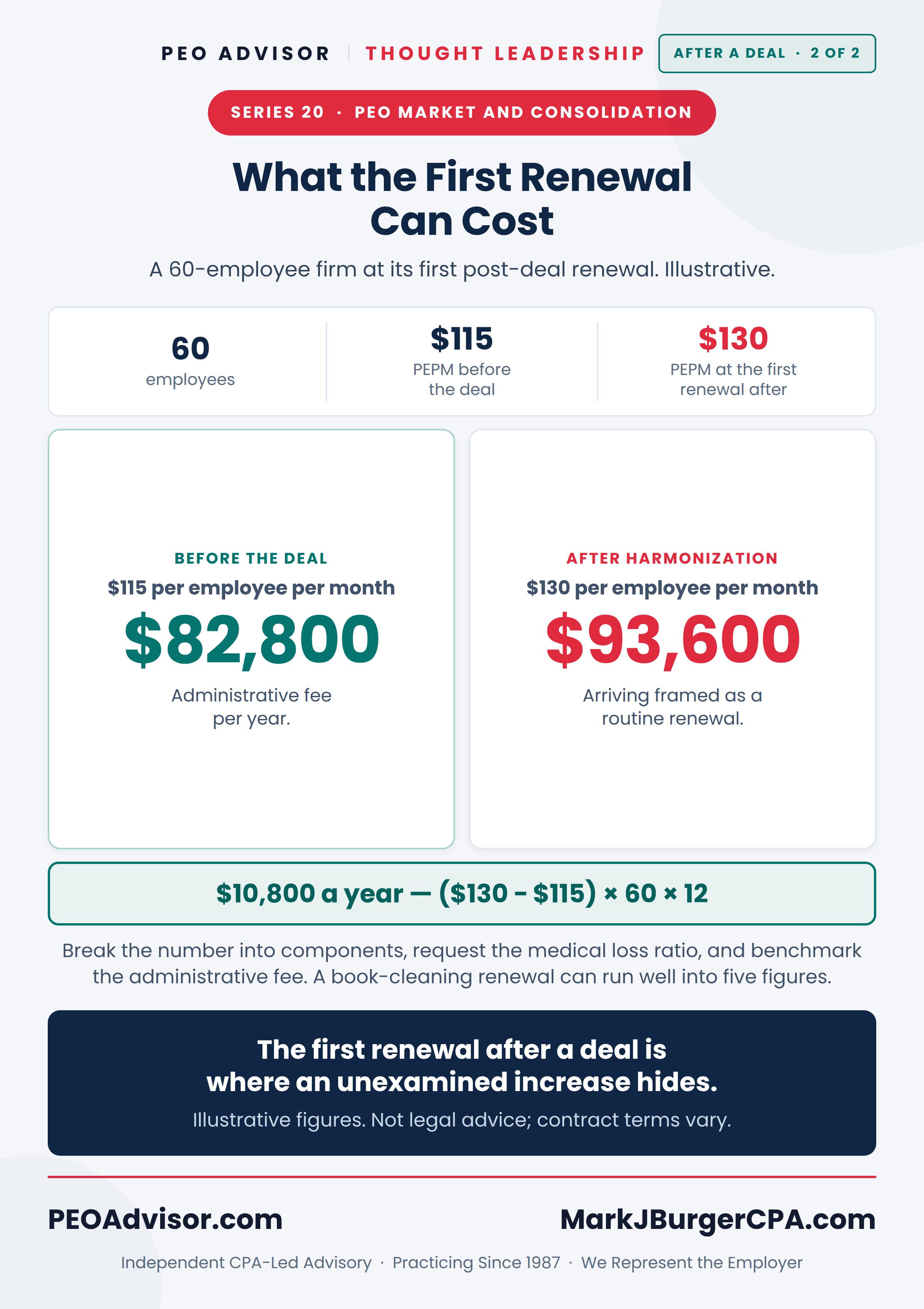
Worked example (illustrative). A 60-employee firm’s PEO is acquired. At the first post-deal renewal, pricing harmonization moves the administrative fee from $115 to $130 per employee per month. That is (130 − 115) × 60 × 12 = $10,800 a year — an increase arriving framed as a routine renewal, with no change in service to justify it. Renewal discipline catches it: break the number into components, request the medical loss ratio, and benchmark the administrative fee. If the increase reflects genuine added value it may be worth paying; if it is simply harmonization to the acquirer’s book, it is negotiable, and a credible willingness to re-shop is the leverage. Separately, a book-cleaning renewal can be steeper still — a punitive increase designed to push a poor-fit client out can run well into five figures a year — which is why reading the signals early matters. The figures are illustrative and depend on the renewal; the point is that the first renewal after a deal is exactly where an unexamined increase hides.
How Do You Recognize a Book-Cleaning Renewal?
Consolidation often triggers client pruning, so watch for it. Acquirers frequently rationalize the combined client base, and businesses that no longer fit the new strategy can face steep renewals, service decline, or removal from a master plan — the book-cleaning dynamic covered in the industry-landscape series. Rising declines, mid-term terminations, and punitive renewals after a deal are signals worth taking seriously. Seeing them early gives you time to respond rather than scramble.

Case in Point
Case in point (illustrative). Two companies used the same PEO when it was acquired. The first treated the announcement as background noise; its platform migrated with little preparation, its named specialist was reassigned, and its first post-deal renewal carried a harmonization increase it paid without question. The second treated the announcement as a prompt: it confirmed in writing what was changing on service, platform, pricing, and contract, monitored service levels through the integration year, watched for book-cleaning signals, and applied full renewal discipline when the number arrived — catching and negotiating down the same increase. Same deal, same PEO, opposite outcomes — separated by whether the client prepared or assumed. This scenario is illustrative and does not describe an identifiable company.
How Do You Protect Your Business After an Acquisition?
Preparation, not reaction, is the defense. Know your contract’s notice window and termination terms, keep your payroll and employee data accessible, maintain a relationship with an independent adviser who can source alternatives quickly, and monitor service and pricing closely through the year after a deal. If the acquisition degrades your arrangement, knowing when to re-shop your PEO lays out a low-disruption path to a better-fitting provider. An acquisition you are prepared for is manageable; one that surprises you is not.
How Do You Prepare for an Acquisition? A Step-by-Step
- Confirm changes in writing — get what is changing on service, platform, pricing, and contract documented early.
- Know your exit terms — identify your notice window and termination conditions before you might need them.
- Keep your data accessible — ensure payroll and employee data can move if you decide to switch.
- Scrutinize the first post-deal renewal — apply full renewal discipline and watch for book-cleaning signals.
- Keep an independent adviser ready — maintain a relationship that can source alternatives and run a low-disruption switch if needed.
Has consolidation changed your PEO relationship? Contact Mark J. Burger, CPA to review the impact and your options.
Sources and basis. Market figures are NAPEO data retrieved September 30, 2026: 502 PEOs, 233,000 client businesses and 5.4 million worksite employees. That picture, a long tail of regional providers below a handful of giants, matches the market and consolidation analyses in this series. The 60-employee firm, the $115 and $130 per-employee-per-month fees, and the two-company case are illustrative and do not describe an identifiable company. Contract terms vary; this content is educational, not legal or tax advice.
Frequently Asked Questions
What happens to my contract when my PEO is acquired?
Your contract is typically assigned to the new owner under its existing terms, but your service team may change, your technology platform may migrate, and your rates may reset as pricing is harmonized. None of this is automatically negative, but each is a change to track. Confirm in writing what is changing on service, platform, pricing, and contract early in the transition.
Will my PEO rates change after an acquisition?
They can, and the first renewal after a deal is the most likely place for a change, since acquirers often harmonize pricing then. Apply full renewal discipline: break the number into components, request the medical loss ratio, and benchmark against the market. A merger is exactly when an unexamined renewal can carry an unexpected increase.
Is it common to be dropped after a PEO merger?
It happens. Acquirers frequently rationalize the combined client base, and businesses that no longer fit the new strategy can face steep renewals, service decline, or removal from a master plan. Rising declines, mid-term terminations, and punitive renewals after a deal are signals of a book-cleaning worth watching, so you can respond before you are forced to.
How do I protect my business if my PEO is acquired?
Know your contract’s notice and termination terms, keep your payroll and employee data accessible, maintain an independent adviser relationship for quick alternatives, and monitor service and pricing closely through the year after a deal. If the acquisition degrades your arrangement, a sequenced, low-disruption switch to a better-fitting provider is the remedy.
Should I switch PEOs after mine is acquired?
Not automatically. An acquisition can improve your benefits or technology, so evaluate the actual impact first. Scrutinize the first post-deal renewal, watch for book-cleaning signals, and compare your arrangement against the market. Switch only if the deal degrades your terms, service, or fit – and if so, use a low-disruption transition to protect continuity.
How likely is my PEO to be acquired?
Rising, especially for regional and mid-tier providers. With more than 500 PEOs, a long tail ripe for roll-up, and acquisitive platforms closing dozens of deals a year, a large share of businesses will see their provider change hands. Treating acquisition as a probability to plan for, rather than a surprise, is prudent relationship management.
About the author. Mark J. Burger, CPA, advises small and mid-sized businesses on strategic workforce and co-employment decisions through GuidePoint PEO LLC. His analysis draws on a CPA practice dating to 1987 and hundreds of PEO cost assessments.
Independent CPA-Led Advisory · Practicing Since 1987 · We Represent the Employer