
Executive Summary
Multi-location franchising multiplies HR complexity: different states, inconsistent policies, and compliance risk that compounds with every unit. Consider two competing restaurant franchisees, each with 12 locations and 180 employees. One manages HR location by location, at a modeled cost of roughly $280,000 a year with uneven compliance. The other standardizes on a PEO. NAPEO puts the return on investment from using a PEO at 27 percent in cost savings alone, with 12 percent lower employee turnover. That is what a PEO for franchises does: it turns fragmented, unit-by-unit administration into one standardized, compliant system.
Why Does Multi-Location Franchising Multiply HR Complexity?
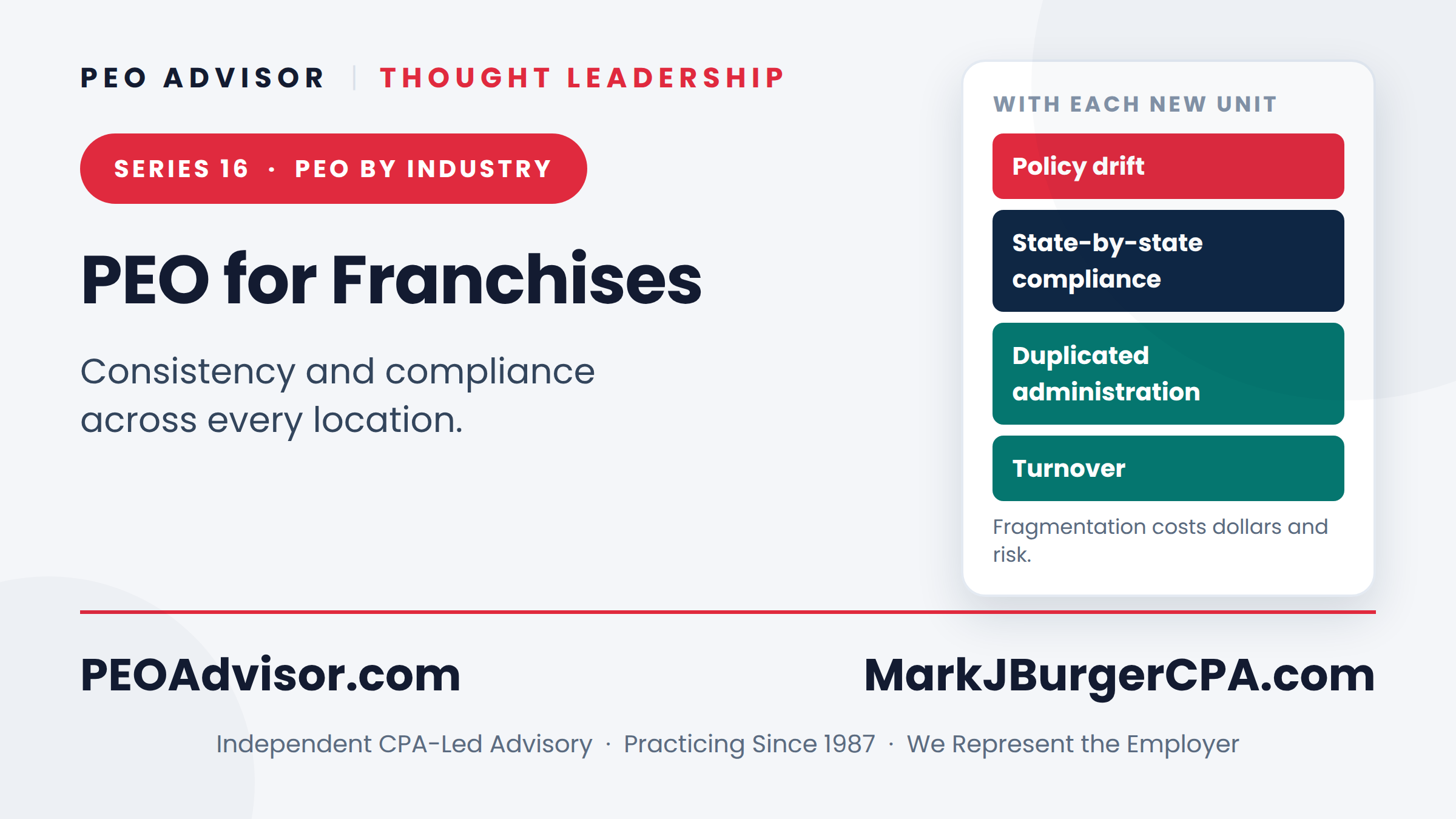
Every new unit and every new state multiplies the HR burden. Franchise growth is operationally unforgiving on the people side: policies drift between locations, compliance obligations differ by state, and administration duplicated unit by unit becomes both costly and inconsistent. The franchisee managing HR location by location pays for that fragmentation in dollars and risk. For the operator modeled in this article, that is around $280,000 a year, roughly $1,556 per employee. The problem is structural to multi-location operations, and it worsens as the footprint grows. For the state-by-state rules behind that burden, see the multi-state compliance rules employers face in 2026.
Why Do Two Franchisees of the Same Size Get Different Outcomes?
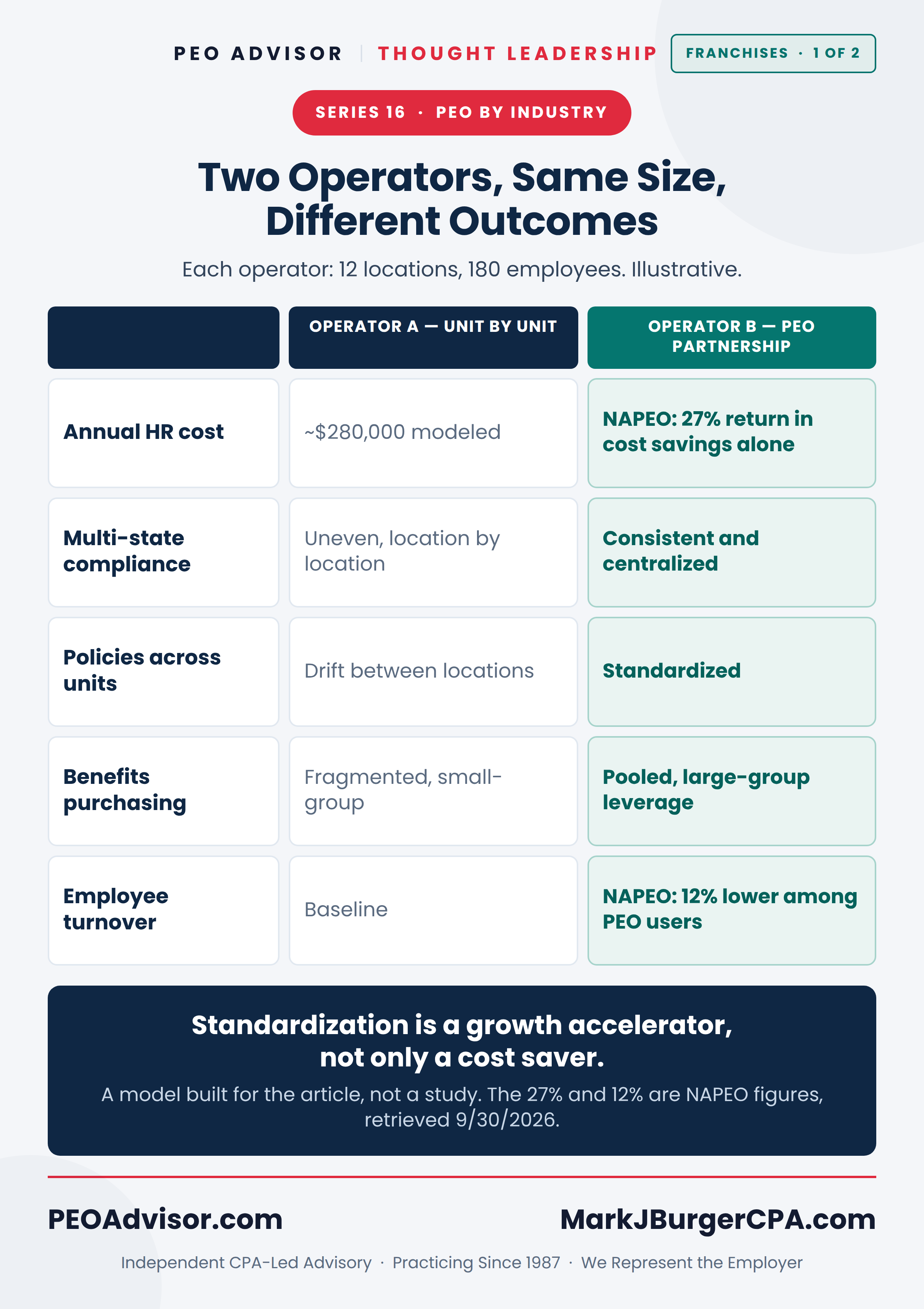
| 12 locations / 180 employees | Operator A — unit-by-unit HR | Operator B — PEO partnership |
|---|---|---|
| Annual HR cost | ~$280,000 modeled | NAPEO puts the return at 27% in cost savings alone |
| Multi-state compliance | Uneven, location by location | Consistent and centralized |
| Policies across units | Drift between locations | Standardized |
| Benefits purchasing | Fragmented, small-group | Pooled, large-group leverage |
| Employee turnover | Baseline | NAPEO reports 12% lower among PEO users |
What Does Standardizing Franchise HR Actually Save?
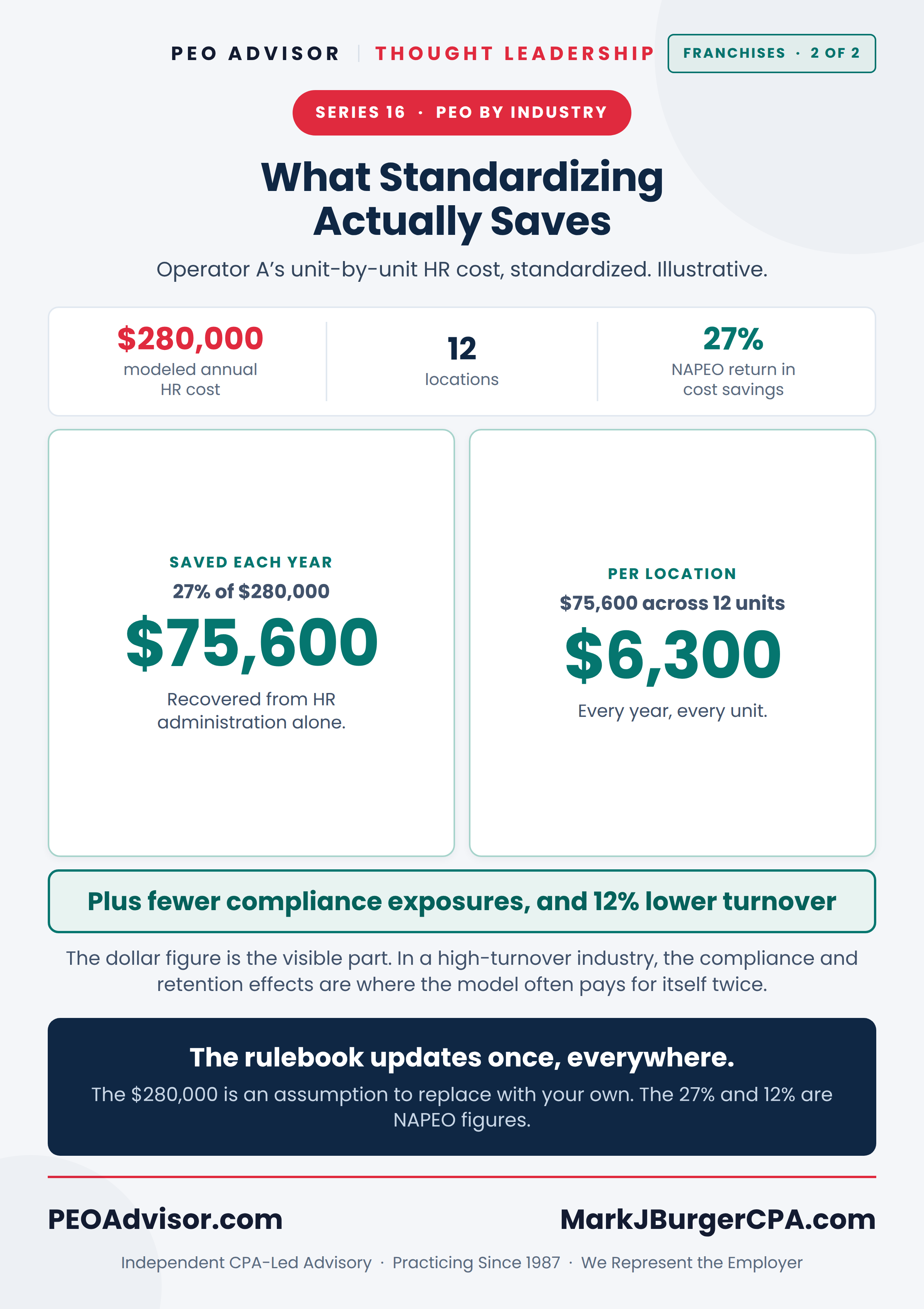
Worked example (illustrative). Take the modeled $280,000 of annual, unit-by-unit HR cost across 12 locations and 180 employees. That is about $1,556 per employee. Apply NAPEO’s published 27 percent return in cost savings and the figure is roughly $75,600 a year, or about $6,300 per location.
Treat both halves of that calculation as inputs you should replace. The $280,000 is an assumption, not a benchmark. Your own in-house HR cost is knowable. Add the salary and burden of whoever administers payroll, benefits and onboarding, plus software, broker fees and the hours your managers spend on it. The 27 percent is NAPEO’s, and NAPEO is the industry’s trade association, so it is advocacy research rather than an independent audit. The saving worth acting on is the one your own quotes produce.
The dollar figure is the visible part. Fewer compliance exposures across states and lower turnover are harder to price and often larger. NAPEO reports 12 percent lower employee turnover among PEO users, which matters more in food service than in most industries, because each avoided departure saves recruiting and training cost that never appears on an HR invoice.
How Does Consistency Become a Competitive Advantage?
Standardized people operations are a growth accelerator, not just a cost saver. Successful multi-location operators do not merely replicate a business model; they standardize the operational infrastructure beneath it. Consistent policies, benefits, and compliance across every location reduce risk, improve the employee experience, and let leadership focus on growth rather than firefighting unit-level HR issues. NAPEO puts the return from using a PEO at 27 percent in cost savings alone, alongside 12 percent lower employee turnover and a doubled growth rate — consistency paying off on both cost and culture. Those are the trade association’s figures, not an independent audit, and they are worth testing against your own quotes.
| How consistent is HR across your locations? Get a no-cost read on what standardizing payroll, benefits, and multi-state compliance could save across your units, through the PEO Advisor assessment. Start the franchise PEO assessment |
How Does a PEO for Franchises Standardize HR?
A PEO replaces unit-by-unit administration with one platform. Through co-employment, a PEO delivers a single system for payroll, benefits, onboarding, and compliance across all locations, so policies are uniform and administration is centralized rather than duplicated. It also pools the franchise’s employees for benefits purchasing, giving even a mid-sized operator large-group leverage that improves both cost and the offer to employees. The result is one consistent, compliant, competitive HR operation spanning every unit. How franchise operators use PEO support for benefits and reporting covers the same mechanics.
How Does a PEO Handle Multi-State Compliance and Turnover?
Franchises live at the intersection of multi-state compliance and high turnover. Operating across states means different minimum wages, paid-leave mandates, and pay-transparency rules in each — what multi-state PEO compliance requires in 2026 details the landscape — and franchise industries such as food service carry high turnover that compounds recruiting and training cost. A PEO manages the multi-state compliance centrally and improves retention through competitive benefits, attacking the two costliest people problems in franchising at once.
The compliance edge is easy to underestimate until an expansion forces it. A handbook written for two states does not automatically satisfy a third, and a missed paid-leave accrual or an out-of-date pay-transparency notice is the kind of error that surfaces in a claim rather than a report. Centralizing the obligation with a PEO that tracks each state means the rulebook updates once, everywhere, instead of unit by unit after something breaks — which is why the operators who standardize early tend to expand faster than the ones who rebuild HR with each new market.
Case in Point
Case in point (illustrative). A franchisee with eight units in two states signed leases for a third state and discovered, weeks before opening, that the new state carried paid-leave and pay-transparency rules its unit-level handbooks did not address. Rather than rebuild HR a third time, the operator moved to a PEO that standardized policies across all three states, centralized onboarding and payroll, and pooled the whole workforce for benefits. The third-state opening proceeded on schedule and compliant, and the operator stopped re-solving the same HR problems each time it expanded. This scenario is illustrative and does not describe an identifiable operator; it shows why standardization matters most at the moment of growth.

How Do You Choose a Franchise-Ready PEO? A Step-by-Step
- Confirm multi-state capability in your states. Ask for documented capability in each state you operate, not a national brand claim.
- Test standardization without erasing local needs. Confirm it can enforce uniform policy while accommodating state-specific rules.
- Check franchise-industry experience. Ask how it has served comparable multi-unit operators and what it delivered.
- Quantify the benefits leverage. Compare pooled large-group pricing against your current unit-by-unit benefits.
- Ask for consistency and savings evidence. Request the compliance and cost results for similar footprints.
- Evaluate independently. Match your footprint to a genuinely multi-state PEO rather than choosing on a single presentation. A CPA-led framework for choosing the right PEO partner sets out the process.
Run a multi-location franchise? Standardize HR with Mark J. Burger, CPA.
Sources and basis. The two-operator comparison is a model built for this article rather than a study: 12 locations, 180 employees, and an assumed $280,000 of annual in-house HR cost, about $1,556 per employee. Substitute your own figures.
The outcome percentages are NAPEO’s, retrieved September 30, 2026: a 27 percent return on investment in cost savings alone, 12 percent lower employee turnover, growth at twice the rate of non-users, and a 50 percent lower rate of going out of business. NAPEO is the PEO industry’s trade association, so those figures are its research rather than independent findings, and this article cites them on that basis. The $75,600 and $6,300 figures are arithmetic on that model. The case in point is illustrative and does not describe an identifiable operator. This content is educational, not legal or tax advice.
Frequently Asked Questions
How does a PEO help a franchise business?
A PEO replaces unit-by-unit HR with one platform for payroll, benefits, onboarding, and compliance across all locations, standardizing policies and centralizing administration. It also pools employees for large-group benefits. For the 12-location, 180-employee operator modeled in this article, in-house HR runs about $280,000 a year. NAPEO puts the return from using a PEO at 27 percent in cost savings alone, with 12 percent lower employee turnover.
Why is HR harder for multi-location franchises?
Because every new location and state multiplies complexity: policies drift between units, compliance obligations differ by state, and administration duplicated unit by unit becomes costly and inconsistent. A franchisee managing HR location by location pays for that fragmentation in dollars and risk, and the problem worsens as the footprint grows – which is what a PEO’s centralized platform resolves.
Can a PEO handle franchises across multiple states?
Yes, if the provider has genuine multi-state capability. A franchise operating across states faces different minimum wages, paid-leave mandates, and pay-transparency rules in each. A capable PEO manages that compliance centrally across every location. Confirm the provider’s documented capability in your specific states rather than relying on a national brand claim.
Does a PEO reduce franchise turnover?
It can help. Franchise industries such as food service carry high turnover that compounds recruiting and training cost. By offering competitive large-group benefits and consistent, professional HR support across locations, a PEO improves the employee experience and retention, attacking one of the two costliest people problems in franchising alongside multi-state compliance.
Will a PEO override my franchise’s local management?
No. Under co-employment the PEO standardizes and administers HR, payroll, benefits, and compliance, while the franchisee retains control over hiring, daily operations, and local management at each unit. The goal is consistency and compliance across locations, not the removal of local operational authority.
What should a franchise operator look for in a PEO?
Look for genuine multi-location and multi-state capability, the ability to standardize policies without ignoring local needs, franchise-industry experience with your turnover and staffing patterns, and documented results for comparable multi-unit operators. Because capability varies by provider and state, an independent evaluation that matches your footprint to a truly multi-state PEO is the reliable approach.
About the author. Mark J. Burger, CPA, advises small and mid-sized businesses on strategic workforce and co-employment decisions through GuidePoint PEO LLC. His analysis draws on a CPA practice dating to 1987 and hundreds of industry cost assessments.
Independent CPA-Led Advisory · Practicing Since 1987 · We Represent the Employer


