As of August 2026.
Executive Summary
PEO consolidation is under way and measurable, even as the industry remains strikingly fragmented. NAPEO counted 523 PEOs serving 4.5 million worksite employees in 2022. It now counts 502 serving 5.4 million. Fewer providers carry more people. Deal activity explains it: Vensure Employer Solutions closed its 108th acquisition in April 2026, adding more than 80,000 worksite employees across eight deals, and CoAdvantage merged with PrimePay — following Paychex’s roughly $4.1 billion acquisition of Paycor and Engage PEO’s absorption of Aspen HR. This analysis maps the M&A landscape and what is driving it.
Is the PEO Industry Fragmented or Consolidating?
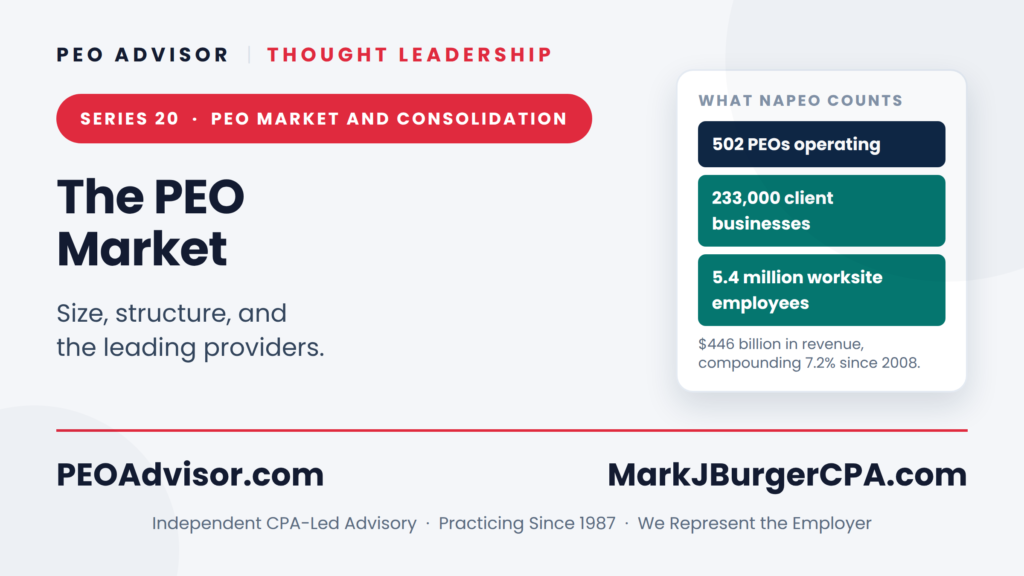
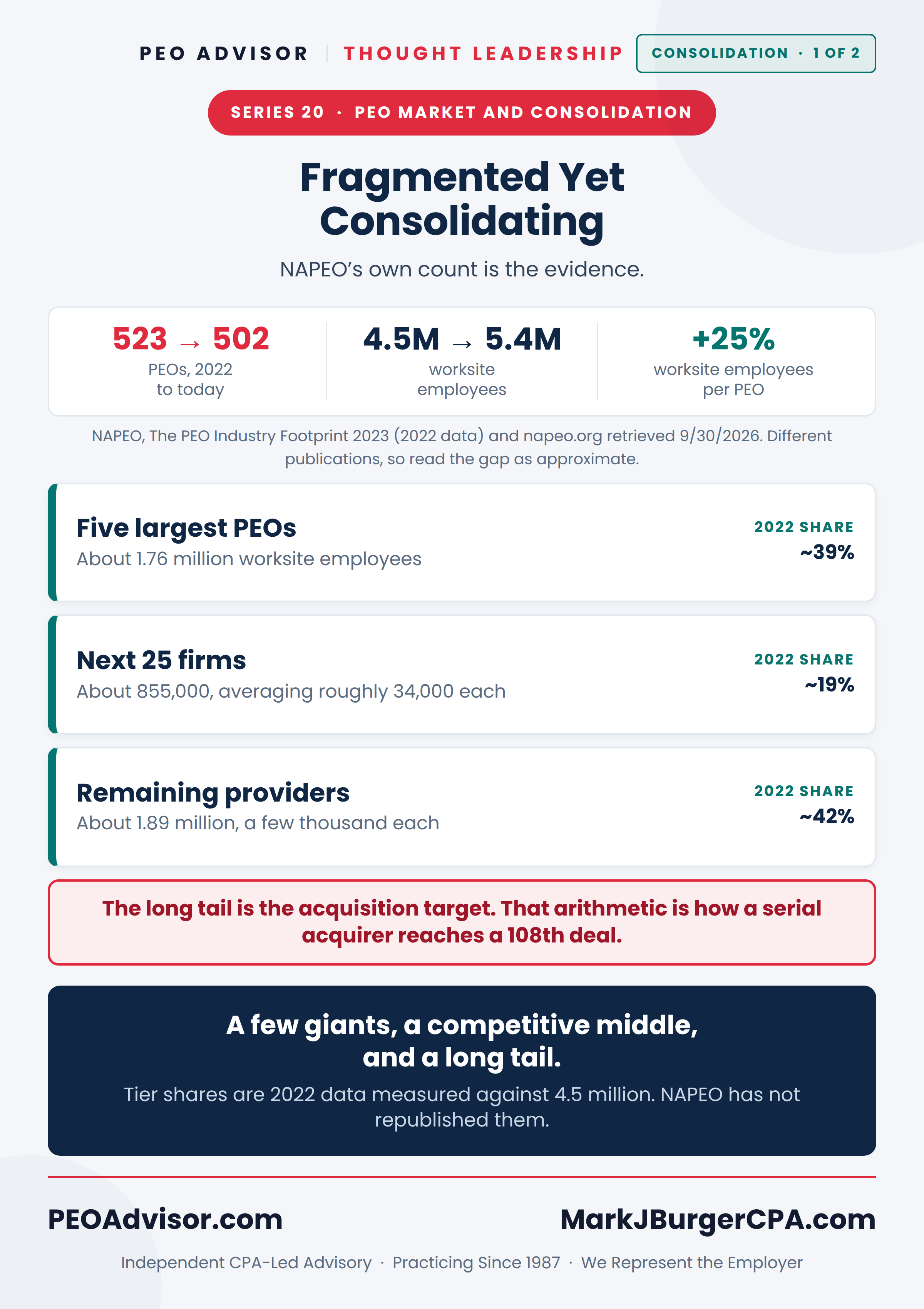
The PEO market is both crowded and concentrating at the same time. NAPEO counts 502 PEOs serving 233,000 client businesses and 5.4 million worksite employees, in an industry generating an estimated $446 billion in revenue. Concentration is real. On the last tier breakdown NAPEO published, the five largest PEOs accounted for about 39 percent of worksite employees, the next 25 firms roughly 19 percent, and the remaining providers the balance. Those shares are 2022 data and are treated as such throughout this analysis.
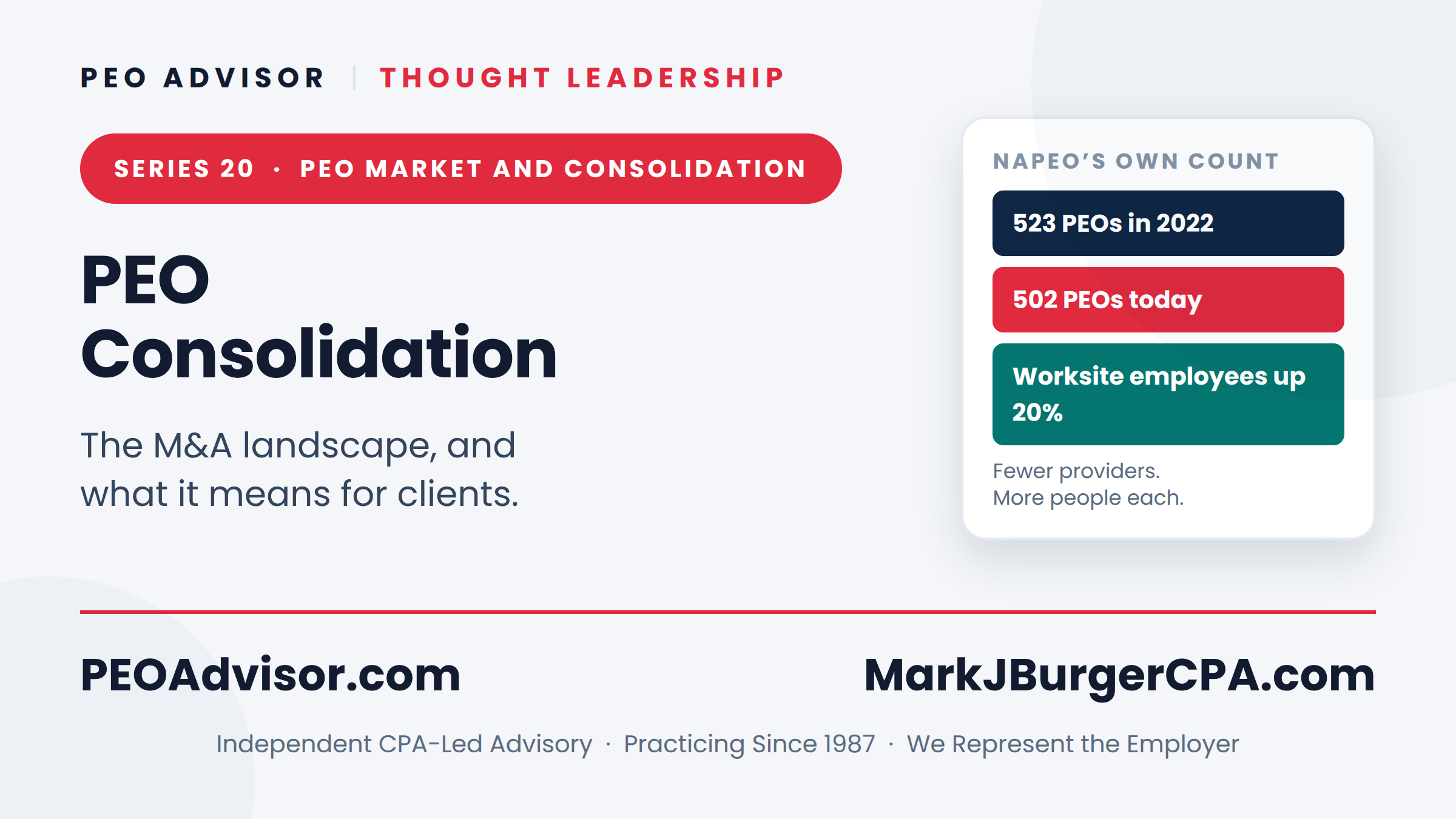
The clearest evidence of consolidation is NAPEO’s own count. Its 2023 Footprint paper put the industry at 523 PEOs and 4.5 million worksite employees. Today it reports 502 and 5.4 million. That is about 8,600 worksite employees per PEO then and about 10,800 now, a rise of roughly a quarter. The two counts come from different NAPEO publications, so read the exact gap as approximate. The direction is not in doubt.
That structure fuels the deal flow. A few giants, a competitive middle, and a long tail is precisely the shape a consolidating market takes, because large platforms can buy scale and regional depth faster than they can build either. For the earlier stage of this trend, see our analysis of PEO consolidation in 2024.
| Tier | Share of worksite employees (2022) | Approx. worksite employees |
|---|---|---|
| Five largest PEOs | ~39% | ~1.76 million |
| Next 25 firms | ~19% | ~855,000 |
| Remaining providers (long tail) | ~42% | ~1.89 million |
Which Deals Are Defining the PEO Market?
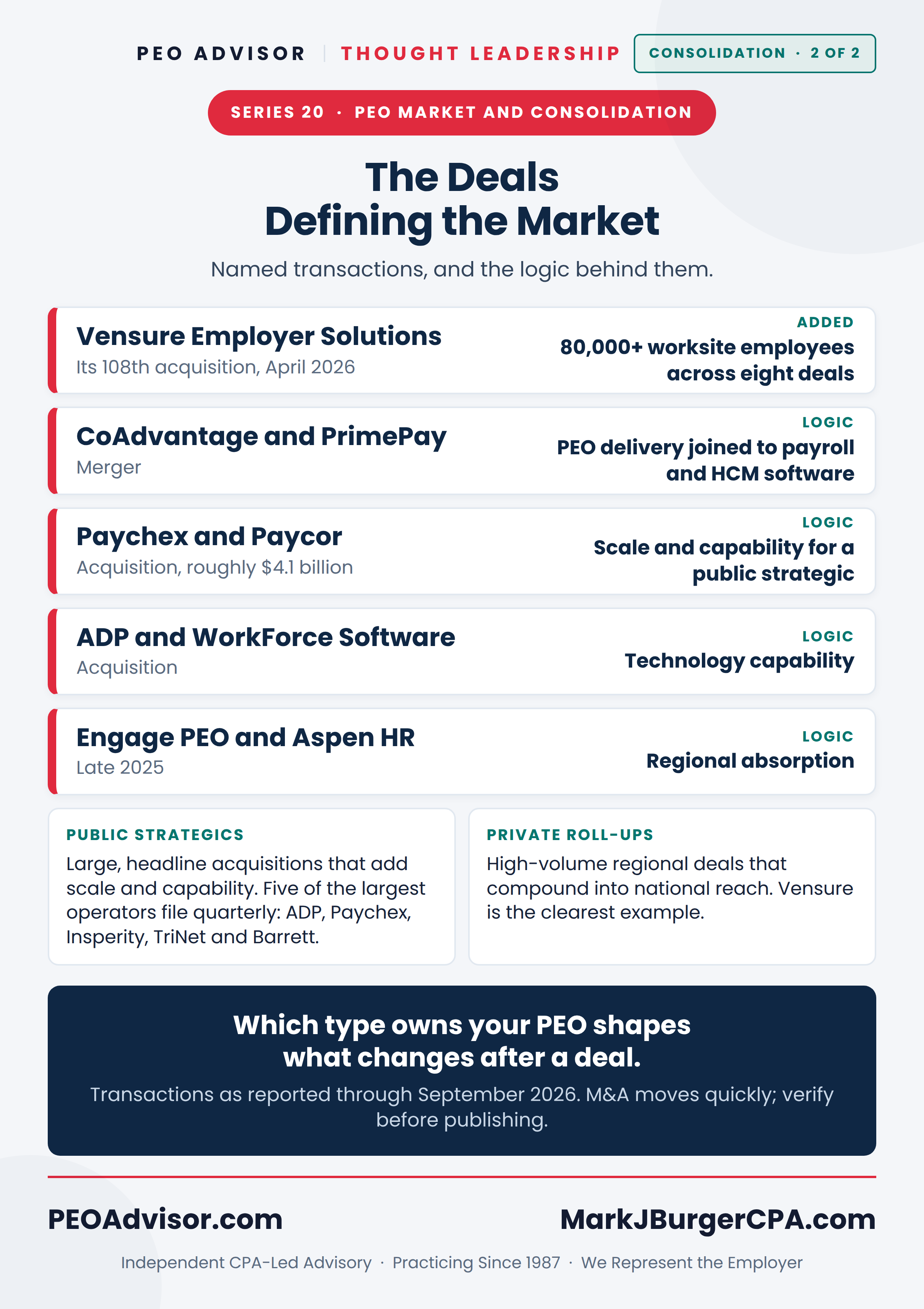
A handful of transactions illustrate the pace and logic of the wave. Vensure Employer Solutions closed its 108th acquisition in April 2026, adding more than 80,000 worksite employees across eight deals — a template for buying broker relationships, state-level compliance depth, and operating scale through regional acquisitions. CoAdvantage merged with PrimePay, combining full-service PEO delivery with payroll and HCM software aimed at SMBs and franchises. These follow Paychex’s roughly $4.1 billion acquisition of Paycor, ADP’s purchase of WorkForce Software, and Engage PEO’s acquisition of Aspen HR in late 2025.
| Is your PEO a likely acquisition target? Get a no-cost read on where your PEO sits in a consolidating market, and what an ownership change could alter, through the PEO Advisor assessment. Start the PEO assessment |
What Do the Cited Market Shares Add Up To? A Worked Example
Worked example (illustrative arithmetic on cited figures). Apply the published shares to the 4.5 million worksite employees they were measured against in 2022. The top five’s 39 percent is about 1.76 million. The next 25 firms’ 19 percent is about 855,000, averaging roughly 34,000 each. The remaining 42 percent, about 1.89 million, is spread across several hundred providers averaging only a few thousand each.
That arithmetic is why consolidation runs the way it does. The acquisition targets are the hundreds of small regional PEOs in that tail, which is how a serial acquirer reaches a 108th deal. The shares are 2022 figures and the per-firm averages are arithmetic on them, so both are illustrative rather than current.
Growth since has not changed the shape of the opportunity. The industry now counts 5.4 million worksite employees across 502 providers, against 4.5 million across 523 in 2022. NAPEO has not published an updated split, so how that growth divided between the giants and the long tail is not on the public record, and no honest analysis can claim otherwise. What is on the record is the direction: more worksite employees, carried by fewer firms. Hundreds of small regional providers remain the only pool deep enough to supply a serial acquirer.
What Is Driving PEO Consolidation?
Scale, technology, and distribution are the engines. Acquirers are consolidating fragmented regional markets to gain purchasing scale on benefits and workers’ compensation, to acquire modern technology, and — critically — to buy broker relationships and state-level compliance depth that would take years to build. For strategic buyers, a larger platform spreads fixed costs and funds technology investment; for acquisitive platforms like Vensure, serial regional deals compound into national reach. Both logics point the same direction: more consolidation ahead.
Who Is Doing the Buying?
Two types of acquirer dominate, with different playbooks. Publicly traded strategics make large, headline acquisitions to add scale and capability. Five of the largest operators file quarterly: ADP, Paychex, Insperity, TriNet, and Barrett. Acquisitive private platforms, most visibly Vensure, run high-volume roll-up strategies, absorbing regional PEOs one after another. A third stream pairs PEO delivery with payroll and HCM software, as in CoAdvantage–PrimePay. For a client, which type owns your PEO shapes what changes after a deal — the subject of a companion analysis in this set and of a review of how industry consolidation affected PEO clients in 2025.
Case in Point
Case in point (illustrative). Consider a mid-sized employer on a well-regarded regional PEO — the kind of provider that sits squarely in the long tail described above. In a consolidating market, that regional PEO is precisely the acquisition target a serial roll-up seeks: strong broker relationships and state-level compliance depth, at a scale a national platform can absorb. When the deal comes, the client’s service team, platform, rates, and contract can all move — not because anything was wrong, but because the math of consolidation made its provider a target. The employer that understood the landscape treated the announcement as a prompt to confirm what was changing; the one that did not was caught unprepared. This scenario is illustrative and does not describe an identifiable company.
What Does the Consolidation Wave Signal for Employers?
Expect the pace to continue, and plan accordingly. With willing sellers, motivated acquirers, and a long tail of regional PEOs still to be absorbed, deal activity is expected to continue through 2026 and beyond. For businesses on a PEO, that means a rising probability that their provider will be involved in a transaction, and a corresponding need to understand how consolidation affects service, rates, and contracts. The market analysis and client-impact pieces in this set cover both.

How Do You Prepare for Consolidation? A Step-by-Step
- Know where your PEO sits — a long-tail regional provider is a more likely acquisition target than a top-five strategic.
- Identify the likely acquirer type — a strategic, a private roll-up, or a software-plus-PEO combination changes what a deal alters.
- Treat any announcement as a prompt — confirm in writing what changes on service, platform, rates, and contract.
- Scrutinize the first post-deal renewal — pricing harmonization tends to surface there, and how a PEO renewal is built shows where to look.
- Keep an independent read available — have your options and an adviser relationship ready before you need them, including the signals that it is time to re-shop your PEO.
Was your PEO recently acquired, or worried it might be? Contact Mark J. Burger, CPA for an independent read on what it means for you.
Sources and basis. Current industry figures are NAPEO data retrieved September 30, 2026. They are 502 PEOs, roughly 233,000 client businesses, 5.4 million worksite employees, an estimated $446 billion in revenue, and compound annual growth of 7.2 percent since 2008. The tier shares come from NAPEO, The PEO Industry Footprint 2023, Figure 2. They rest on 2022 data, measured against 4.5 million worksite employees. That paper counted 523 PEOs and 208,000 client businesses. NAPEO has not republished the split against its current total, and its 2026 Footprint paper is available to members only.
Named transactions are as reported: Vensure Employer Solutions’ 108th acquisition (April 2026), CoAdvantage–PrimePay, Paychex–Paycor (about $4.1 billion), ADP–WorkForce Software, and Engage PEO–Aspen HR (late 2025). The per-firm averages are simple arithmetic on the cited shares and are illustrative; the case in point is illustrative and does not describe an identifiable company. This content is educational, not legal or tax advice.
Frequently Asked Questions
Is the PEO industry consolidating?
Yes, and NAPEO’s own counts show it. Its 2023 Footprint paper reported 523 PEOs serving 4.5 million worksite employees. It now reports 502 serving 5.4 million. Fewer providers carry more people. Vensure closed its 108th acquisition in April 2026, and CoAdvantage merged with PrimePay, following Paychex-Paycor and Engage’s acquisition of Aspen HR.
What are the biggest PEO acquisitions recently?
Recent notable deals include Paychex’s roughly $4.1 billion acquisition of Paycor, ADP’s purchase of WorkForce Software, Engage PEO’s acquisition of Aspen HR in late 2025, CoAdvantage’s merger with PrimePay, and Vensure Employer Solutions’ ongoing roll-up, which reached its 108th acquisition in April 2026. Activity is continuous, so the list of deals keeps growing.
Why are PEOs merging?
Acquirers consolidate to gain purchasing scale on benefits and workers’ compensation, acquire modern technology, and buy broker relationships and state-level compliance depth that would take years to build. Strategic buyers spread fixed costs and fund technology; acquisitive platforms compound regional deals into national reach. Both point toward continued consolidation of a fragmented market.
How consolidated is the PEO market?
It is concentrated at the top and fragmented below. On NAPEO’s last published breakdown, from 2022 data, the five largest PEOs held about 39 percent of worksite employees, the next 25 firms about 19 percent, and the remaining providers the balance. NAPEO’s provider count has since fallen from 523 to 502 while worksite employees rose to 5.4 million.
Should I worry if my PEO gets acquired?
Not necessarily, but you should pay attention. An acquisition can change your service team, technology platform, rates, and contract terms – sometimes for the better, sometimes not. With deal activity high in 2026, the odds your PEO is involved in a transaction are rising, so understanding the potential impact and watching your first post-deal renewal is prudent.
Will PEO consolidation continue?
It is expected to. With willing sellers, motivated strategic and private-equity-backed acquirers, and a long tail of regional PEOs still to be absorbed, deal activity is projected to continue through 2026 and beyond. Businesses on a PEO should assume consolidation will touch their provider eventually and plan to evaluate the impact when it does.
About the author. Mark J. Burger, CPA, advises small and mid-sized businesses on strategic workforce and co-employment decisions through GuidePoint PEO LLC. His analysis draws on a CPA practice dating to 1987 and hundreds of PEO cost assessments.
Independent CPA-Led Advisory · Practicing Since 1987 · We Represent the Employer