
Executive Summary
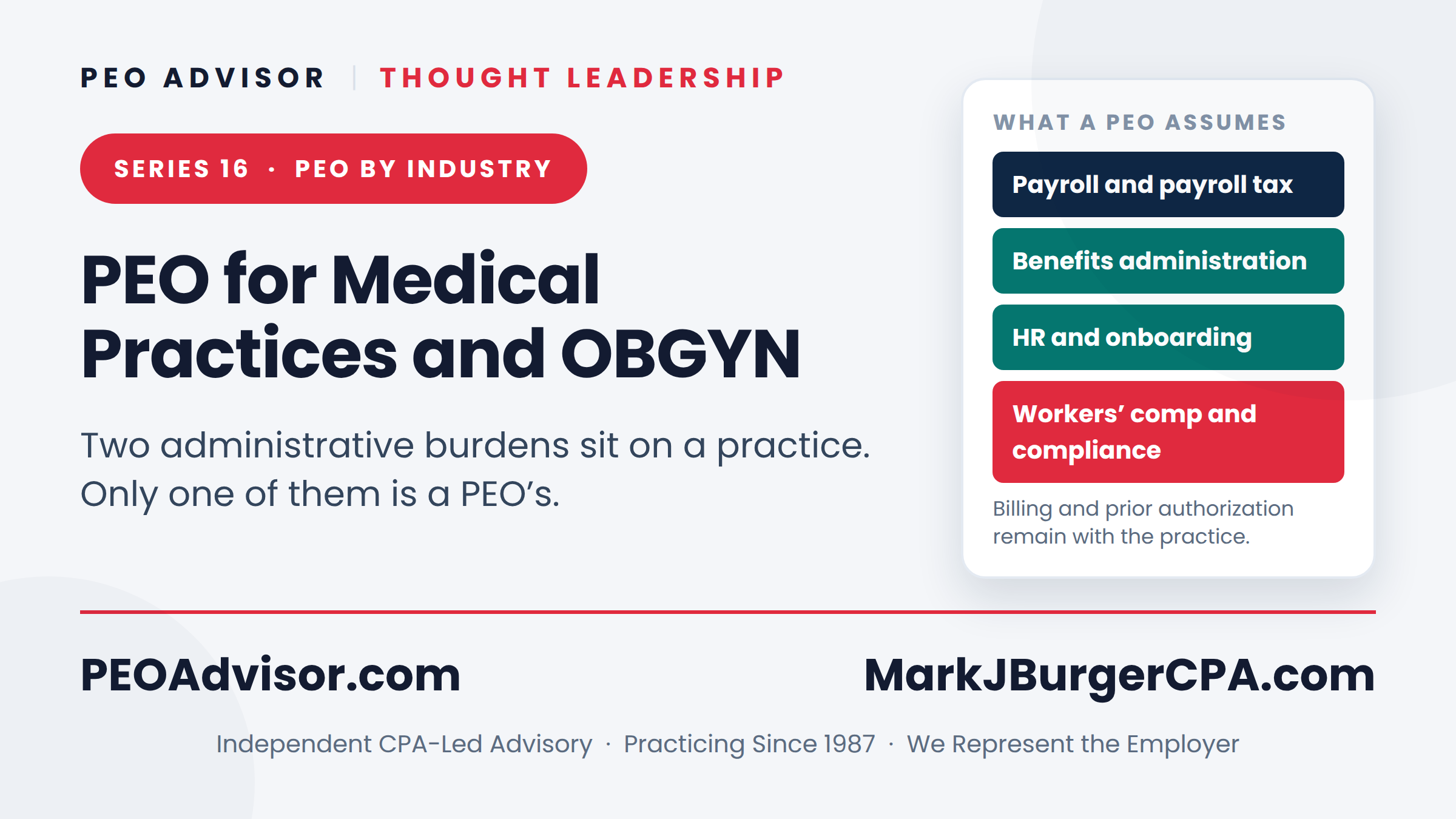
Eighty-four percent of medical groups reported year-to-date operating costs above the prior year. That is MGMA’s June 2026 poll. The increases were led by labor: wages, benefits, staffing shortages, and minimum-wage changes. Support-staff salaries and benefits alone typically absorb about a quarter of practice revenue. That share is what a co-employment partnership reaches. This guide to a PEO for medical practices separates the employment administration a PEO assumes from the payer administration it does not. It then sets out how to price each.
Where Does a Medical Practice’s Revenue Actually Go?
Labor is the cost center, and it has risen for four consecutive years. MGMA polled 251 medical groups in June 2026. Eighty-four percent reported year-to-date operating costs above the same point in 2025. Among those reporting increases, the average was about 11 percent. The same series recorded 90 percent in 2025, 92 percent in 2024, and 95 percent in 2023. Average increases ran 10 to 12.5 percent in each of those years. MGMA names wages, benefits, staffing shortages, and minimum-wage increases as the leading drivers.
Support-staff salaries and benefits alone typically account for roughly a quarter of total practice revenue. MGMA reported that in June 2025. That is the pool a co-employment partnership operates on. It is not the practice’s clinical cost, and not its payer-side billing work. The same pressure runs through the wider regulated-care sector, as our analysis of how a PEO serves healthcare, senior living, and education employers sets out.
What Makes Up a Practice’s Administrative Cost?
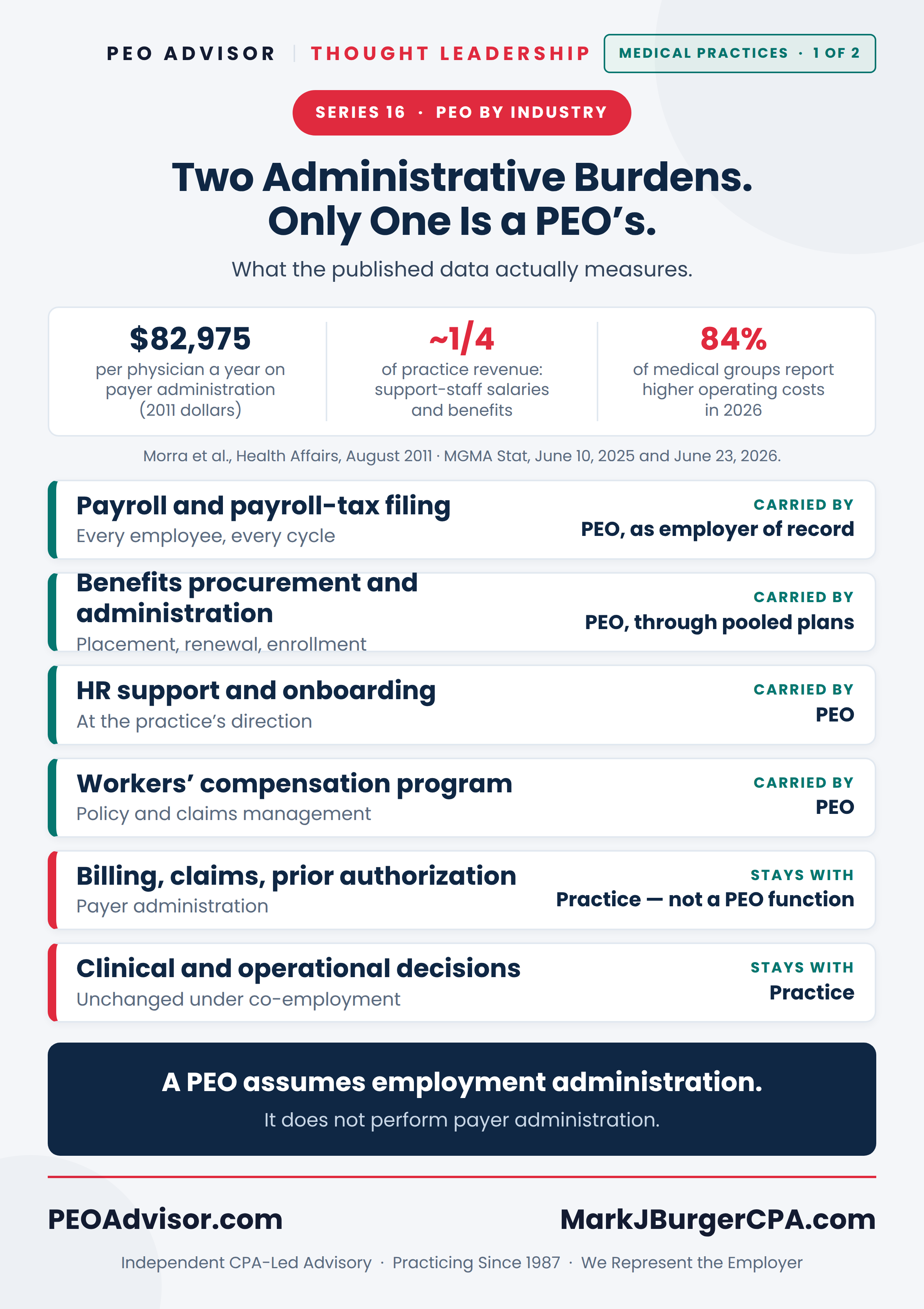
Two different administrative burdens sit on a physician practice, and only one of them is a PEO’s. The first is payer administration: billing, claims, and prior authorization. The standard peer-reviewed measure remains Morra and colleagues in Health Affairs, August 2011, which put United States practices at $82,975 per physician a year interacting with health plans, against $22,205 in Ontario. A PEO does not perform any of that work.
The second burden is employment administration, and that one a PEO assumes. It covers payroll and payroll-tax filing, benefits procurement and administration, HR support and onboarding, the workers’ compensation program, and employment compliance. Under co-employment the PEO becomes the administrative employer of record for those functions while the practice keeps clinical and operational control. The table below is a scope table, not a price list.
| Function | Who carries it under a PEO agreement |
|---|---|
| Payroll and payroll-tax filing | PEO, as administrative employer of record |
| Benefits procurement and administration | PEO, through its pooled plans |
| HR support and onboarding | PEO, at the practice’s direction |
| Workers’ compensation program | PEO, policy placement and claims management |
| Employment compliance | Shared; the practice retains site-level duties |
| Billing, claims, prior authorization | Practice — a PEO does not perform payer administration |
| Clinical and operational decisions | Practice — unchanged |
What Does the Overhead Really Cost a Practice?
Worked example — a disclosed model, not a benchmark. Assume a 25-physician group at $12 million in annual revenue. Both inputs are assumptions stated here, not published figures. On the payer side, Morra’s $82,975 per physician implies roughly $2.07 million a year at that size, in 2011 dollars — work a PEO does not touch. On the employment side, at MGMA’s quarter-of-revenue observation, support-staff salaries and benefits run near $3 million; what a PEO assumes is the administration and procurement of that payroll and those benefits, not the compensation itself.
The model deliberately produces no savings figure. What a PEO saves a given practice depends on the quote it is offered measured against what it spends today on payroll processing, benefits brokerage and administration, HR support, and workers’ compensation. Those numbers sit in the practice’s own payroll register and benefits renewal, and they should replace every assumption above before any decision. A provider quoting a savings figure before seeing those records is estimating, not measuring.
| Not sure what administration is costing your practice? Get a no-cost read on your administrative load, benefits pricing, and recoverable overhead through the PEO Advisor assessment. Start the Medical Practice PEO Value assessment |
How Does Co-Employment Help a Medical Practice?
A PEO lets an independent practice buy benefits and administration at a scale it cannot reach alone. Under co-employment the PEO becomes the employer of record for payroll tax and employment compliance. Physicians retain full clinical and operational control. The PEO delivers large-group benefits that help a private practice compete with hospital systems for nurses and medical assistants. It absorbs payroll and compliance work, and manages the workers’ compensation program.
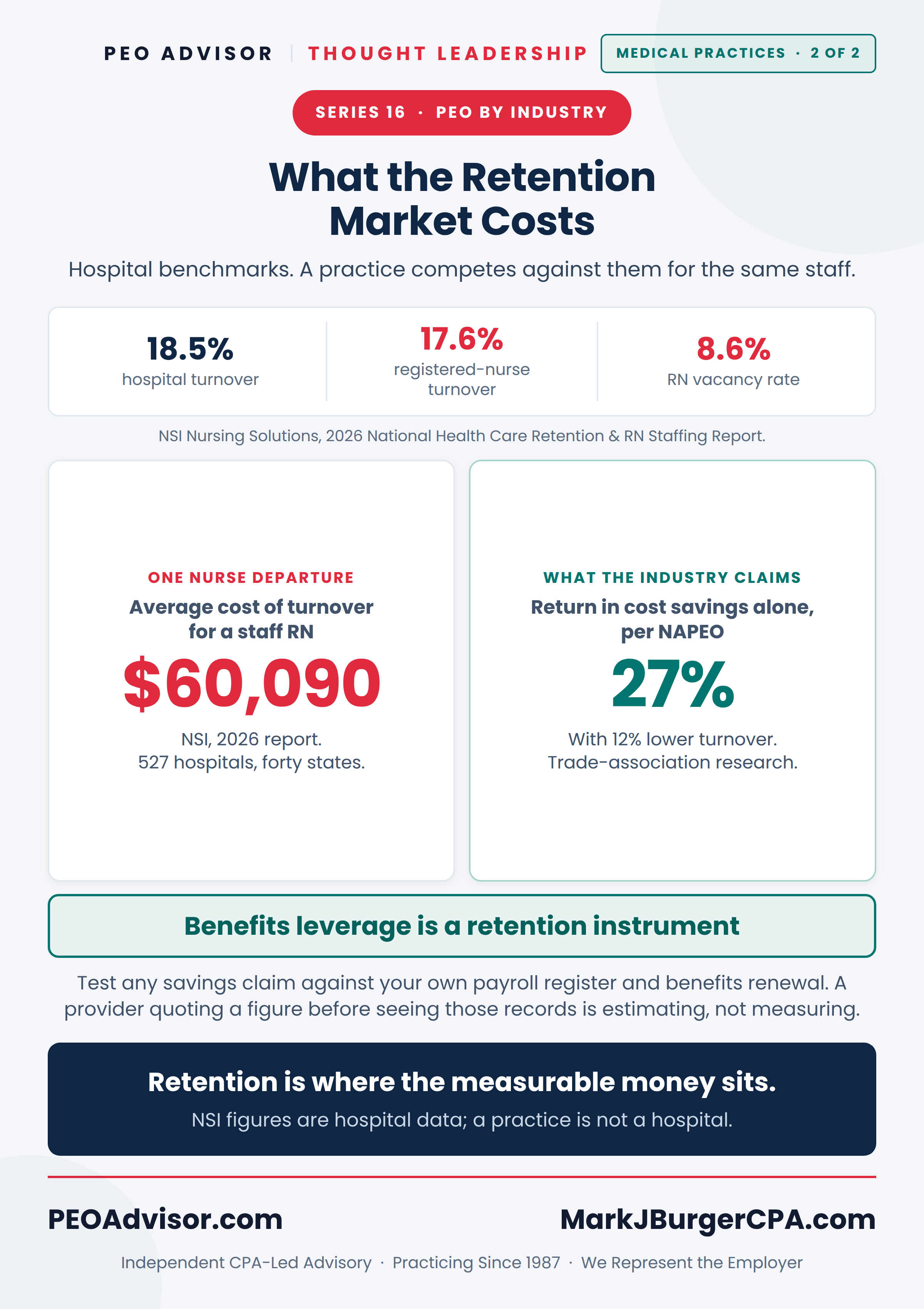
NAPEO is the industry’s trade association. It reports a 27 percent return in cost savings alone, and 12 percent lower employee turnover among PEO clients. Those figures come from association-sponsored research, not an independent body. Treat them as the industry’s own case. Test them against the quote in front of you. PEO Company examines the same mechanism across dental, specialty, and senior-living employers in its analysis of how healthcare co-employment gives organizations a competitive edge in volatile times.
The leverage matters most where a practice is smallest relative to its competitors. A hospital system negotiates benefits for thousands of employees. An independent group of twenty physicians cannot match that pricing alone. The effect shows up first in recruiting and retention. It shows up next in the compliance work that no longer lands on a practice administrator’s desk. Pooled pricing is not automatically good pricing, however, and our guide to telling whether a PEO health plan is costing more than it should shows how to test the benefits quote you are given.
What Does Clinical Turnover Cost, and What Holds Staff?
Benefits are a retention instrument, and retention is where the measurable money sits. NSI Nursing Solutions’ 2026 National Health Care Retention and RN Staffing Report covers 527 hospitals across forty states, 965,886 healthcare workers, and 262,405 registered nurses. It records hospital turnover at 18.5 percent and registered-nurse turnover at 17.6 percent. The RN vacancy rate stands at 8.6 percent. The average cost of one staff nurse’s turnover is $60,090.
Those are hospital figures, and a physician practice is not a hospital. Their relevance is the market a practice competes in. The hospital across town carries that vacancy rate and that replacement cost. It bids for the same nurses and medical assistants, with benefits an independent group cannot match alone. Pooled through a PEO, the group buys at large-group rates.
The overhead also costs attention. Every hour a physician or practice administrator gives to benefits renewals, payroll corrections, and employment compliance is an hour not spent on care. The honest measure here is the hours a PEO removes and the turnover it helps avoid, both readable from the practice’s own records before and after.

Case in Point
Case in point (illustrative). A 14-physician OBGYN group was losing nurses and medical assistants to a nearby hospital system offering richer health coverage, and its administrator was spending most of a week each month on benefits, payroll, and compliance. After partnering with a healthcare-experienced PEO, the group gained large-group pricing that closed most of the gap, offloaded payroll and compliance, and reduced turnover. This scenario is illustrative and does not describe an identifiable client. The underlying levers are the ones set out in our blueprint for lifting employee retention through a PEO.
How Do You Choose a PEO for Medical Practices?
- Require healthcare experience. Ask for medical and OBGYN references and how the provider has served comparable practices.
- Test the benefits leverage. Compare its large-group plan pricing against what you offer today — this is often the most valuable element.
- Confirm compliance fluency. Verify healthcare-specific compliance support and clinically aware onboarding.
- Quantify what you spend today. Price payroll processing, benefits brokerage and administration, HR support, and workers’ compensation program management from your own records, not from a benchmark.
- Check the retention record. Ask how the provider moved turnover and staffing for similar groups.
- Evaluate independently. Compare providers on documented healthcare capability rather than a single sales presentation.
The practices that get the most from a PEO do not shop the administrative fee in isolation. They quantify the overhead they carry today. They test the benefits catalog against what a hospital across town offers their nurses. They confirm the provider has actually served medical and specialty groups before signing anything.
Run a medical or OBGYN practice? Book Your PEO Strategy Call with Mark J. Burger, CPA and model your administrative overhead against what a healthcare-experienced PEO can recover.
Sources and basis. Operating-cost readings come from MGMA Stat polls published June 23, 2026 and June 10, 2025. The June 2026 poll drew 251 applicable responses. Every operating-cost figure quoted above is theirs. Payer-administration cost comes from Morra D and colleagues in Health Affairs, August 2011. That study put United States practices at $82,975 per physician a year, against $22,205 in Ontario. The figures are 2011 dollars, and the study has not been repeated at that scale.
Turnover figures come from NSI Nursing Solutions, 2026 National Health Care Retention and RN Staffing Report. Its sample is stated above. The 27 percent cost-savings return and the 12 percent lower turnover are NAPEO figures. NAPEO is the industry’s trade association, not an independent body, and the text above says so.
The 25-physician group at $12 million in revenue is a disclosed model. Its inputs are stated as assumptions. The 14-physician OBGYN group is illustrative. Neither describes an identifiable client, and no savings figure is estimated for either. Under co-employment a PEO acts as the administrative employer of record for payroll tax and employment compliance. The practice retains clinical and operational control. Mark J. Burger, CPA, advises small and mid-sized businesses on strategic workforce and co-employment decisions through GuidePoint PEO LLC, practicing since 1987. This content is educational, not legal, tax, or clinical advice.
Frequently Asked Questions
How does a PEO help a medical practice?
A PEO becomes the employer of record for payroll tax and employment compliance. Physicians retain full clinical and operational control. The PEO delivers large-group benefits that help a practice compete with hospital systems for clinical staff. It absorbs payroll and HR administration, and manages workers’ compensation. NAPEO, the industry trade association, reports a 27 percent return in cost savings alone. Test that against your own quote.
How much do medical practices spend on administration?
Two separate burdens exist. Payer administration covers billing, claims, and prior authorization. Morra and colleagues measured it at $82,975 per physician a year in Health Affairs, using 2011 data. A PEO does not perform that work. Employment administration is the part a PEO assumes. MGMA reported in June 2025 that support-staff salaries and benefits alone account for about a quarter of total practice revenue.
Can a PEO help my practice compete with hospitals for staff?
Yes, principally through pooled benefits purchasing. That gives an independent practice access to large-group plans comparable to much larger systems. The competition is measurable. NSI’s 2026 retention report covers 527 hospitals. It records a registered-nurse vacancy rate of 8.6 percent and RN turnover of 17.6 percent. It puts the average cost of one nurse’s departure at $60,090.
Does using a PEO affect clinical control of my practice?
No. Under co-employment the PEO handles payroll, benefits, and compliance as the administrative employer of record, while physicians retain complete clinical and operational authority over patient care and staff. It is a division of administrative labor, not a transfer of control over how the practice delivers care.
Is a PEO worth it for a specialty group like OBGYN?
Often, yes, for the same two reasons as any physician group. The first is benefits leverage against hospital systems competing for the same nurses and medical assistants. The second is removal of employment administration from the practice administrator’s desk. Whether it pays depends on the quote measured against what the practice spends today. Choose a provider with documented healthcare experience rather than a generalist.
How does a PEO return physician time to patient care?
By assuming payroll, benefits administration, HR support, and employment compliance, a PEO removes work that pulls physicians and practice administrators away from clinical and operational priorities. It does not reduce billing, claims, or prior-authorization work, which stays with the practice. Measure the hours recovered from your own records before and after rather than from a published average.
About the author. Mark J. Burger, CPA · Practicing Since 1987. Mark advises small and mid-sized businesses on strategic workforce and co-employment decisions through GuidePoint PEO LLC. His analysis draws on a CPA practice dating to 1987 and hundreds of industry cost assessments.
Independent CPA-Led Advisory · Practicing Since 1987 · We Represent the Employer


