
Executive Summary
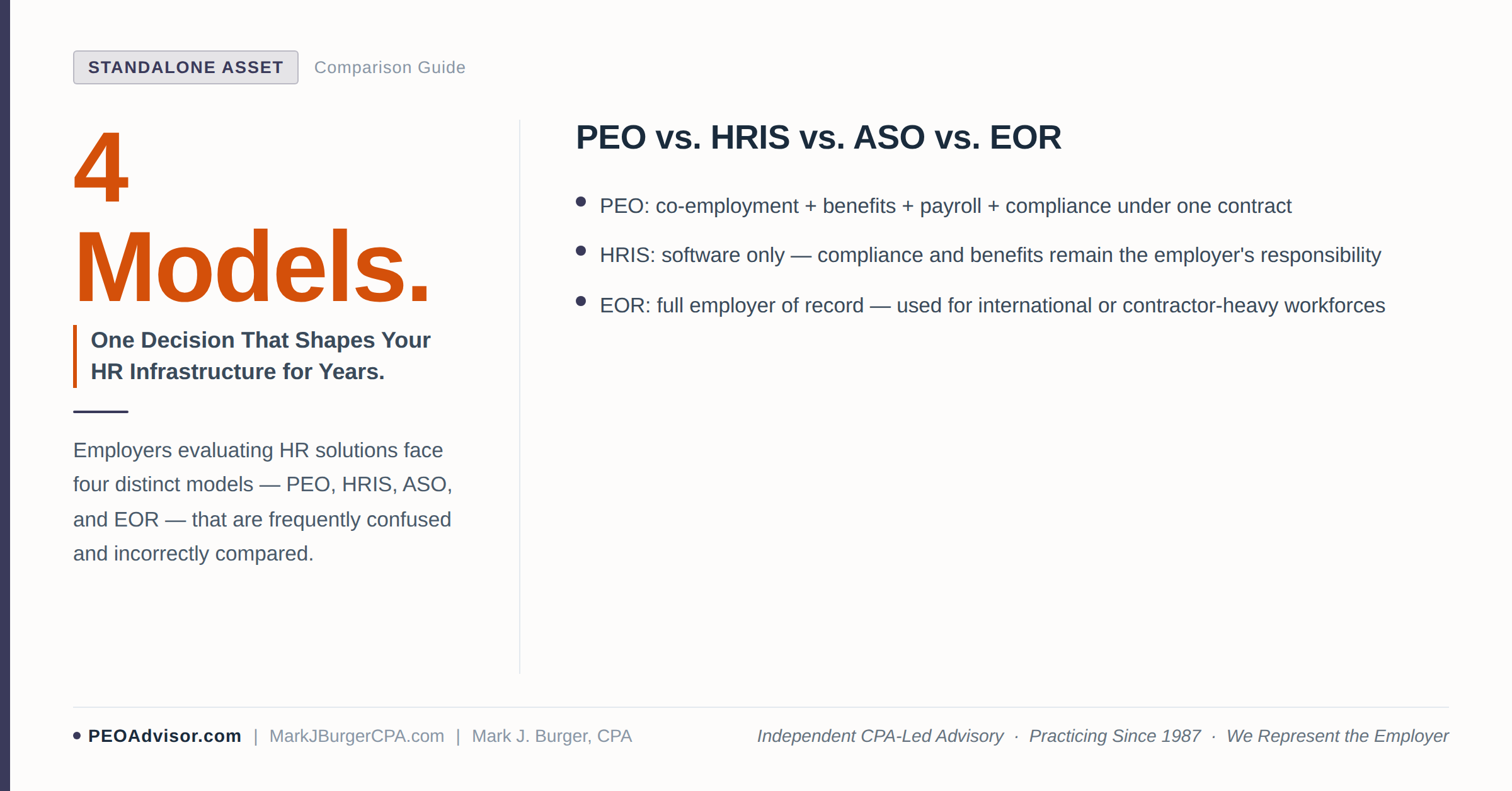
Four common HR solutions are easy to confuse and very different in practice. A PEO shares employer responsibilities through co-employment and delivers pooled benefits, HR, and compliance. An HRIS is software only — powerful tools, but you still do the work. An ASO administers HR without co-employment, so you keep sole employer status and liability. An EOR becomes the full legal employer, ideal for hiring where you have no entity. Choosing correctly depends on whether you want tools, administration, shared employment, or a full employer of record.
The Four Solutions, Defined
Start with what each one actually is, because the differences are structural. A PEO (Professional Employer Organization) enters co-employment with your business, becoming the administrative employer for payroll, taxes, and benefits under its own identification while you run the company — our plain-English primer on what a PEO actually is covers the mechanics in more depth. An HRIS (Human Resource Information System) is software — a platform for payroll and HR data that you operate yourself. An ASO (Administrative Services Organization) outsources HR administration without co-employment, so you remain the sole employer. An EOR (Employer of Record) becomes the full legal employer of your workers, typically to enable hiring where you have no legal entity.
| Dimension | PEO | HRIS | ASO | EOR |
|---|---|---|---|---|
| What it is | Co-employment service | Software platform | Admin outsourcing, no co-employment | Full legal employer |
| Employer status | Shared (administrative employer) | You | You (sole) | The EOR |
| Pooled large-group benefits | Yes | No | Usually no | Through the EOR |
| Who does the work | The PEO | You | The provider | The EOR |
| Best fit | SMB ~10–150 wanting benefits & offload, keeping control | Internal HR capacity; needs tools | Larger employer, own plans, full control | Employ where you have no entity |
PEO: Shared Employment and Pooled Benefits
A PEO is the fullest-service option and the only one that pools you for benefits. Through co-employment, a PEO delivers large-group health and retirement benefits, HR and compliance support, workers’ compensation, and payroll — the infrastructure of a large employer, as a service. It fits small and mid-sized businesses (roughly 10 to 150 employees) that want competitive benefits and to offload HR while keeping operational control. A Certified PEO adds statutory federal-tax protection. The trade-off is a shared-employer structure and contract terms.
HRIS: Tools Without the Service
An HRIS gives you a platform, not a partner. An HRIS provides software to run payroll, benefits enrollment, time, and HR data yourself. It suits organizations with the internal HR capacity to operate it and a preference for keeping everything in-house. What it does not provide is pooled benefits, co-employment, compliance expertise, or anyone doing the work for you. For a business whose real gap is capacity and expertise rather than software, an HRIS alone leaves the burden where it was — PEO Company’s comparison of outsourcing HR to a PEO versus managing it in-house walks through the same trade-off from the outsourcing side.
Cheaper Line Item, Wrong Solution
Worked example (illustrative). A 40-person firm compares an HRIS against a PEO on price. The HRIS lists at an illustrative $10 per employee per month — about $4,800 a year — and looks like the obvious saving next to a PEO at, say, $125 per employee per month, roughly $60,000 a year in administrative fee. But the two are not the same purchase. The HRIS is software; the firm still staffs HR, sources small-group benefits at small-group prices, and owns all the compliance. The PEO fee also buys large-group benefit pricing, the HR and compliance work done for it, and workers’ compensation. If the firm’s real gap is capacity and benefits — not software — the cheaper line item leaves that gap unfilled, and the benefit savings alone can outweigh the fee difference. The lesson is to price the gap, not the tool. Figures are illustrative.
ASO: Administration Without Co-Employment
An ASO handles HR administration while you stay the sole employer. An ASO performs many of the same administrative functions as a PEO — payroll processing, benefits administration, compliance support — but without co-employment. You file under your own identification, retain full employer status and liability, and typically do not access the PEO’s pooled large-group benefits in the same way. ASOs often suit larger employers that want administrative help and their own benefit plans while keeping complete control and their own experience ratings.
| Not sure which HR solution fits your gap? Get a no-cost, independent read on PEO, HRIS, ASO, and EOR fit for your business through the PEO Advisor assessment. Start the PEO Advisor assessment |
EOR: A Full Employer of Record
An EOR becomes the legal employer, usually to enable hiring you otherwise could not. An EOR takes on full legal employment of your workers, handling payroll, taxes, benefits, and compliance and assuming employer liability. Its signature use is hiring in a state or country where you have no legal entity — the EOR’s entity employs the worker for you. It fits companies expanding into new jurisdictions or engaging small numbers of workers where standing up an entity is impractical, typically priced per employee.

Case in Point
Case in point (illustrative). A 35-person company bought an HRIS to modernize payroll and save money against a PEO quote. The software was good, but a year later the same problems remained: an office manager was still absorbing HR and compliance on top of another job, the group’s small-group benefits could not compete for talent, and a multi-state hire had surfaced compliance gaps the platform did not close. The HRIS had fixed the tooling, not the capacity-and-benefits gap that was the real issue. The company moved to a PEO, kept the HRIS-style self-service the employees liked, and finally offloaded the work and accessed large-group benefits. This scenario is illustrative and does not describe an identifiable company; it shows why the diagnosis matters more than the acronym.
How to Choose: A Step-by-Step
- Name your actual gap. Tools, administration, benefits and capacity, or the ability to employ where you have no entity.
- Decide the employer status you must keep. Sole employer (HRIS or ASO), shared (PEO), or handed over (EOR).
- Weigh the benefits need. Only a PEO pools you for large-group benefits; an HRIS and ASO do not.
- Assess your capacity to do the work. If you lack HR staff and expertise, software alone will not fill it.
- Check the geographic need. If you must employ in a state or country with no entity, that points to an EOR.
- Compare on your needs and cost. Price the gap, not the tool, ideally through an independent comparison.
Not sure which HR solution fits? Get an independent PEO/HRIS/ASO/EOR comparison from Mark J. Burger, CPA.
This is definitional content; no hard third-party statistics are asserted. The HRIS-vs-PEO price comparison and the 35-person case are illustrative and do not describe an identifiable company. Structure, liability, and pricing vary by provider — confirm current terms with each before relying on this comparison. Educational, not legal or tax advice.
Frequently Asked Questions
What is the difference between a PEO and an HRIS?
A PEO is a service that shares employer responsibilities through co-employment, delivering pooled benefits, HR, compliance, and payroll. An HRIS is software you operate yourself to run payroll and HR data. The PEO provides expertise and does the work and pools you for benefits; the HRIS gives you tools but leaves the work and benefits sourcing to you.
What is the difference between a PEO and an ASO?
Both handle HR administration, but a PEO uses co-employment – becoming the administrative employer under its own identification and pooling you for large-group benefits – while an ASO does not. With an ASO you remain the sole employer under your own identification, keep full liability and your own benefit plans, and typically do not access the PEO’s pooled benefits the same way. ASOs often suit larger employers wanting control.
What is an Employer of Record (EOR)?
An EOR becomes the full legal employer of your workers, handling payroll, taxes, benefits, and compliance and assuming employer liability. Its main use is enabling hiring in a state or country where you have no legal entity – the EOR’s entity employs the worker for you. It suits expansion into new jurisdictions or small headcounts where standing up an entity is impractical.
PEO or EOR – which do I need?
Choose a PEO to share employment, pool benefits, and offload HR for your existing workforce while keeping operational control, typically within your own entities. Choose an EOR when you need to employ workers where you have no legal entity, such as a new state or country. They solve different problems: a PEO supports your established operations; an EOR enables employment you could not otherwise undertake.
Is a PEO better than an HRIS for a small business?
If the small business’s real gap is HR capacity, expertise, and access to competitive benefits, a PEO is usually the stronger fit because it provides all three as a service and pools the business for large-group benefits. If the business has internal HR capacity and only needs better software, an HRIS may suffice. The right choice depends on whether the gap is tools or service.
How do I choose between PEO, HRIS, ASO, and EOR?
Match the solution to your gap: PEO for pooled benefits, offloaded HR, and co-employment with retained control; HRIS for software when you have internal capacity; ASO for administration while keeping sole employer status and your own plans; EOR to employ workers where you have no entity. An independent advisor can compare them on your specific needs and cost.
About the author. Mark J. Burger, CPA, advises small and mid-sized businesses on strategic workforce and co-employment decisions through GuidePoint PEO LLC. His analysis draws on a CPA practice dating to 1987 and hundreds of PEO cost assessments.


