
Executive Summary
Two decisions bring most businesses to PEO Advisor: whether to engage a PEO for the first time, and whether to leave the one they have. Both come down to readable signs. You likely need a PEO when HR administration is consuming leadership time, benefits are not competitive, compliance is slipping, or you are expanding across states. You likely need a new PEO when renewals rise without justification, service degrades, the technology lags, or the provider cannot handle your footprint. This guide lays out both sets of signs so you can act before the cost compounds.
Two Checklists: Ready for a PEO, or Ready to Switch
The two decisions run on different signs, so it helps to see them side by side. Read down each column and count how many apply to you — the count, not any single item, is what turns a feeling into a decision. If you are new to the model, what a PEO actually is and how co-employment works is worth a look before you score yourself against either column.
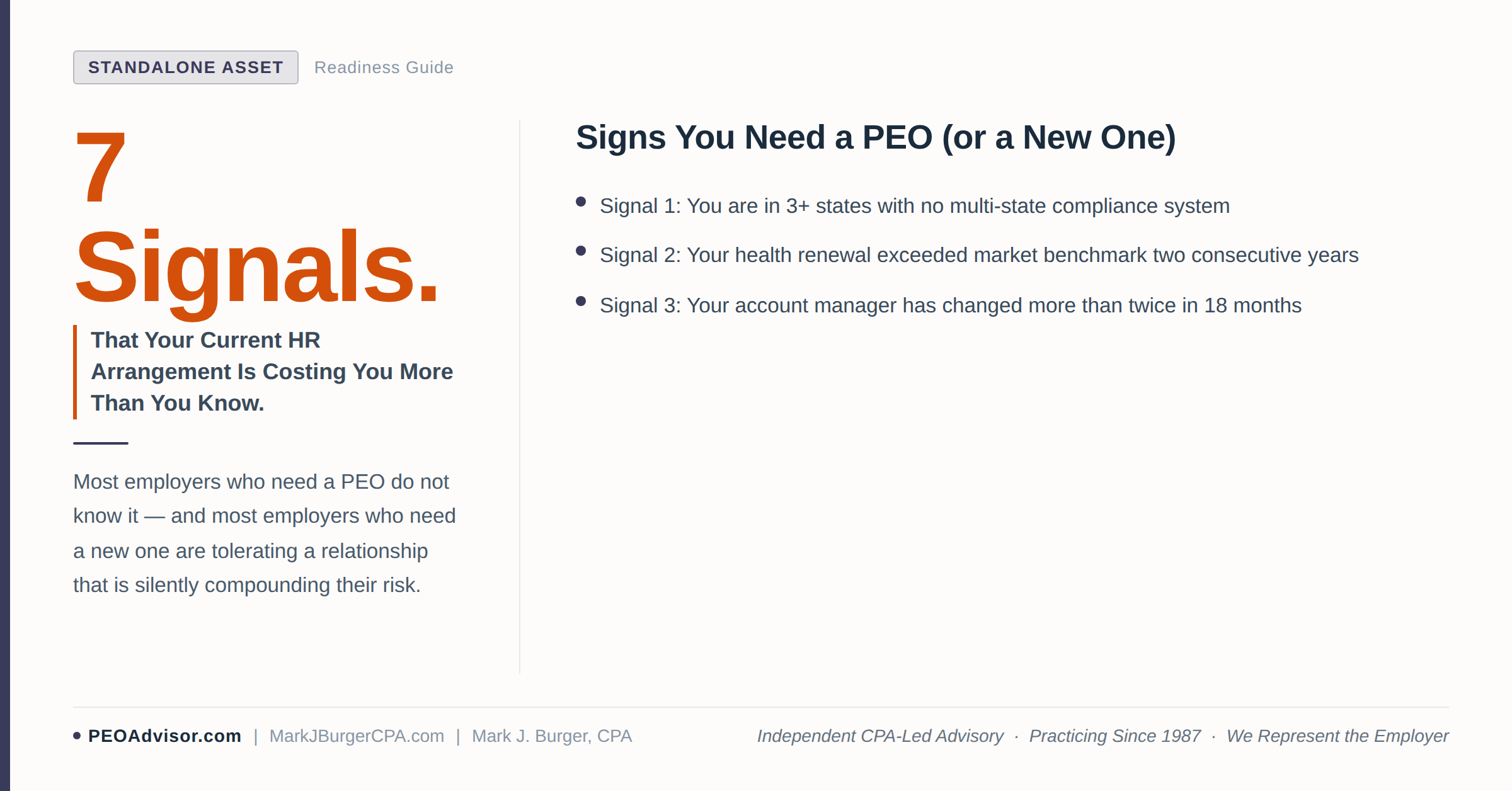
| Signs you are ready for a first PEO | Signs you need a new PEO |
|---|---|
| Leadership spends disproportionate time on HR and payroll | Renewals rise 10–20% with no claims-based justification |
| Benefits cannot compete for talent | Service degrades or there is no dedicated contact |
| Compliance is a growing worry, especially across states | The technology platform lags or creates manual work |
| Turnover is high and retention support is thin | The PEO cannot handle the states you now operate in |
| Growth is outpacing your administrative capacity | Contract terms have become rigid or misaligned with growth |
Signs You Are Ready for a PEO
A handful of recurring situations signal that a PEO would help. Consider a PEO when leadership is spending disproportionate time on HR and payroll; when your benefits cannot compete for talent; when compliance is a growing worry, especially across multiple states; when turnover is high and retention support is thin; or when growth is outpacing your administrative capacity. Time savings is the most cited reason businesses engage a PEO. When several of these appear together, a business is usually ready to evaluate one seriously.
Signs You Need a New PEO
Being on a PEO already does not mean being on the right one. Consider switching when renewals rise 10 to 20 percent without a claims-based justification; when service degrades or your account has no dedicated contact; when the technology platform lags or creates manual work; when the PEO cannot handle the states you now operate in; or when contract terms have become rigid or misaligned with your growth. One issue may be fixable; several together signal a relationship that has expired — see the five red flags in a PEO agreement for a closer look at what a bad relationship looks like in the contract itself.
Counting the Signs: A Worked Example
Worked example (illustrative). A company paying a $60,000 annual administrative fee receives an 18 percent renewal increase with no claims-based justification — about $10,800 more a year for the same service. That alone is one sign, and it might be negotiable. But suppose the account also lost its dedicated service contact this year, and the platform still requires manual reconciliation every pay period. That is three signs at once: cost, service, and technology. A single sign is a negotiation; three converging signs are a market check. The dollar figure quantifies one sign; the count tells you which conversation to have. Figures are illustrative.
| Not sure how many signs apply to you? Download our PEO Readiness & Relationship-Health Checklist — score both decisions on one page — through a no-cost PEO Advisor assessment. Start the PEO Readiness & Relationship-Health assessment |
Fixable Issue vs. Real Mismatch
Distinguish a single problem from a pattern. A lone steep renewal or service lapse may respond to direct pushback — request the medical loss ratio, negotiate a cap, ask for credits; knowing whether your PEO’s health plan is actually costing you more than it should is the first step. A cluster of signs, especially cost, service, technology, and multi-state gaps together, indicates a structural mismatch that negotiation will not resolve. Counting how many signs apply converts a vague dissatisfaction into a clear, defensible decision.
Case in Point
Case in point (illustrative). A 40-person company had been on the same PEO since it had 15 employees. The relationship still worked administratively, so no one questioned it — until a renewal arrived up 16 percent, the platform still could not produce the multi-state reporting the company now needed, and the service contact it had known was gone. Counting the signs, leadership realized this was not one bad year but a relationship that had been outgrown. A quiet market check ahead of renewal produced a better-fitting provider at a lower all-in cost. This scenario is illustrative and does not describe an identifiable client; it shows how a relationship that fit at 15 employees can quietly stop fitting at 40.

What to Do Next: A Step-by-Step
- Count your signs. Mark how many apply in each column of the checklist above.
- Model your baseline. If you are ready for a first PEO, compute your true, fully loaded current HR cost.
- Score the relationship. If you may need a new PEO, rate cost, service, technology, and multi-state fit.
- Attempt pushback on fixable issues. For a lone renewal or service lapse, request the medical loss ratio, a rate cap, and credits.
- Run a quiet market check. If a pattern exists, begin comparing providers ahead of your renewal, on your timing.
- Evaluate independently. Decide on cost, service, benefits, and fit through a review with no stake in the outcome — PEO Company’s walkthrough of evaluating a PEO through a five-step selection process is a useful model for structuring that review.
Wondering whether it is time for a PEO, or a new one? Request a no-cost readiness and relationship review from Mark J. Burger, CPA.
The renewal-increase range (10 to 20 percent) and the PEO sweet spot (roughly 10 to 150 employees) cited in this article reflect general PEO market patterns. The worked example and the 40-person case in point are illustrative and do not describe an identifiable client. This content is educational, not legal or tax advice.
Frequently Asked Questions
How do I know if my business needs a PEO?
You likely need a PEO when leadership spends disproportionate time on HR and payroll, your benefits cannot compete for talent, compliance is a growing worry (especially across states), turnover is high with thin retention support, or growth is outpacing your administrative capacity. Time savings is the most cited reason businesses engage a PEO. Several signs together indicate readiness to evaluate one.
What are the signs I need to switch PEOs?
Consider switching when renewals rise 10 to 20 percent without claims justification, service degrades or lacks a dedicated contact, the technology lags or creates manual work, the PEO cannot handle your current states, or contract terms have become rigid or misaligned with growth. One issue may be fixable; several together signal a relationship that has expired and warrants a market check.
Can I fix problems with my current PEO instead of switching?
Sometimes. A single steep renewal or service lapse may respond to pushback – requesting the medical loss ratio, negotiating a rate cap, and asking for credits. But a cluster of signs across cost, service, technology, and multi-state capability indicates a structural mismatch negotiation will not fix. Count the signs to distinguish a fixable issue from a real mismatch.
Is my business too small for a PEO?
Probably not. The PEO sweet spot is roughly 10 to 150 employees, and smaller businesses often gain the most because they feel benefits and compliance pressure acutely and lack the scale to solve it alone. Very small employers may hit plan participation minimums, but PEOs are fundamentally a small-and-mid-sized-business solution, not a large-company one.
How often should I re-evaluate my PEO?
Re-evaluate at every renewal and whenever your size, structure, or state footprint changes materially. Scoring the relationship against concrete signs each year keeps the decision current and ensures a switch, if warranted, is driven by evidence and timing you control rather than a renewal deadline. A relationship that fit at 20 employees may not fit at 120.
What is the first step to getting a PEO?
Model your true, fully loaded current HR cost and identify your specific gaps – benefits, compliance, capacity, or multi-state. Then compare the all-in cost and value of a PEO against that baseline, ideally through an independent evaluation that weighs providers on your actual needs. Starting from your own numbers ensures the decision is grounded, not driven by a sales pitch.


