
Executive Summary
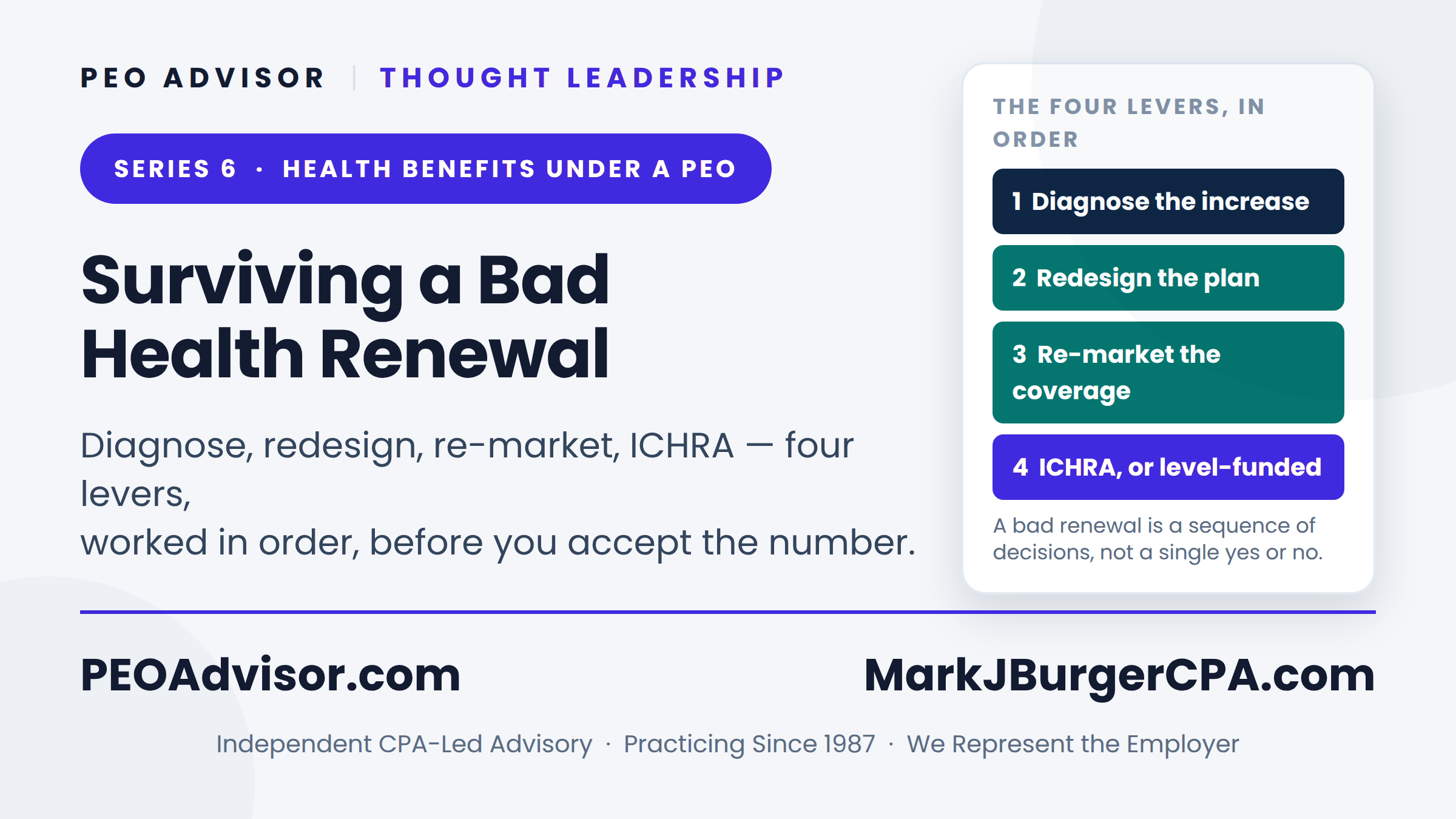
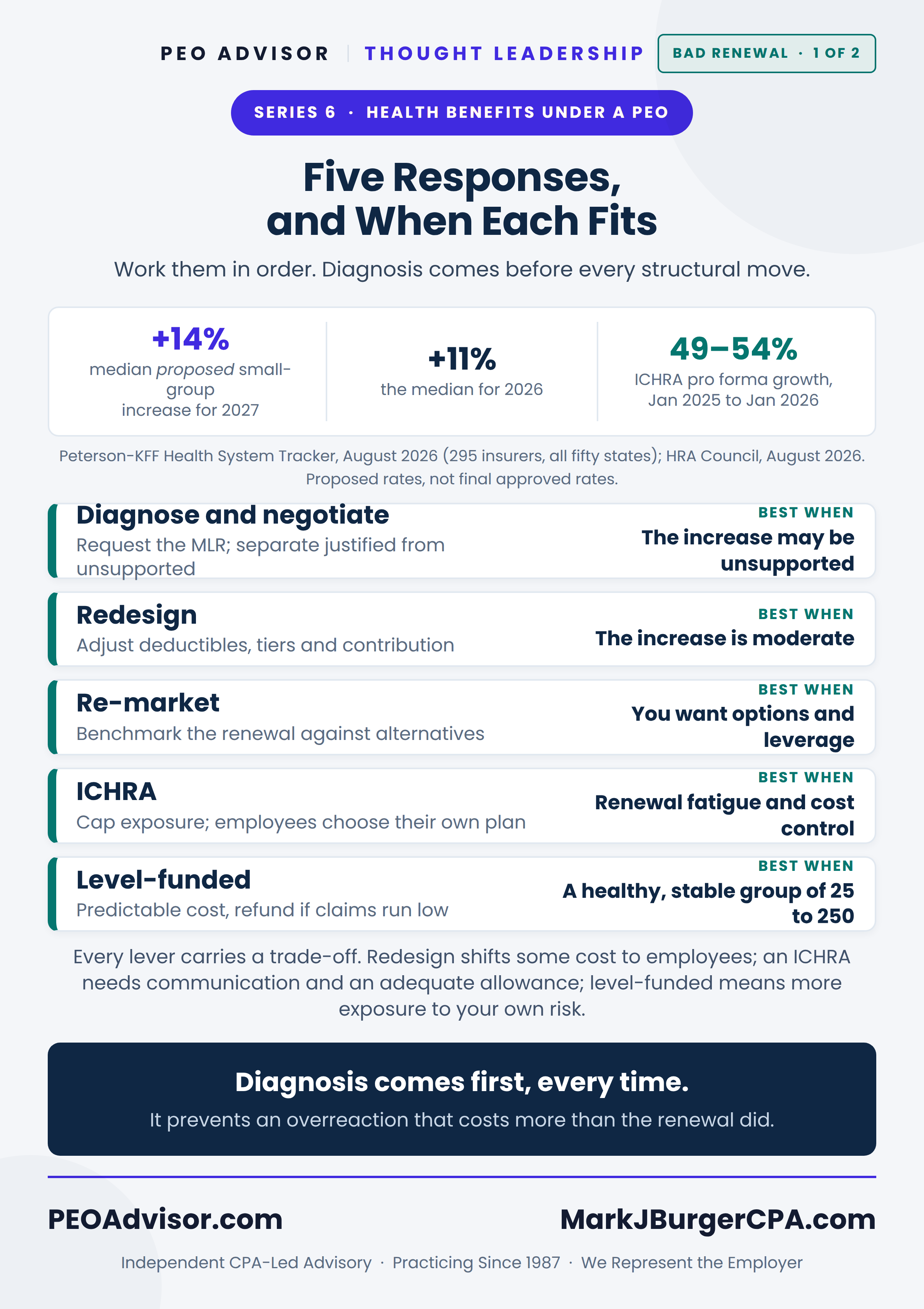
When a health renewal spikes, you have more options than accept or panic. You can redesign the plan to blunt the increase. You can re-market to test the master plan against alternatives. Or you can move to an ICHRA and let employees buy individual coverage on a defined employer contribution. Small-group insurers have filed a median proposed increase of 14 percent for 2027, up from 11 percent for 2026. Some regions run far higher. With healthier groups leaving the insured pool, the response you choose shapes next year’s cost and your exposure to adverse selection.
What Actually Drove the Increase?
Before you react, understand what actually drove the number. A steep renewal can come from your group’s own claims, from the broader pool, from the medical trend, or from the PEO’s margin. Request the medical loss ratio and claims experience — the renewal series in this library covers exactly how — and separate a justified increase from an unsupported one. If your group’s claims do not support the number, the first move may be negotiation rather than a structural change. Diagnosis prevents an overreaction that costs more than the renewal did.
| Response lever | What it does | Best when | Trade-off |
|---|---|---|---|
| Diagnose & negotiate | Request MLR; separate justified from unsupported | The increase may be unsupported | May not be enough alone |
| Redesign | Adjust deductibles, tiers, contribution | A moderate increase | Shifts some cost to employees |
| Re-market | Benchmark against alternatives | You want options and leverage | Effort; a transition if you move |
| ICHRA | Cap exposure; employees choose their plan | Renewal fatigue; cost control | Needs communication and an adequate allowance |
| Level-funded | Predictable cost with a refund if claims are low | Healthy, stable group of ~25–250 | More exposure to your own risk |
Can Redesigning the Plan Absorb the Increase?
Often the fastest relief comes from changing the plan, not the carrier. Adjusting deductibles, copays and plan tiers can absorb a meaningful part of an increase while preserving coverage. So can revisiting the employer contribution strategy. Offering a leaner base plan alongside richer buy-up options lets employees choose their own trade-off between premium and out-of-pocket cost. Redesign is the least disruptive lever, because it keeps your carrier and network intact while resetting the cost curve. For a moderate increase it is frequently enough on its own.
Should You Re-Market the Coverage?
Test the renewal against the market before you accept it. Re-marketing means putting your group in front of alternatives — a different master plan, a level-funded arrangement, or the open market — to see whether the renewal is competitive. As the renewal series explains, a market check run quietly and on the right timeline gives you both better options and leverage with your incumbent. Re-marketing does not commit you to move; it converts a take-it-or-leave-it renewal into a benchmarked decision.
What Do the Levers Save in Sequence? A Worked Example
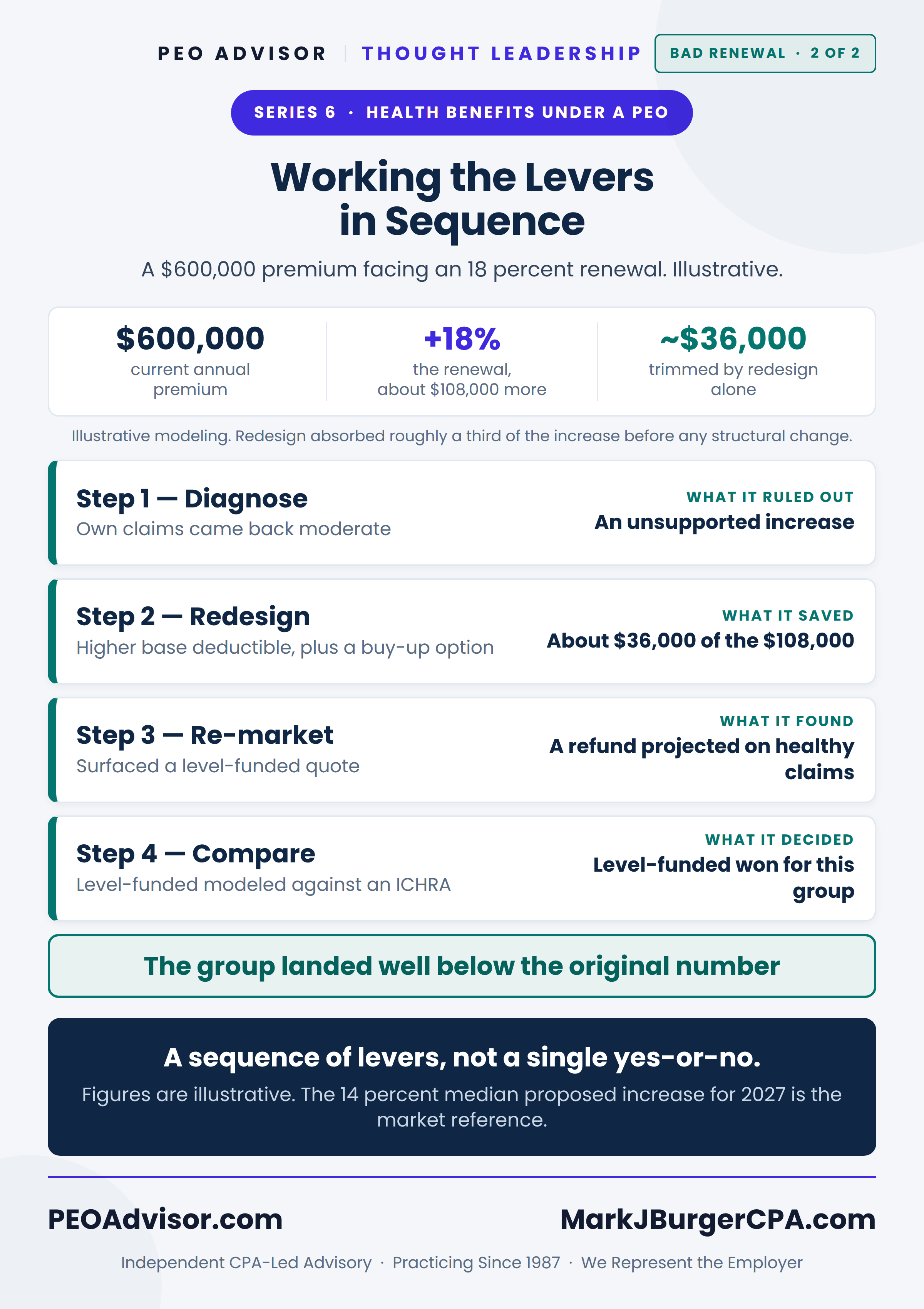
A group faces a renewal 18 percent above its current $600,000 premium — about $108,000 more. Diagnosis shows the group’s own claims are moderate, so it starts with redesign. Raising the base-plan deductible and adding a buy-up option trims roughly a third of the increase, about $36,000.
Re-marketing then surfaces a level-funded quote its healthy claims history makes attractive, projecting a refund if claims stay low. Modeled against an ICHRA at a fixed allowance, the level-funded route wins for this group. The bad renewal became a sequence of levers rather than a single yes-or-no, and the group landed well below the original number.
The figures are illustrative. The 14 percent median proposed increase for 2027 is the market reference, from the Peterson-KFF Health System Tracker’s August 2026 analysis of filings from 295 insurers across all fifty states.
Is an ICHRA the Escape Hatch?
An ICHRA converts an unpredictable renewal into a budget you control. Set a defined monthly allowance and let employees buy their own individual-market coverage. That caps the employer’s exposure to the group renewal entirely. The HRA Council’s August 2026 report puts pro forma ICHRA growth at roughly 49 to 54 percent for January 2025 to January 2026, driven by renewal fatigue. Part 1 of this series compares the ICHRA with master plans and level-funded coverage.
It shifts plan selection to employees. It requires clear communication and a genuinely adequate allowance. For an employer tired of absorbing double-digit increases, it changes the question from “how much will the renewal be” to “how much do we choose to contribute.”
Is Level-Funded the Middle Path?
For a healthy group, level-funded can capture the reward of good claims. If your group runs healthy, a level-funded plan offers predictable monthly cost with a refund when claims come in below projection. It also gives claims-data transparency to inform future decisions. It sits between the fully insured master plan and a full self-funded arrangement. It can be the right answer for a stable group of roughly 25 to 250 employees that is effectively subsidizing a sicker pool. The trade-off is more visibility into, and responsibility for, your own risk. Getting there still runs through the underwriting gauntlet, so prepare your data first.
How Does Adverse Selection Change Your Timing?
Your timing decision interacts with everyone else’s. As healthier groups leave the fully insured pool for level-funded, self-funded and ICHRA options, the remaining pool grows sicker and pricier. That pushes next year’s renewals higher still. A healthy group that stays fully insured indefinitely can find itself subsidizing the drift. This is not a reason to move recklessly. It is a reason to evaluate your structure proactively rather than only when a renewal forces the question.
Case in Point
An employer had absorbed double-digit health renewals three years running, each time simply accepting the number and passing part of it to employees. Facing a fourth, it finally treated the renewal as a decision. It diagnosed the increase and found moderate own-claims. It tried redesign, which helped but was not enough. Then it re-marketed.
Worn out by the annual uncertainty, it moved to an ICHRA with a genuinely adequate allowance, capping its exposure to a budget it set rather than a renewal it received. Employees gained plan choice and the employer gained a predictable number. This scenario is illustrative and does not describe an identifiable employer. It shows how the levers can end in a structural change when the pattern, not one year, is the problem.

How Do You Decide? A Step-by-Step Framework
- Diagnose the increase: request the medical loss ratio and separate justified from unsupported.
- Try redesign first: deductibles, tiers, and contribution strategy for the least disruption.
- Re-market to benchmark the renewal and gain leverage with the incumbent.
- Model an ICHRA if you want to cap exposure and shift plan choice to employees.
- Consider level-funded if your group is healthy and wants refund potential.
- Weigh adverse selection: evaluate your structure proactively, not only under renewal pressure.
Facing a renewal that does not work?
Have Mark J. Burger, CPA run the four response options against your groupFrequently Asked Questions
What are my options when a health renewal is too high?
You have four main levers: diagnose the increase and negotiate if it is unsupported, redesign the plan through deductibles, tiers, and contribution strategy, re-market the coverage against alternatives, or move to an ICHRA to cap exposure. A level-funded plan can also be a middle path for a healthy group. Work them in order, starting with diagnosis, before accepting or overreacting.
Can plan redesign lower a health renewal?
Often, yes. Adjusting deductibles, copays, and plan tiers, or revisiting the employer contribution strategy, can absorb a meaningful part of an increase while preserving coverage. Offering a leaner base plan with richer buy-up options lets employees choose their own premium-versus-out-of-pocket trade-off. Redesign keeps your carrier and network intact and is often enough for a moderate increase.
Is an ICHRA a good response to a bad renewal?
It can be. An ICHRA sets a defined employer allowance and lets employees buy individual-market coverage, capping the employer’s exposure to the group renewal. The HRA Council puts pro forma adoption growth at roughly 49 to 54 percent for January 2025 to January 2026, largely due to renewal fatigue. It requires clear communication and an adequate allowance, but it changes the question from what the renewal will be to what you choose to contribute.
When does a level-funded plan make sense?
A level-funded plan suits a healthy, stable group of roughly 25 to 250 employees that wants predictable monthly cost, refund potential when claims run low, and claims-data transparency. It fits groups that feel they are subsidizing a sicker pool under community-style pricing. The trade-off is accepting more visibility into, and responsibility for, the group’s own claims risk.
What is adverse selection in health insurance?
Adverse selection is the drift that occurs when healthier groups leave the fully insured pool for level-funded, self-funded or ICHRA options. A sicker, costlier pool is left behind, and renewals push higher. A healthy group that stays fully insured indefinitely can end up subsidizing that drift. That is why evaluating your structure proactively matters, rather than only under renewal pressure.
Should I negotiate before changing my health plan structure?
Yes. Diagnose the increase first by requesting the medical loss ratio and claims experience. If your group’s claims do not support the renewal, negotiation may resolve it without a disruptive structural change. Changing carriers or moving to an ICHRA is a larger step; confirm it is necessary before taking it, since an overreaction can cost more than the renewal itself.