
Executive Summary
Law firms, accounting and advisory practices, fintech and financial-services companies, and other professional businesses compete for high-wage talent, where benefits and retention matter far more than physical risk. For these employers, a PEO delivers competitive large-group benefits, a modern employee experience, and light-touch compliance across the many states where knowledge workers now sit. According to the National Association of Professional Employer Organizations (NAPEO), roughly 523,000 businesses now use a PEO, and per-employee-per-month pricing usually fits a high-wage base better than percentage of payroll. The right match is about benefits depth and technology, not workers’ compensation.
What Does a PEO Offer a Professional or Financial-Services Firm?
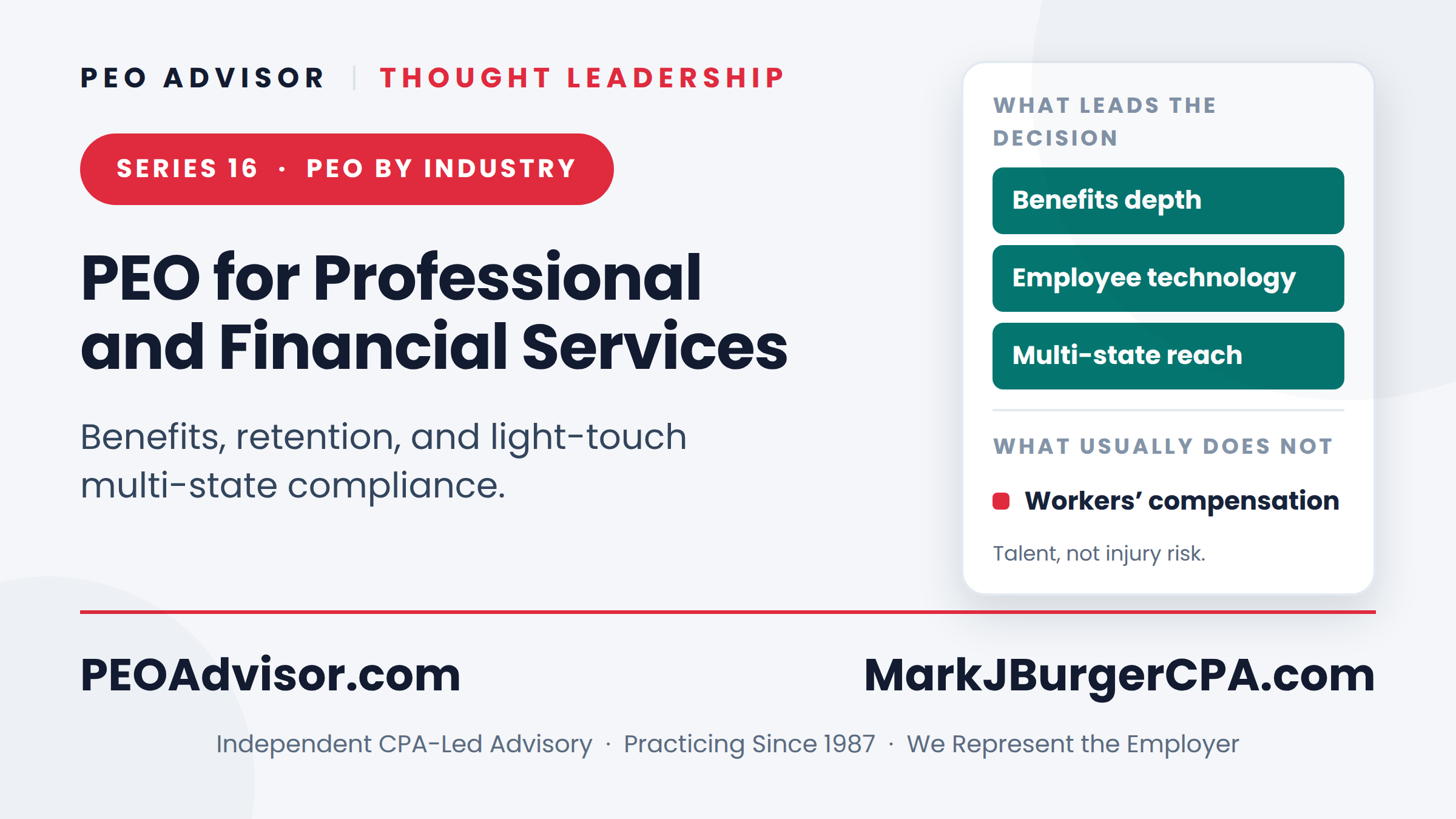
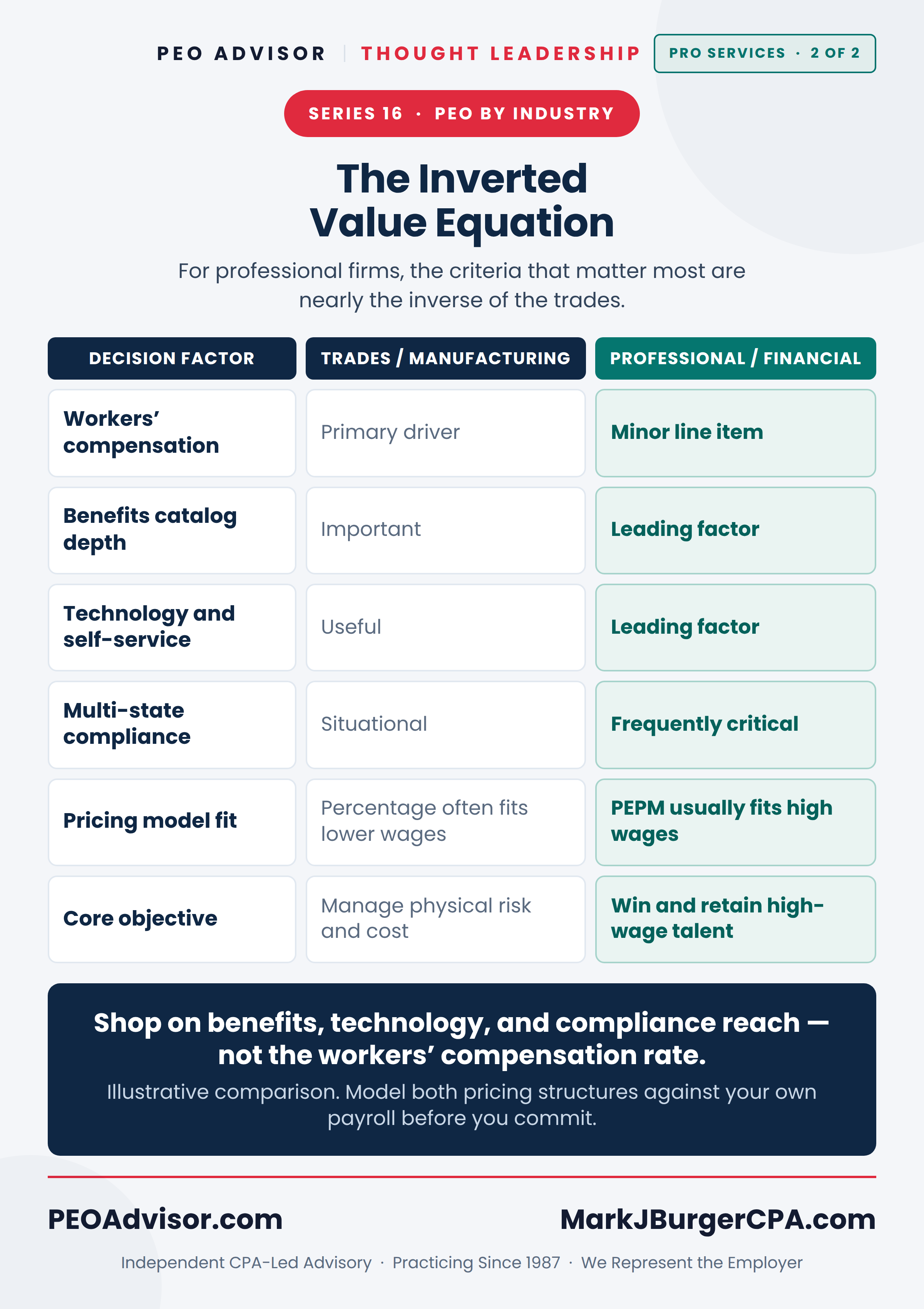
For knowledge-work firms, the PEO case is talent, not injury risk. Professional and financial-services businesses carry low workers’ compensation exposure but intense competition for skilled, high-wage people. Their PEO value comes from benefits that rival large employers, a polished employee experience, and compliance handled quietly in the background. The decision criteria are almost the inverse of the trades: benefits depth, technology, and service quality lead, while workers’ compensation becomes a minor line item. A firm that evaluates a PEO the way a manufacturer would, starting with the workers’ compensation program, is optimizing for the wrong variable. Read this alongside the companion analysis on choosing a PEO for skilled trades and manufacturing, where the priorities invert.
Benefits That Compete for Talent
Access to large-group benefits is the single most powerful recruiting and retention lever available to a smaller professional firm. A boutique practice competing against national players can, through a PEO’s pooled purchasing, offer health, retirement, and voluntary benefits comparable to much larger organizations. For high-earning professionals who evaluate employers partly on the quality of their benefits, that parity matters. NAPEO research places the average return on a PEO relationship near 27 percent in cost savings, driven by consolidated purchasing across HR administration, health benefits, workers’ compensation, and unemployment insurance. Ask a prospective PEO about the depth and modernity of its benefits catalog, and read our analysis of how to tell whether a PEO health plan is costing you more than it should before you compare proposals.
Which PEO Pricing Model Fits a High-Wage Firm?
At professional wage levels, the pricing model is a material decision, not a billing formality. Because a percentage-of-payroll fee is charged against gross wages, it rises with every raise, bonus, and commission a firm pays. A per-employee-per-month fee, commonly written as PEPM, holds flat and tracks headcount instead. In 2026, competitive full-service PEO administrative fees generally run 3 to 6 percent of payroll, or roughly $90 to $165 per employee per month, according to current market pricing data. At six-figure average compensation, those two structures diverge sharply.
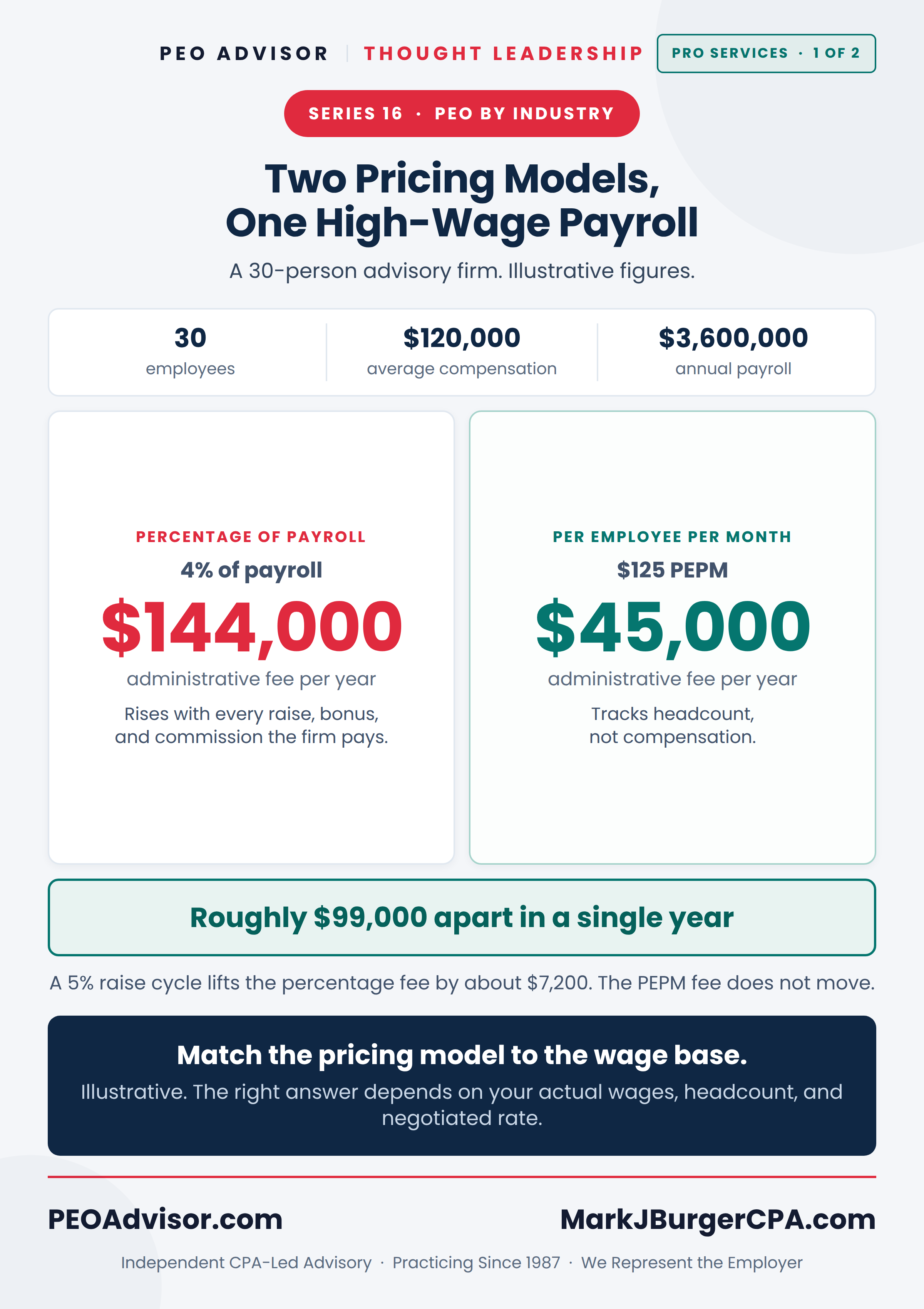
Worked example (illustrative). Consider a 30-person advisory firm with an average total compensation of $120,000, for an annual payroll of $3,600,000. Under a 4 percent percentage-of-payroll model, the administrative fee is $144,000 a year. Under a $125 PEPM model, the fee is $125 multiplied by 30 employees across 12 months, or $45,000 a year. The two structures describe the same services and the same PEO, yet they stand roughly $99,000 apart in a single year. Every raise the firm grants widens the gap under the percentage model, because the fee rises with the payroll it is charged against. Figures here are illustrative; the right answer depends on the firm’s actual wages, headcount, and negotiated rate.
| 30-person advisory firm | Percentage of payroll (4%) | Per-employee-per-month ($125) |
|---|---|---|
| Average compensation | $120,000 | $120,000 |
| Annual payroll | $3,600,000 | $3,600,000 |
| Annual administrative fee | $144,000 / yr | $45,000 / yr |
| Effect of a 5% raise cycle | Fee rises ~$7,200 | Fee unchanged |
| Advantage | — | PEPM saves ~$99,000/yr |
The lesson is not that PEPM is always cheaper. It is that the model must be matched to the wage base. A firm paying $120,000 average compensation usually fares better on PEPM, decoupling its administrative cost from its compensation strategy. Confirm which model a proposal uses, and model both against your actual payroll; the break-even math is worked in detail in our analysis of percentage of payroll versus per-employee-per-month pricing.
Case in Point
Case in point (illustrative). A 40-person registered investment advisory firm engaged a PEO under a percentage-of-payroll model when it was younger and its average compensation was modest. Over four years it added senior advisors and portfolio managers and granted steady raises; average compensation climbed past $130,000, and the percentage fee climbed with it, quietly adding tens of thousands of dollars a year that no one had re-quoted. At renewal the firm modeled a per-employee-per-month structure against its now higher-wage payroll, found it saved roughly $90,000 a year, and converted. Nothing about the PEO’s service had changed; only the pricing model was wrong for the firm the practice had become. This scenario is illustrative and does not describe an identifiable client.
| Not sure which pricing model fits your firm? Get the Professional-Services PEO Fit Guide — benefits depth, technology, and pricing-model checklist — through a no-cost PEO Advisor assessment. Start the Professional-Services PEO Fit Guide assessment |
Do Professional Firms Need Multi-State Compliance Help?
Knowledge workers are distributed, so compliance must travel with them. Professional and financial-services firms increasingly employ people across many states, which brings multi-state payroll, registration, and employment-law obligations even without any physical operations in those states. A single remote hire in a new state can create tax registration, paid-leave, and wage-notice requirements the firm did not previously carry. A PEO suited to these firms handles that quietly and accurately, so a growing, distributed team does not become a compliance liability. Our 2026 multi-state PEO compliance guide details the jurisdiction-by-jurisdiction obligations this creates, and PEO Company walks through the same decision from a practitioner’s seat in its analysis of a multi-state law firm weighing a PEO partnership.
The 2026 Market Context
The PEO industry has moved from niche to mainstream, which strengthens a professional firm’s negotiating position. According to NAPEO, roughly 523,000 businesses now use a PEO, an increase of about 8 percent year over year, in an industry generating an estimated $414 billion in revenue. That scale is what allows a pooled benefits program to rival a large employer’s. It also interacts with the pricing question. Because a percentage fee is applied to gross wages, and because the 2026 Social Security wage base rose to $184,500 from $176,100 in 2025, per the Social Security Administration, a high-earner workforce concentrates both employer tax and percentage-based fee exposure in the same compensation bands. For a high-wage firm, that is one more reason to scrutinize the pricing model rather than the headline rate.

What to Evaluate: The Inverted Value Equation
| Decision factor | Trades / manufacturing PEO | Professional / financial-services PEO |
|---|---|---|
| Workers’ compensation | Primary driver | Minor line item |
| Benefits catalog depth | Important | Leading factor |
| Technology and self-service | Useful | Leading factor |
| Multi-state compliance | Situational | Frequently critical |
| Pricing model fit | Percentage often fits lower wages | PEPM usually fits high wages |
| Core objective | Manage physical risk and cost | Win and retain high-wage talent |
How to Evaluate a PEO for a Professional or Financial-Services Firm: A Step-by-Step
- Rank benefits first. Compare each PEO on the depth and modernity of its health, retirement, and voluntary benefits catalog, since that is your primary talent lever.
- Test the employee experience. Review the technology, mobile self-service, and onboarding flow your professionals will actually use.
- Map your state footprint. List every state where you employ people and confirm the PEO can manage payroll, registration, and employment-law obligations in each.
- Confirm the pricing model. Determine whether each proposal is percentage of payroll or PEPM, and request the fee in both formats.
- Model both against your payroll. Run each structure against trailing-twelve-month payroll and a 24-month compensation forecast to find your true cost.
- Weigh service and term. A modest saving is not worth a long lock on poor service; read the term and exit language before you sign.
The firms that achieve the strongest PEO outcomes do not shop on the workers’ compensation rate that dominates the trades. They shop on benefits, employee experience, compliance reach, and a pricing model matched to high wages, and they model that model against a forecast before they commit.
Run a professional or financial-services firm? Book Your PEO Strategy Call with Mark J. Burger, CPA for a complimentary fit analysis matched on benefits depth, technology, and pricing-model fit.
NAPEO industry data (roughly 523,000 businesses using a PEO, up about 8 percent year over year; a $414 billion industry; approximately 27 percent average cost savings) and the 2026 Social Security wage base of $184,500, up from $176,100, per the Social Security Administration, are real and attributed. The 30-person advisory-firm pricing example, the inverted value-equation comparison, and the case in point are illustrative and do not describe an identifiable client. Mark J. Burger, CPA, advises small and mid-sized businesses on strategic workforce and co-employment decisions through GuidePoint PEO LLC, practicing since 1987. This content is educational, not legal, tax, or insurance advice.
Frequently Asked Questions
What does a PEO offer professional-services firms?
For law, accounting, advisory, and fintech firms, a PEO offers competitive large-group benefits, a modern employee experience, and light-touch multi-state compliance, the levers that win and keep high-wage talent. Workers’ compensation, central for the trades, is a minor factor here. The decision turns on benefits depth, technology, service quality, and a pricing model suited to professional wage levels.
Which PEO pricing model is best for high-wage firms?
Per-employee-per-month usually fits high-wage professional firms better than percentage of payroll, because a percentage fee rises with every raise and bonus while a fixed per-head fee does not. A firm with high average compensation can pay materially more under a percentage model. Confirm which model a proposal uses, and model both against your actual payroll before deciding.
Can a small firm offer big-company benefits through a PEO?
Yes. Through a PEO’s pooled purchasing, a boutique firm can offer health, retirement, and voluntary benefits comparable to much larger organizations. For high-earning professionals who weigh employers partly on benefits, that parity is a real recruiting and retention advantage. Ask a prospective PEO about the depth and modernity of its benefits catalog before comparing proposals.
Do professional firms need multi-state compliance help?
Increasingly, yes. Knowledge-work firms employ people across many states even without physical operations, creating multi-state payroll, registration, and employment-law obligations. A PEO suited to these firms handles that quietly and accurately, so a growing distributed team does not become a compliance liability. Confirm the provider can manage your actual state footprint without friction.
Is workers’ compensation important for professional-services PEO selection?
It is a minor factor. Professional and financial-services firms carry low workers’ compensation exposure, so selection should focus on benefits depth, technology, service quality, multi-state capability, and pricing-model fit. This is nearly the inverse of the trades and manufacturing, where workers’ compensation dominates the decision. Evaluate providers on the criteria that actually drive your outcomes.
How do professional firms choose the right PEO?
Compare providers on benefits catalog depth and modernity, technology and employee self-service, service responsiveness, multi-state capability, and a pricing model suited to high wages, then model that model against your payroll. An independent evaluation weighs these on your firm’s real priorities, which center on winning and retaining talent rather than managing physical risk.


