
Executive Summary
For construction-related skilled trades, manufacturers, and staffing-heavy operations, workers’ compensation risk and multi-state crews dominate the HR equation. Because a PEO assumes your workers’ compensation exposure, your class codes and experience modifier decide which providers will even quote the business and at what cost. Mainstream PEOs frequently decline high-hazard classifications and elevated modifiers, but a specialty market exists precisely for hard-to-place trades. NAPEO research places the average return on a PEO relationship near 27 percent in cost savings, and for physical industries the right workers’ compensation structure and safety program is where that saving is won.
Why Industry Drives the Fit in Skilled Trades and Manufacturing
Workers’ compensation risk, set by your trade, is the deciding factor. Because a PEO takes on your workers’ compensation exposure, your class codes and experience modifier heavily influence which providers will quote you and at what price. Physical trades — construction, fabrication, installation, and staffing — carry greater injury exposure, and mainstream PEOs frequently decline high-hazard classes or elevated modifiers.
Being turned down does not mean you are uninsurable. It means you are shopping the wrong segment of the market — the same distinction our guide to identifying quality PEO providers and true strategic partners makes for any specialized risk. The distinction matters because a string of declines from generalist providers can convince an owner that no PEO will help, when in fact a different segment of the market underwrites exactly this risk every day.
What Workers’ Compensation Structures Do PEOs Offer for Manufacturing and Skilled Trades?
A specialty market exists precisely for hard-to-place trades. PEOs and programs that focus on difficult workers’ compensation accounts will consider risks that generalists reject, and they offer structures that can align cost with your own claims experience rather than with an industry average. For a manufacturer or contractor with a meaningful modifier, the structure is part of the fit, and a specialist will discuss which one suits your risk instead of offering a single option. PEO Company documents this same discipline for a related physical trade in its analysis of partnering with a PEO in the windows and doors industry, from metal fabrication through light manufacturing.
| Structure | How it works | Typical fit |
|---|---|---|
| Guaranteed cost | Fixed premium; the carrier keeps the underwriting result | Smaller or newer accounts with limited claims data |
| Large-deductible | Employer funds claims up to a deductible; lower fixed premium | Established accounts confident in their safety record |
| Administrative-services-only (ASO) | Employer self-funds claims and pays for administration only | Larger, low-frequency accounts with strong cash reserves |
| Captive | Group-owned insurer; members share underwriting profit | Mature accounts with disciplined loss control |
The Math That Moves Your Premium
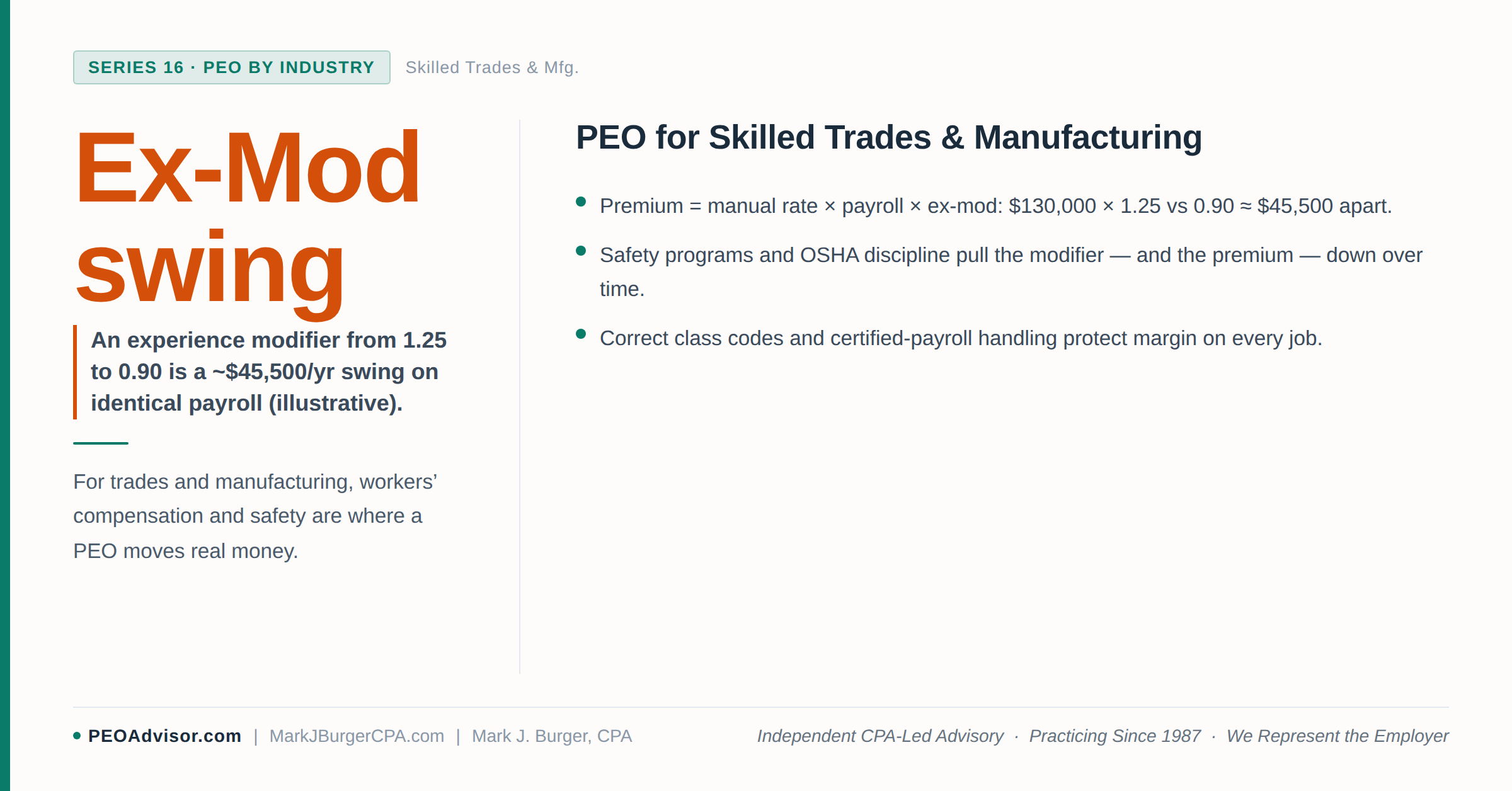
The experience modifier is the multiplier that adjusts your workers’ compensation premium up or down based on your claims history relative to peers. Under the National Council on Compensation Insurance (NCCI) rating method used in most states, a modifier of 1.00 is the industry-average baseline; above 1.00 raises cost, and below 1.00 lowers it. For high-hazard trades, that single factor can swing the premium by tens of thousands of dollars on identical payroll.
Worked example (illustrative). Consider a metal-fabrication shop with $2,000,000 in payroll in a single governing class code, at an illustrative manual rate of $6.50 per $100 of payroll. The manual premium is ($2,000,000 ÷ 100) × $6.50 = $130,000. The experience modifier is then applied to that manual premium.
| Metal-fabrication shop ($2,000,000 class-code payroll) | High modifier (1.25) | Improved modifier (0.90) |
|---|---|---|
| Manual premium (payroll ÷ 100 × $6.50 rate) | $130,000 | $130,000 |
| Experience modifier applied | × 1.25 | × 0.90 |
| Annual workers’ compensation premium | $162,500 | $117,000 |
| Swing on identical payroll | — | Saves ~$45,500 / yr |
What this means for you: the modifier is not fixed. A specialty PEO that places the account correctly and then drives the safety and claims-management work can move a 1.25 toward 1.00 and below over successive rating periods. On this illustrative payroll, each 0.10 of modifier improvement is worth about $13,000 a year. The figures depend on your own facts, but the mechanism is the same in every physical trade: the modifier is the lever, and it is a lever you can move.
How Does a PEO Handle Multi-State Crews?
Crews that cross state lines multiply payroll and compliance complexity. Contractors and manufacturers with projects or facilities in more than one state face different unemployment rates, wage bases, and rules in each — and some states require each co-employer to be underwritten individually so its own modifier applies. Prevailing-wage obligations on public works, whether federal Davis-Bacon or a state equivalent, add certified-payroll reporting on top of the ordinary payroll run. Our 2026 multi-state PEO compliance guide walks through the broader jurisdiction-by-jurisdiction obligations this compounds.
A PEO equipped for multi-state trades coordinates this rather than treating every state the same. The practical point is that your provider must handle your actual project footprint, not just its home market. Ask a prospective PEO to name the states where it is registered, how it manages certified payroll, and how it applies your modifier when work moves across state lines.
Can a PEO Lower My Workers’ Compensation Cost Through Safety?
Safety is not only compliance; it is the lever on your workers’ compensation cost. A strong PEO brings safety and risk-management programs — job-site audits, OSHA-aligned training, return-to-work protocols, and active claims management — that reduce injuries and, over time, improve the experience modifier that drives your premium. For physical industries this is a direct financial benefit, not an administrative extra: fewer claims mean a lower modifier, and a lower modifier means lower cost.
Ask a prospective PEO what safety, training, and claims-management support it provides for your specific trade, and how it has moved modifiers for comparable clients. A provider that cannot describe its loss-control process in concrete terms is selling administration, not risk reduction.

Case in Point
Case in point (illustrative). A 60-employee structural-steel fabricator had been declined by two mainstream PEOs and carried an experience modifier near 1.30 after a run of avoidable claims. Working through the specialty market, it was placed on a large-deductible structure and enrolled in the PEO’s job-site safety and return-to-work program. Over two rating periods the modifier fell toward 1.00 as frequency dropped, and the company modeled the total workers’ compensation cost — structure, deductible funding, and experience-rating credits — rather than the headline rate alone. The account moved from decline-prone to placed and cost-controlled. This scenario is illustrative and does not describe an identifiable client.
| Not sure where you stand? Download our Trades & Manufacturing PEO Checklist — class codes, modifiers, and multi-state must-haves — through a no-cost PEO Advisor assessment. Start the Trades & Manufacturing PEO Checklist assessment |
How to Place a Trades or Manufacturing Business With the Right PEO: A Step-by-Step
- Know your experience modifier before you shop. It tells you which segment of the PEO market you are in and where safety can help most.
- Pull your governing class codes and loss runs. Gather three to five years so a specialist can rate the account accurately.
- Map your multi-state footprint. List every state of operation, prevailing-wage exposure, and certified-payroll obligation.
- Approach the specialty market, not generalists. Providers that write physical-industry risk will consider classes others decline.
- Compare structures, not just the admin fee. Weigh guaranteed cost, large-deductible, ASO, and captive against your claims profile.
- Model total workers’ compensation cost. Include the structure and any experience-rating credits, not the headline rate alone.
- Weigh the safety and claims-management support. Documented loss control is what moves the modifier, and the modifier is what moves the cost.
For trades and manufacturing, the PEO decision is won on workers’ compensation structure, safety support, and multi-state capability far more than on the administrative fee. That is the analysis that turns a decline-prone account into a placed, cost-controlled one.
In a trade or manufacturing business? Request a complimentary specialty workers’ compensation review from Mark J. Burger, CPA to reach the PEOs that will actually write your risk.
NAPEO industry data (roughly 523,000 businesses using a PEO, up about 8 percent year over year; a $414 billion industry; approximately 27 percent average cost savings) and the NCCI experience-rating method (1.00 baseline modifier) are real and attributed. The metal-fabrication worked example and the case in point are illustrative and do not describe an identifiable client. This content is educational, not legal, tax, or insurance advice.
Frequently Asked Questions
Why do PEOs decline construction and manufacturing businesses?
Because a PEO assumes your workers’ compensation exposure, high-hazard class codes and elevated experience modifiers common in physical trades lead mainstream PEOs to decline the business. A decline signals you are shopping the wrong segment, not that you are uninsurable. Specialty PEOs that focus on difficult workers’ compensation accounts will consider risks generalists reject.
What workers’ compensation structures do PEOs offer for trades?
Specialty PEOs offer guaranteed-cost, large-deductible, administrative-services-only, and captive arrangements, each shifting risk and cost differently. A contractor or manufacturer with a meaningful experience modifier may find a large-deductible or captive structure aligns cost with its own claims better than guaranteed cost. The structure is part of the fit, and a specialist will discuss which suits your risk.
How does a PEO handle multi-state crews?
A PEO equipped for multi-state trades coordinates different unemployment rates, wage bases, and rules across states, and handles the requirement in some states that each co-employer be underwritten individually so its own modifier applies. It also manages prevailing-wage and certified-payroll reporting. The key is choosing a provider that handles your actual project footprint rather than only its home market.
Can a PEO lower my workers’ compensation cost?
Yes, through group purchasing, the right program structure, and safety and risk-management programs that reduce injuries and improve your experience modifier over time. For physical industries, fewer claims mean a lower modifier and lower premium — a direct financial benefit. Ask a prospective PEO what safety support it provides and how it has moved modifiers for comparable clients.
What is an experience modifier and why does it matter?
The experience modifier adjusts workers’ compensation cost based on your claims history relative to peers, with 1.00 as the baseline. A modifier above 1.00 raises cost and can make placement harder even in an acceptable trade. Because it drives premium and eligibility, knowing your modifier before shopping tells you which segment of the PEO market you are in and where a safety program can help most.
Should trades businesses use an independent PEO advisor?
Often, yes, because reaching the specialty market efficiently and comparing workers’ compensation structures is difficult alone. An independent advisor who knows which PEOs write physical-industry risk can avoid a string of declines from generalists and model total workers’ compensation cost across specialists — turning a decline-prone account into a placed, cost-controlled one.


