
Executive Summary
Open enrollment is the natural moment to move to a PEO, because aligning the transition with your benefits cycle avoids coverage gaps and simplifies employee communication. A well-run transition means confirming plan effective dates, gathering census and dependent data early, preparing employees for the new enrollment experience, and — where a mid-year move is unavoidable — protecting wage bases. Timed to open enrollment, a PEO transition upgrades your benefits and HR without disrupting a single employee’s coverage. This guide walks the full sequence.
Why Open Enrollment Is the Right Window
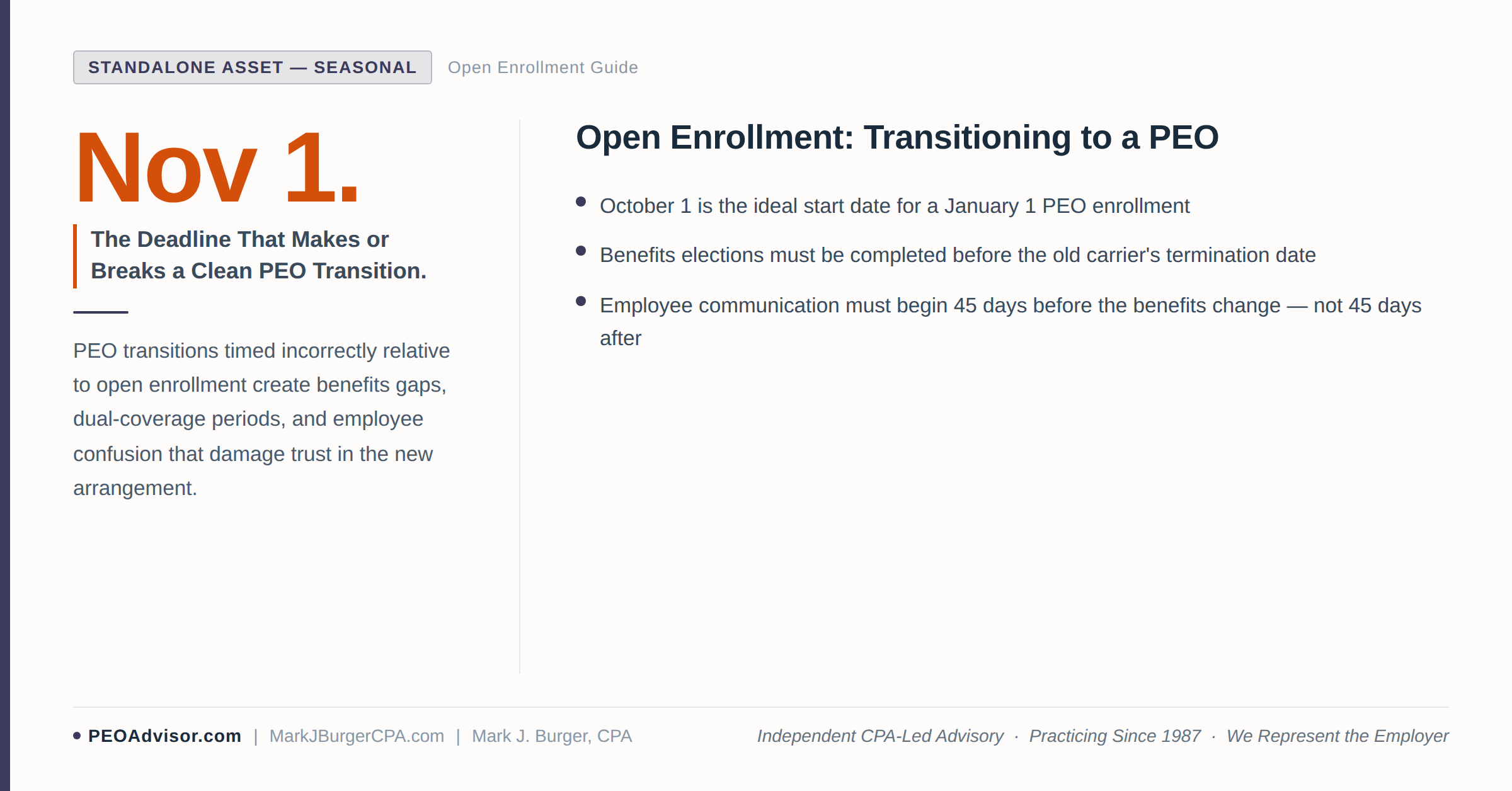
Aligning the move with your benefits cycle removes the two biggest transition risks. Transitioning to a PEO during open enrollment lets new coverage begin exactly as old coverage ends, eliminating the gap that a mid-cycle move risks, and it folds the change into a moment when employees already expect to review and elect benefits. That alignment simplifies both the mechanics and the communication. For most employers, timing a PEO move to open enrollment is the single most effective way to keep the transition clean — PEO Company reaches the same conclusion in its own guide to transitioning to a PEO at open enrollment.
| Timeframe | Action |
|---|---|
| 8–10 weeks out | Gather accurate census and dependent data; confirm the PEO’s required format |
| 6–8 weeks out | Underwriting and quotes; select plans |
| 3–4 weeks out | Employee communication; set up the self-service platform |
| Enrollment window | Employees make elections on the new platform |
| Effective date | New coverage begins as old coverage ends; verify the first payroll |
Prepare the Data Early
Clean census and dependent data is the backbone of a smooth transition. Gather an accurate employee census — ages, ZIP codes, coverage tiers — and dependent data well ahead of the enrollment window, since gaps and errors delay quotes and enrollment. Confirm what the PEO needs and in what format, and note that dependent information sometimes must be requested specifically rather than pulled from a standard report. Early, accurate data is what lets underwriting and enrollment run on schedule — our full PEO integration guide walks through the data migration side of this in more depth.
Communicate the Change to Employees
Employees should experience an upgrade, not an upheaval. Plan clear, timed communication: what is changing, what is improving, how to enroll on the new platform, and where to get help. Because open enrollment is already a benefits moment, employees are primed to engage — use that to introduce the new plans and self-service experience positively. Most of the transition happens behind the scenes; what employees see should be a smooth enrollment and, ideally, better benefits than before.
| Not sure your timeline has enough runway? Download our PEO Open-Enrollment Transition Timeline — a week-by-week checklist — through a no-cost PEO Advisor assessment. Start the Open-Enrollment Transition Timeline assessment |
Protect Coverage and Wage Bases
Sequence effective dates, and mind the tax calendar. Align the PEO’s benefit effective dates so replacement coverage starts the moment prior coverage ends — no gap. If the move happens mid-year rather than at a January boundary, be aware that shifting to the PEO’s employer identification number can restart Social Security and unemployment wage bases unless successor-employer treatment applies — the kind of treatment our guide to identifying quality PEO providers and true strategic partners discusses under CPEO certification. Where possible, a January 1 open-enrollment alignment avoids the reset entirely.
What the Right Timing Is Worth: A Worked Example
Worked example (illustrative). A 30-employee company plans a PEO move and can choose the effective date. Two executives are high earners near the 2026 Social Security cap of $184,500. If the company moves mid-year — say July 1, after each executive has already earned $150,000 — the shift to the PEO’s employer identification number restarts each one’s Social Security base at zero, and without successor-employer treatment the employer is re-taxed on wages it already taxed: roughly 6.2 percent × $150,000 × 2 = $18,600 in duplicated, unrecoverable employer Social Security. Aligning the same move to a January 1 open enrollment eliminates that duplication entirely, because every wage base starts fresh on that date anyway — and the benefit plan year begins cleanly with no coverage gap. Same transition, same PEO; the calendar alone is worth $18,600 here, plus a seamless enrollment. The figures are illustrative and use 2026 values; a Certified PEO carries the bases over even mid-year, so confirm treatment and dates before you commit.

Case in Point
Case in point (illustrative). A company frustrated by a bad renewal rushed onto a PEO in the spring, mid-benefit-cycle. A two-week gap opened between its old plan’s termination and the new plan’s effective date, the mid-year EIN change re-taxed its two highest earners, and employees were confused by an enrollment sprung on them off-cycle. A comparable company waited a few months and aligned the move to its January 1 open enrollment: coverage handed off with no gap, the wage bases reset naturally, and employees absorbed the change during the window they already expected to review benefits. Same decision to switch, far cleaner result — the difference was timing the move to the calendar rather than to a moment of frustration. This scenario is illustrative and does not describe an identifiable company.
The Transition Checklist: A Step-by-Step
- Confirm plan effective dates so new coverage begins as old coverage ends.
- Gather accurate census and dependent data early, in the format the PEO requires.
- Prepare clear employee communication and self-service onboarding for the enrollment window.
- Protect wage-base carryover, favoring a January 1 alignment or a Certified PEO for mid-year moves.
- Verify the first post-transition payroll and enrollment run correctly.
Planning a PEO move around open enrollment? Have Mark J. Burger, CPA sequence a seamless, gap-free transition.
Process guidance and the 2026 Social Security cap ($184,500) reflect current figures; re-verify before relying on them. The 30-employee timing worked example and the rushed-vs-aligned case in point are illustrative and do not describe an identifiable company. This is a seasonal asset intended for refresh each open-enrollment season. Educational, not legal or tax advice.
Frequently Asked Questions
When is the best time to transition to a PEO?
Open enrollment is the natural window, because aligning the move with your benefits cycle lets new coverage begin exactly as old coverage ends and folds the change into a moment employees already expect to review benefits. A January 1 alignment additionally avoids the wage-base reset a mid-year move can trigger, making it the cleanest timing for most employers.
How do I avoid a benefits gap when moving to a PEO?
Align the PEO’s benefit effective dates so replacement coverage starts the moment prior coverage ends. Transitioning during open enrollment makes this natural. Confirm both the termination and new-plan effective dates in writing before initiating the move, and communicate enrollment steps to employees in advance so no one experiences a lapse in coverage.
What data does a PEO need for open enrollment?
An accurate employee census – ages, ZIP codes, coverage tiers – and dependent data, gathered early. Some dependent information must be requested specifically rather than pulled from a standard report. Clean, complete data prevents delays in underwriting and enrollment, so confirm what the PEO needs and in what format well ahead of the enrollment window.
Does moving to a PEO at open enrollment affect payroll taxes?
If the move is mid-year, shifting to the PEO’s employer identification number can restart Social Security and unemployment wage bases unless successor-employer treatment applies, potentially double-taxing capped wages on the employer side. Aligning the transition to a January 1 boundary avoids this, and a Certified PEO carries the bases over. Confirm the treatment before a mid-year move.
How do I prepare employees for a PEO transition?
Communicate clearly and early: what is changing, what is improving, how to enroll on the new platform, and where to get help. Because open enrollment is already a benefits moment, employees are primed to engage. Introduce the new plans and self-service experience positively, and keep the behind-the-scenes work invisible so employees see a smooth enrollment and better benefits.
How long does a PEO transition take at open enrollment?
Plan several weeks of overlapping work before the enrollment window – data gathering, underwriting, plan setup, and employee communication – timed to a clean effective-date handoff. Starting early enough to align with a January 1 boundary, where feasible, also avoids the mid-year wage-base reset. Rushing the enrollment risks errors and coverage gaps, so build in runway.


