
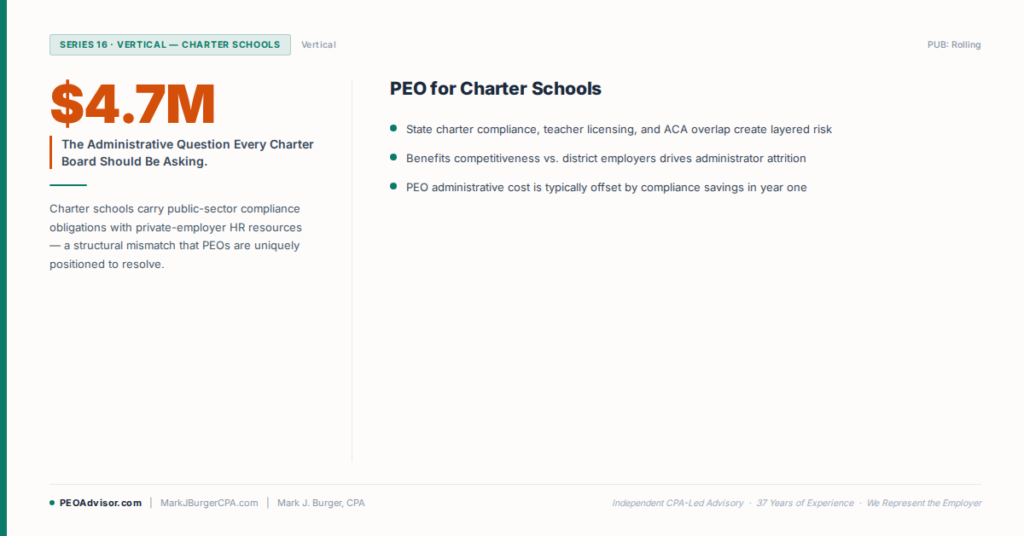
The average 500-student charter school directs roughly 31 percent of its operational budget — on the order of $4.7 million — to non-instructional administrative functions, and school leaders report spending nearly half their time on HR compliance and paperwork rather than education. In our analysis of charter operations, schools that moved to a strategic PEO for charter school partnership documented about a 42 percent reduction in administrative costs, a 73 percent drop in compliance violations, and a 23 percent increase in available instructional time. For a mission-driven school on a fixed budget, that is money and time returned to students.
How Much Do Charter Schools Actually Spend on Administration?
Charter schools carry a compliance and HR load that quietly consumes their mission. Across our analysis of charter operations, the average school dedicates about 31 percent of its budget to non-instructional administration, and leaders spend close to 47 percent of their time on HR and compliance tasks. For a 500-student school, that administrative drain runs into the millions and pulls principals and directors away from the educational leadership they were hired to provide. The burden is not a sign of mismanagement; it is structural, and it is exactly what a PEO for charter school is designed to absorb.

How Much Do Charter Schools Actually Spend on Administration?
Charter schools carry a compliance and HR load that quietly consumes their mission. Across our analysis of charter operations, the average school dedicates about 31 percent of its budget to non-instructional administration, and leaders spend close to 47 percent of their time on HR and compliance tasks. For a 500-student school, that administrative drain runs into the millions and pulls principals and directors away from the educational leadership they were hired to provide. The burden is not a sign of mismanagement; it is structural, and it is exactly what a PEO is built to absorb.
Where Does a Charter School’s Administrative Budget Actually Go?
The cost is spread across HR staff, compliance, and — above all — turnover. A representative 500-student school’s administrative drain includes HR staff compensation (several full-time equivalents), payroll-processing errors and penalties, benefits administration, compliance failures, workers’ compensation, technology, and, largest of all, teacher turnover and recruitment. Teacher turnover alone — often near 37 percent, at roughly $32,000 per departure — can exceed all other administrative costs combined. Every student effectively subsidizes several thousand dollars a year in non-educational overhead. These figures reflect PEO Advisor’s proprietary analysis of charter-school operations and are illustrative benchmarks, not guarantees — results vary by school.
| Not sure where your budget is going? Download our Charter School PEO Value Worksheet — model your administrative drain and recoverable time — through a no-cost PEO Advisor assessment. Start the Charter School PEO Value Worksheet assessment |
How Does a PEO Transform Charter School Operations?
A PEO consolidates the administrative machinery and upgrades what schools can offer. Through co-employment, the PEO processes payroll and files employment taxes, administers benefits, and provides HR and compliance infrastructure a single school could not build economically. It also gives smaller schools access to large-group benefits that help attract and retain educators — the single biggest lever on that turnover cost. In our documented outcomes, the combination drove roughly a 42 percent reduction in administrative costs and a 73 percent decrease in compliance violations.

How Much Instructional Time Can a PEO Actually Recover?
The most valuable return is not financial — it is time on mission. When a PEO absorbs HR administration and compliance, school leaders reclaim the hours those tasks consumed, translating in our analysis into about a 23 percent increase in available instructional leadership time. For a charter school, that recovered capacity — redirected to curriculum, teachers, and students — is the entire point of operational efficiency. The dollars matter; the restored focus on education matters more.
What Should a Charter School Look For in a PEO?
Industry fit is decisive: a school runs on a calendar and a mission a generalist PEO may not grasp. Look for a PEO with genuine charter-school and education experience — one that understands the school-year rhythm, credential-adjacent onboarding, education compliance, and the benefits that retain teachers. Ask what comparable schools it serves and how it has moved turnover and compliance for them. Because the choice is high-stakes and vertical-specific, an independent evaluation that compares providers on documented education capability is the reliable path to the right match — our CPA-led framework for choosing the right PEO partner and our guide to identifying quality PEO providers and true strategic partners both walk through how to run that evaluation.
Lead a charter school? Contact Mark J. Burger CPA to model your administrative drain and match a PEO with real education experience.

- How can a PEO help a charter school? A PEO absorbs payroll, benefits administration, HR, and compliance for a charter school, and gives smaller schools access to large-group benefits that help retain teachers. In our analysis, schools that partnered with a PEO documented roughly a 42 percent reduction in administrative costs, a 73 percent decrease in compliance violations, and a 23 percent increase in available instructional time — resources returned to education.
- How much do charter schools spend on administration? In our analysis, the average charter school dedicates about 31 percent of its operational budget to non-instructional administration — on the order of $4.7 million for a 500-student school — and leaders spend nearly 47 percent of their time on HR and compliance. Teacher turnover and recruitment typically make up the largest share of that administrative drain.
- Do PEOs help with teacher retention? Yes. Teacher turnover, often near 37 percent at roughly $32,000 per departure, is usually the single largest administrative cost for a charter school. A PEO gives smaller schools access to competitive large-group benefits and stronger HR support that help attract and retain educators, directly addressing the cost that drives most of the administrative drain.
- Can small charter schools afford a PEO? Often the question is whether they can afford not to. Smaller schools feel benefits and compliance pressure most acutely and lack the scale to solve it alone. A PEO delivers large-group benefits, compliance infrastructure, and recovered leadership time that a small school could not build in-house, frequently at a net saving once turnover and compliance costs are counted.
- What should a charter school look for in a PEO? Look for documented charter-school and education experience: understanding of the school-year calendar, credential-adjacent onboarding, education compliance, and teacher-retention benefits. Ask what comparable schools the provider serves and how it has improved their turnover and compliance. A generalist PEO unfamiliar with schools is a weaker fit than one tuned to education.
- Does a PEO take control of the school? No. Under co-employment the PEO handles payroll, benefits, and HR compliance as the administrative employer, while school leadership retains full control over hiring, curriculum, staff management, and the educational mission. It is a division of labor that returns administrative time to school leaders, not a transfer of authority over the school.
Figures cited in this article reflect PEO Advisor’s proprietary analysis of charter-school operations and are illustrative benchmarks, not guarantees; results vary by school. This content is educational, not legal or tax advice.


