
The Engagement Crisis Facing Small and Medium-Sized Businesses
Employee engagement in the United States remains at 31 percent in early 2026, unchanged from 2024 and down from the 36 percent peak recorded in 2020 according to Gallup research. Globally, engagement hovers between 21 and 23 percent, representing one of the lowest periods in recent history. For small and medium-sized businesses, this creates a compounding challenge: 56 percent of employees are actively considering leaving their current employers while replacement costs range from 50 to 60 percent of annual salary for hourly workers.
The crisis extends beyond engagement metrics. Recent research reveals that 90 percent of employees experienced burnout in the past year, and 85 percent of employees are not engaged in their workplace. Disengaged employees cost the global economy 8.8 to 8.9 trillion dollars annually in lost productivity, equivalent to 9 percent of global GDP.
This is not a temporary adjustment. This represents a fundamental shift in workforce expectations. Employees now prioritize work-life balance, professional development, and workplace flexibility over traditional benefits packages. According to 2026 industry research, 85 percent of employees would consider leaving a company that does not support their wellbeing, making comprehensive benefits access a competitive necessity rather than an optional perk.
The question facing business leaders is straightforward: how do you compete for talent when you cannot match the resources of larger employers? The answer increasingly involves strategic alignment with a certified Professional Employer Organization.
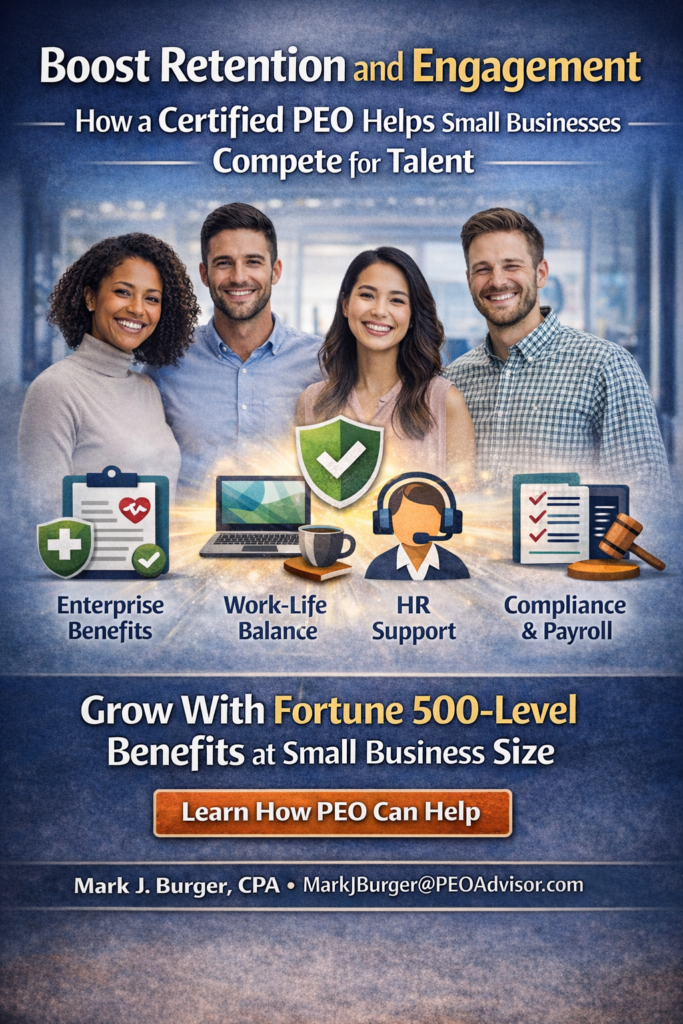
Why Employee Turnover Costs Matter More Than Ever in 2026
Understanding the true cost of employee turnover helps business owners evaluate retention strategies effectively. According to the Society for Human Resource Management, replacing an hourly employee costs 50 to 60 percent of their annual salary. For a position paying 40,000 dollars annually, replacement costs reach 20,000 to 24,000 dollars per departure.

For small businesses planning to expand in 2026, the stakes are even higher. Recent surveys indicate that 55 percent of small businesses expect to add employees this year, even as they face intensifying competition for talent. With 79 percent of businesses raising wages and offering hiring incentives to attract workers, preventing turnover becomes even more critical than replacing departed employees.
Beyond direct replacement costs, turnover creates operational disruption. Remaining employees assume additional responsibilities during transition periods. Customer relationships suffer when experienced employees leave. Institutional knowledge disappears. Training investments are lost. These indirect costs often exceed the measurable replacement expenses.
Effective employee retention strategies address both the financial impact and the operational disruption that turnover creates.
What Is a Professional Employer Organization?
A Professional Employer Organization is a firm that provides comprehensive HR services to client companies through a co-employment relationship. The PEO handles payroll administration, benefits management, workers compensation, compliance oversight, and HR support. This arrangement allows small and medium-sized businesses to access enterprise-level HR capabilities without building internal departments.
For growing businesses, PEO services offer an alternative to hiring internal HR staff or managing compliance independently. Rather than employing a full HR team, businesses partner with certified PEOs to access professional HR expertise, technology platforms, and benefits administration.

IRS-certified PEOs meet strict federal standards for financial stability, reporting accuracy, and regulatory compliance. ESAC-accredited PEOs demonstrate additional commitment to operational excellence and client protection. These certifications matter because they indicate a PEO’s capacity to deliver consistent, reliable service.
The distinction between certified and non-certified PEOs is significant. IRS certification provides employers with specific tax benefits and compliance protections that non-certified providers cannot offer. ESAC accreditation adds independent verification of financial stability and operational capability.
How PEO Services Improve Employee Engagement and Retention
Strategic PEO partnership directly impacts the five primary drivers of employee engagement identified in 2026 research: competitive benefits access, work-life flexibility, professional development opportunities, manager effectiveness, and workplace recognition systems. Understanding how certified PEO services address each driver helps employers evaluate whether this approach fits their retention strategy.
The urgency of this alignment has intensified. With 56 percent of employees considering leaving their current employers and 90 percent reporting burnout in the past year, businesses need comprehensive solutions that address multiple retention factors simultaneously. PEO partnerships provide integrated capabilities that small businesses typically cannot build independently.
Do Certified PEOs Provide Enterprise Benefits for Small Companies?
Your 50-employee company cannot negotiate the same health insurance rates as a 5,000-employee corporation. This is a fundamental challenge of scale. Insurance carriers price based on risk pools. Smaller groups pay higher per-employee costs for identical coverage.
A well-structured PEO relationship changes this calculation. By pooling employees from multiple client companies, certified PEOs create large risk pools that qualify for enterprise pricing. According to NAPEO research, businesses using PEOs grow 7 to 9 percent faster than companies managing HR internally, partly because competitive benefits packages reduce turnover and improve talent acquisition.
The difference in benefits quality is measurable. PEO clients typically access Fortune 500-level health plans, dental and vision coverage, retirement programs with employer matching, and supplemental benefits like life insurance and disability coverage. These are not basic packages. These are comprehensive programs that help smaller employers compete for talent against larger organizations.
This access to enterprise-level benefits directly addresses employee retention in 2026. According to recent research, over 80 percent of employees expect their employer to support their wellbeing, and 85 percent would consider leaving a company that does not provide adequate wellbeing support. When employees receive benefits comparable to what Fortune 500 companies offer, they have fewer incentives to pursue opportunities at larger organizations. The benefits quality signals that the employer values their workforce and invests in employee wellbeing.
How PEO Services Improve Manager Effectiveness and Employee Engagement
Gallup attributes 70 percent of engagement variance to manager quality. Most small business managers lack formal HR training. They excel in operational leadership but struggle with performance conversations, conflict resolution, and employee development planning. This skills gap directly impacts employee engagement and retention outcomes.
Responsive PEOs provide dedicated HR consultants who support your managers with specific guidance. When a manager faces a difficult performance conversation, they have expert support. When an employee requests accommodation, the manager has compliance expertise backing their decisions. When team conflicts arise, professional HR guidance helps resolve issues before they escalate.
This support transforms manager capability. Your operations leader does not need an HR degree to handle employee relations effectively. They need access to expertise when situations require it. Quality PEOs deliver this access through responsive service and proactive communication.
The impact on employee engagement is measurable. When managers receive professional HR support, they handle employee issues more effectively. This improves employee confidence in leadership, reduces workplace friction, and creates the positive management relationships that drive retention.
Workplace Flexibility Solutions: How PEO Technology Enables Work-Life Balance
Work-life balance remains the top retention driver in 2026. Recent research confirms that employees continue to prioritize flexibility, with remote workers reporting 29 percent engagement compared to only 20 percent for on-site workers. This creates an operational challenge: how do you provide schedule flexibility, time-off management, and benefits access without overwhelming your administrative team?
HR technology solves this problem. Certified PEOs provide self-service platforms where employees manage their own HR needs. Employees access pay information, review benefits details, request time off, update personal information, and download tax documents without involving your staff. This reduces administrative burden while giving employees the control and flexibility they expect.
The technology also provides managers with real-time workforce data. They see who is scheduled, track attendance patterns, monitor overtime, and manage compliance requirements through integrated dashboards. This visibility enables better workforce planning while reducing the manual tracking that consumes management time.
For small business employee retention, workplace flexibility represents a competitive advantage. When employees can manage their schedules, access information independently, and balance personal responsibilities with work demands, job satisfaction increases and turnover intentions decrease. This flexibility becomes particularly important given that 90 percent of employees report experiencing burnout, making autonomy and control over work arrangements essential retention tools.
PEO Compliance Services: Reducing the Burden That Distracts Leadership
Wage and hour regulations, benefits compliance, workers compensation requirements, unemployment insurance, tax withholding, reporting obligations, and labor law adherence create constant compliance demands. Small business leaders spend significant time navigating these requirements instead of focusing on business growth and team development.
IRS-certified PEOs assume substantial compliance responsibility through the co-employment relationship. They maintain expertise in federal and state employment law. They track regulatory changes. They implement compliant processes. They handle reporting requirements. This transfer of compliance burden frees leadership capacity for strategic priorities.
For businesses with multi-state operations, PEO compliance services become particularly valuable. Each state maintains distinct labor laws, unemployment insurance requirements, and wage regulations. Managing compliance across multiple jurisdictions requires specialized expertise that most small businesses cannot maintain internally.
When managers spend less time worrying about whether their scheduling practices comply with overtime regulations, they have more capacity to invest in the engagement activities that retain talent. This shift from compliance management to culture development directly impacts retention outcomes.

Employee Recognition Programs and Professional Development for Small Business
Recent research indicates 71 percent of employees would be less likely to leave their current role if they received frequent recognition. Additionally, 80 percent of employees state that skill-building opportunities increase their engagement. These findings create clear direction: businesses need structured recognition systems and professional development programs.
Most small businesses lack the infrastructure to deliver employee recognition programs consistently. Recognition happens informally. Development is reactive rather than strategic. Performance feedback occurs annually rather than continuously. This gap creates retention vulnerability.
Quality PEOs offer performance management platforms that enable regular feedback, goal tracking, and recognition documentation. These systems create consistency in how managers acknowledge contributions and support employee growth. The platforms also provide development planning tools, training resources, and career progression frameworks that small businesses typically cannot build independently.
The combination of recognition and development opportunities addresses two separate retention drivers. Recognition satisfies the immediate need for acknowledgment and appreciation. Professional development addresses the longer-term need for career growth and skill advancement. Together, these programs create the engagement infrastructure that transforms retention from a problem into a competitive advantage.
How PEO Partnerships Address Burnout and Employee Wellbeing
The burnout epidemic represents one of the most significant retention challenges facing employers in 2026. With 90 percent of employees reporting burnout in the past year, businesses need comprehensive strategies that address both the causes and symptoms of workplace exhaustion.
Strategic PEO partnerships provide multiple wellbeing support mechanisms that small businesses typically cannot offer independently. These include Employee Assistance Programs that provide confidential counseling and mental health resources, wellness program access ranging from fitness benefits to stress management tools, and comprehensive health benefits that address both physical and mental health needs.
According to 2026 research, over 80 percent of employees expect their employer to support their wellbeing. When PEO partnerships deliver mental health resources, wellness programs, and comprehensive benefits packages, they directly address this expectation. Employees who receive adequate wellbeing support demonstrate higher engagement, lower absenteeism, and stronger retention.
The wellbeing advantages extend beyond individual programs. PEO technology platforms often include wellness tracking, health assessments, and preventive care coordination that help employees manage their health proactively. For businesses with limited internal HR capacity, these integrated wellbeing solutions provide professional-grade support without requiring additional staff.
What Should You Look For in a PEO Partner?
Not every PEO delivers the service quality that impacts retention. Some provide basic payroll processing with minimal support. Others create technology barriers that frustrate employees rather than empowering them. The key is identifying PEOs that demonstrate three specific characteristics. Integration-How to Integrate a PEO: Expert Framework for Business Success
Certified PEO vs. Non-Certified: Understanding the Difference
The distinction between certified and non-certified PEOs affects both service quality and employer protection. IRS certification requires PEOs to meet stringent financial, operational, and reporting standards. This certification provides employers with specific benefits and protections.
IRS-Certified PEO Benefits:
- Employers can claim the Work Opportunity Tax Credit and other employment tax credits directly
- Enhanced protection of employer tax liability
- Federal verification of financial stability and operational capability
- Quarterly IRS financial audits ensure ongoing compliance
- Greater certainty regarding employment tax responsibilities

ESAC Accreditation Advantages:
- Independent verification of financial practices and client fund protection
- Demonstrated operational excellence and service quality standards
- Additional layer of client protection beyond IRS certification
- Ongoing compliance with industry best practices
When evaluating PEO options, certification status should be a primary consideration. The additional oversight and accountability that certification requires translates directly into service reliability and employer protection.
Key Characteristics of Quality PEO Partnerships
Beyond certification, three characteristics separate effective PEO partnerships from transactional vendor relationships.
Demonstrated Client Responsiveness
Service quality separates effective PEO partnerships from transactional vendor relationships. Ask how quickly the PEO responds to client inquiries. Request references from current clients in similar industries. Understand how the PEO handles service issues when they arise. Responsive PEOs assign dedicated account managers, provide multiple contact channels, and resolve problems proactively.
Commitment to Employee Experience
Evaluate the technology platform employees will use. Is the interface intuitive? Can employees access information easily from mobile devices? Does the system provide the self-service capabilities that enable flexibility? The employee experience with PEO technology directly affects adoption and satisfaction.
The Pattern Across 37 Years of Advisory Work
After reviewing hundreds of PEO relationships over 37 years, a consistent pattern emerges. Businesses that treat their PEO as a strategic partner rather than a payroll vendor achieve measurably better retention outcomes. This distinction manifests in how employers select their PEO, structure the relationship, and leverage available services.
Companies experiencing retention improvement use their PEO relationship to enhance manager capability, expand benefits access, enable workforce flexibility, reduce compliance distraction, and implement recognition systems. They view the PEO as an extension of their leadership team rather than an external vendor. Organizations that see minimal retention impact typically use only basic PEO services. They process payroll through the PEO but do not leverage HR support, technology capabilities, or strategic guidance. The relationship remains transactional rather than transformational. About Us
Employee Retention Strategies: Practical Steps for Small Business Owners
If you are experiencing engagement and retention difficulties, consider these specific actions:
- Calculate Your True Employee Turnover Costs: Document replacement expenses for recent departures including recruiting costs, training time, productivity loss during vacancy, onboarding expenses, and the impact on remaining staff. This analysis establishes the business case for retention investment.
- Assess Your Current HR Infrastructure: Document what HR capabilities you currently provide. Identify gaps between what employees expect and what you deliver. Determine whether building internal capabilities is financially viable at your current size. Compare the cost of internal HR staff versus certified PEO services.
- Evaluate Whether PEO Services Address Your Specific Gaps: If your retention challenges stem from limited benefits access, lack of HR expertise, compliance concerns, or inadequate technology, a PEO may provide solutions. If challenges are primarily cultural or operational, other interventions may be more appropriate.
- Research IRS-Certified and ESAC-Accredited PEOs: Begin with providers who meet certification and accreditation standards. These credentials indicate baseline capability and financial stability. Request references from companies of similar size in comparable industries.
- Understand Service Models and Responsiveness Standards: Ask how the PEO delivers HR support. Determine response time commitments. Understand how account management works. Clarify what services are included versus what costs extra. Verify that the service model aligns with how your business operates.
- Evaluate HR Technology From the Employee Perspective: Request demonstrations of the employee self-service platform. Consider whether your workforce will find the technology accessible and useful. Determine what training and support the PEO provides for system adoption. Assess whether the technology enables the workplace flexibility employees demand.
- Review Contract Terms for Service Commitments: Ensure the agreement includes specific service level commitments, response time standards, and performance metrics. Verify that you maintain flexibility if service quality does not meet expectations. Understand renewal terms and exit provisions.
Strategic PEO Services: When Partnership Makes Sense for Small Business
PEO alignment addresses retention challenges most effectively for businesses with 25 to 500 employees experiencing specific HR infrastructure limitations. This size range typically cannot justify building comprehensive internal HR departments but needs capabilities beyond basic payroll processing.
The partnership creates particular value when businesses face competitive hiring markets, compliance complexity from multi-state operations, benefits cost pressures, or limited internal HR expertise. In these scenarios, strategic PEO services provide capabilities that directly impact talent acquisition and retention.
However, PEO partnership is not appropriate for every organization. Businesses with established internal HR teams, highly specialized benefits requirements, or unique workforce models may find PEO services too standardized. The key is alignment between what your business needs and what a quality PEO delivers.
When PEO Services Provide Maximum Value:
- Employee count between 25 and 500
- Multi-state operations requiring complex compliance management
- Competitive hiring environment requiring enterprise-level benefits
- Limited internal HR expertise or capacity
- Need for professional HR technology without capital investment
- Focus on core business growth rather than HR administration
When Alternative Solutions May Be More Appropriate:
- Highly specialized workforce with unique benefits requirements
- Established internal HR department with full capabilities
- Industry-specific compliance needs beyond standard PEO expertise
- Preference for complete internal control of all HR functions
The Broader Context of Workforce Management Evolution in 2026
Employee engagement challenges reflect deeper shifts in workforce expectations that have accelerated in 2026. Technology has enabled transparency about compensation, benefits, and workplace practices across industries. Remote work demonstrated that flexibility is operationally viable, with remote workers showing 29 percent engagement compared to 20 percent for on-site workers. Talent scarcity shifted negotiating power toward employees. The burnout epidemic, affecting 90 percent of workers, created urgent demand for wellbeing support.
These changes are permanent rather than temporary. Building sustainable retention strategies requires acknowledging this new reality and developing capabilities that address current workforce expectations. For many small and medium-sized businesses, this means accessing resources through partnerships rather than internal development.
Small businesses in 2026 are increasingly embracing what industry analysts call “strategic flexibility”—combining on-site teams, hybrid arrangements, and outsourced support for specialized functions like HR, payroll, and benefits administration. This approach allows businesses to access enterprise-level capabilities without the fixed costs of building internal departments.
Strategic PEO relationships represent one approach to this challenge. The partnership allows smaller employers to compete for talent by providing benefits, technology, and support that were previously available only to larger organizations. This democratization of HR infrastructure creates more competitive labor markets where business quality matters more than business size.
The trend toward strategic outsourcing reflects broader recognition that core competency focus drives business success. When business owners can delegate complex HR compliance, benefits administration, and payroll management to certified experts, they gain capacity to focus on revenue generation, customer service, and operational excellence. This strategic allocation of resources becomes particularly valuable when 55 percent of small businesses plan to expand their workforce while simultaneously managing retention challenges.
Making Informed Decisions About PEO Partnership: The Value of Independent Guidance
The decision to engage a PEO should be based on careful analysis of your specific retention challenges, assessment of whether PEO services address those challenges, and evaluation of individual PEO providers based on certification, responsiveness, and service quality.
Not every retention problem requires a PEO solution. However, when engagement challenges stem from limited benefits access, inadequate HR support, compliance complexity, or insufficient technology infrastructure, a well-selected PEO partnership can transform those limitations into competitive advantages.
The key is approaching PEO selection with the same rigor you apply to other strategic business decisions. Understand what you need. Identify providers who deliver those specific capabilities. Verify service quality through references and demonstrations. Structure relationships with clear performance expectations and appropriate flexibility.
The Role of Independent PEO Advisory Services
Many business owners find value in working with an independent PEO advisor during the selection process. Unlike PEO brokers who may prioritize vendor relationships, independent advisors focus exclusively on employer needs. This employer-side guidance helps businesses:
- Identify which PEO capabilities address specific retention challenges
- Evaluate certified PEO options based on service quality and responsiveness
- Understand contract terms and service commitments before signing
- Negotiate appropriate pricing and service level agreements
- Avoid common pitfalls in PEO relationships
If you need guidance evaluating whether a PEO partnership makes sense for your specific retention challenges, or help identifying quality PEO providers that align with your business needs, that is precisely the type of independent advisory support we provide.
Ready to Address Your Retention Challenges?
Mark J. Burger, CPA, has provided independent PEO advisory services for 37 years, helping employers identify PEO partners that support business growth and workforce stability. His guidance focuses on aligning PEO capabilities with specific employer needs to create sustainable HR infrastructure for growing organizations.
Schedule a confidential PEO strategy consultation to discuss your specific engagement and retention concerns and evaluate whether strategic PEO partnership provides solutions aligned with your business needs. Contact:MarkJBurger@PEOAdvisor.com or Contact Us – PEO Advisor

- Is a certified PEO actually cost-effective for a business my size? For most businesses with 25 to 500 employees, a certified PEO is cost-effective when evaluated against total workforce costs rather than as a standalone expense. While PEO fees are often expressed as a percentage of payroll, that comparison ignores the cumulative cost of employee turnover, small-group benefits pricing, internal HR staffing, compliance exposure, and leadership time diverted to administrative tasks. Given that replacing one employee typically costs 50 to 60 percent of annual compensation, even modest reductions in turnover frequently offset a substantial portion of PEO fees. When combined with improved benefits pricing, workers’ compensation efficiencies, and reduced compliance risk, many growing companies find that PEO partnerships stabilize costs while improving operational and retention outcomes.
- How do I know which PEOs are truly certified and a good fit for my business? IRS certification and ESAC accreditation provide a critical baseline by confirming financial stability, regulatory compliance, and operational oversight, but they do not guarantee service quality or strategic alignment. Employers must look beyond certification to evaluate how the PEO actually delivers service, including responsiveness, depth of HR support, benefits structure, technology usability, and experience with similar workforce profiles. Two certified PEOs can produce very different employee and management experiences. The right fit is determined by how well the PEO’s service model aligns with your operational needs, growth plans, and employee expectations, not by certification status alone.
- What does the transition to a PEO look like, and how disruptive is it? When properly managed, transitioning to a PEO is typically a structured and low-disruption process completed over 30 to 90 days. Employees remain employed by your company, payroll schedules generally stay the same, and the most visible changes are improved benefits access and employee self-service technology. High-quality PEOs guide the transition with parallel payroll testing, clear employee communication, benefits education, and manager training, which minimizes confusion and operational risk. In many cases, employees experience increased confidence rather than disruption because HR support, payroll accuracy, and benefits clarity improve immediately following implementation.


