
Executive Summary
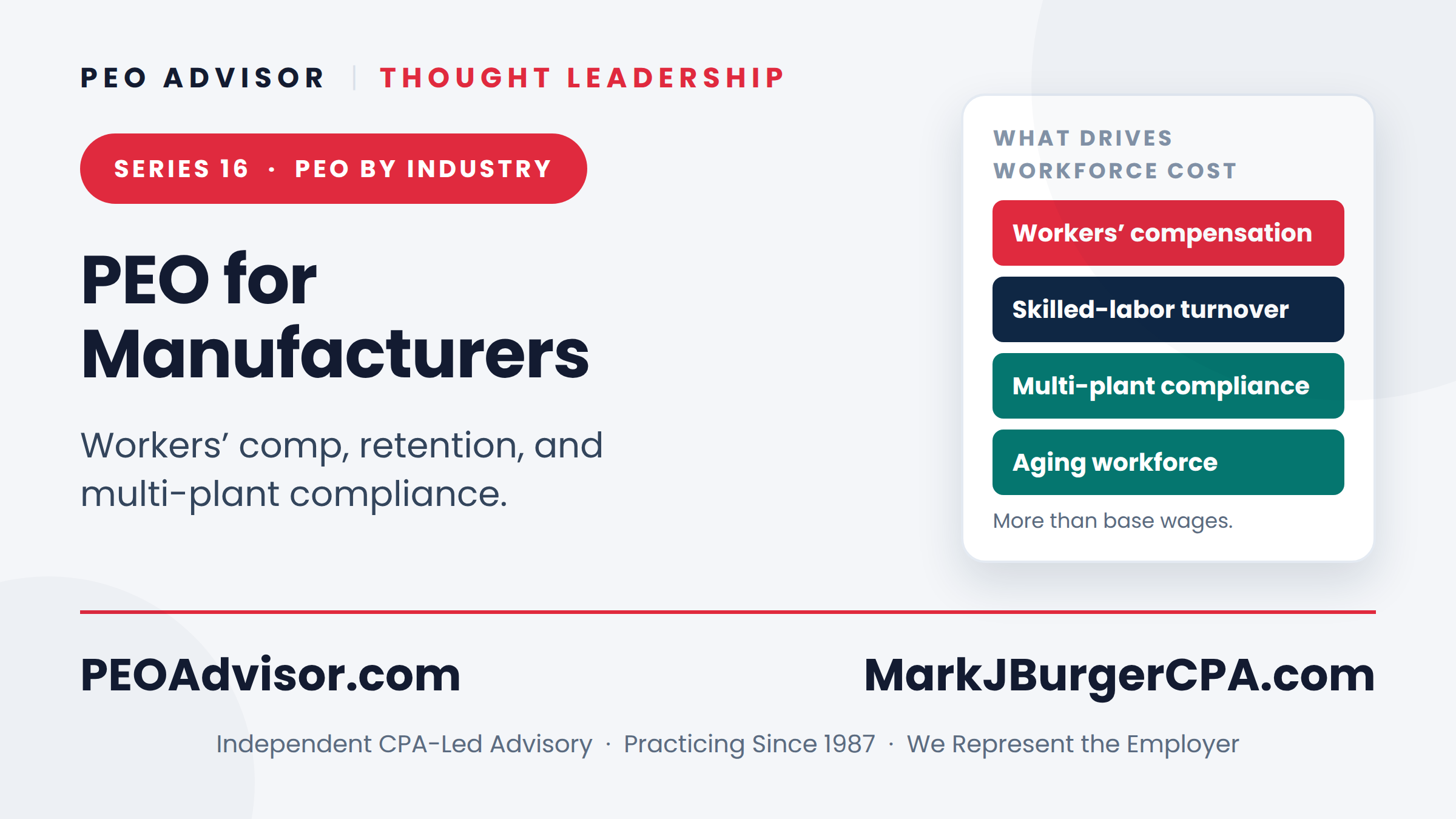
Manufacturers face a persistent labor gap, an aging workforce, and the injury exposure inherent in physical work, which together make workforce cost and stability strategic concerns rather than HR ones. The Manufacturing Institute and Deloitte project 3.8 million manufacturing job openings through 2033, with as many as 1.9 million potentially going unfilled if workforce challenges are not addressed. The economics extend well beyond base wages: in Deloitte’s 2025 Manufacturing Industry Outlook, 60 percent of manufacturing HR leaders surveyed put the cost of replacing a single skilled frontline employee between $10,000 and $40,000. A PEO built for manufacturing turns those fragmented costs – workers’ compensation and safety, benefits and retention, payroll, and multi-state compliance – into managed systems.
The Manufacturing Workforce Squeeze
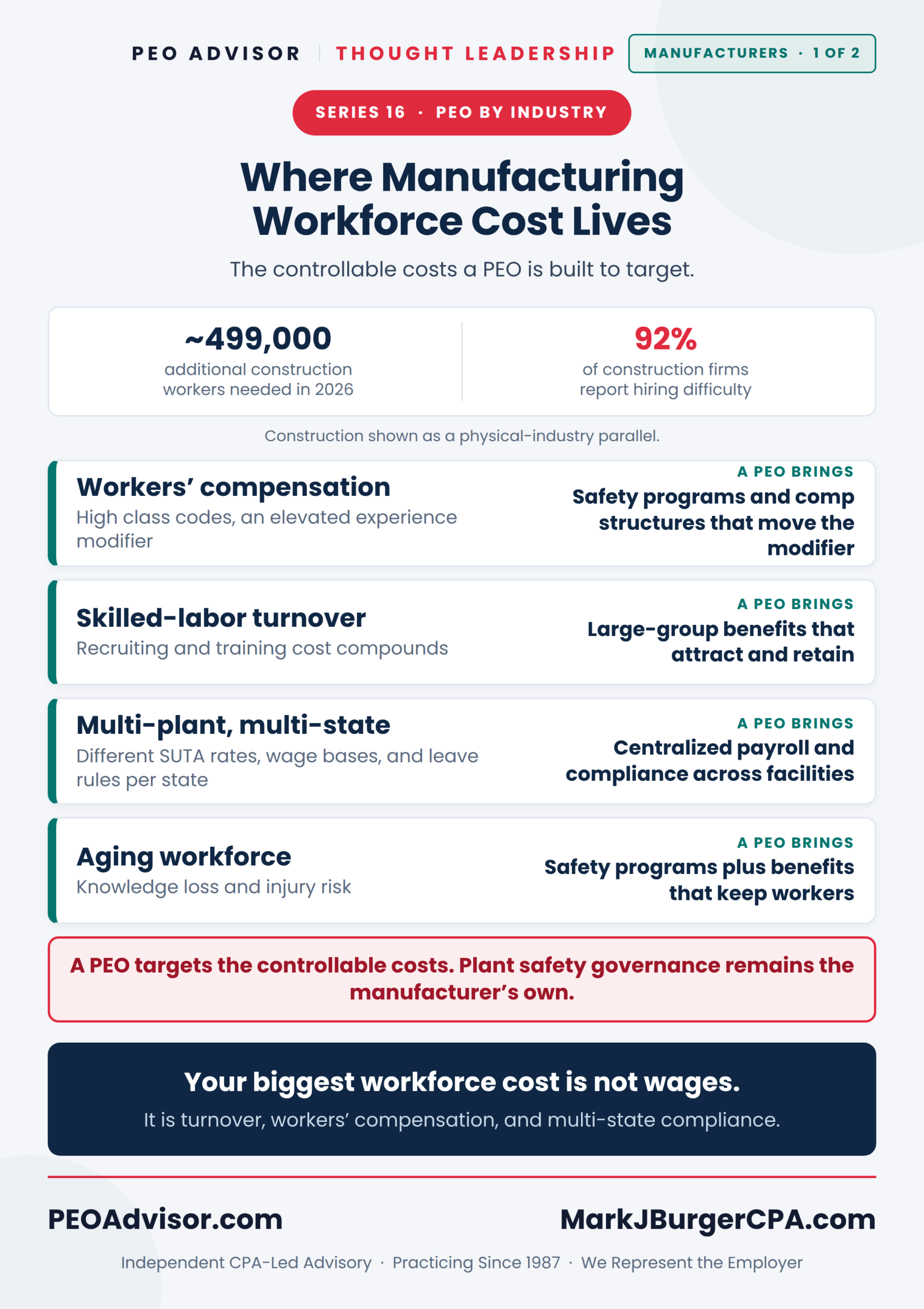
A shrinking, aging talent pool meets physical-work risk. The Manufacturing Institute and Deloitte project 3.8 million manufacturing job openings through 2033, with as many as 1.9 million potentially going unfilled if workforce challenges are not addressed. Approximately 2.8 million of those openings are expected to result from retirements. That is a demographic problem before it is a recruiting one: the workers leaving carry process knowledge that took years to build, and they are leaving faster than the pipeline replaces them.
The economics extend well beyond base wages. Turnover alone can be expensive. In Deloitte’s 2025 Manufacturing Industry Outlook, 60 percent of manufacturing HR leaders surveyed estimated that replacing a skilled frontline employee costs between $10,000 and $40,000. Workers’ compensation, benefits, compliance, recruiting, retention, and the complexity of operating across multiple states all add to total workforce cost, and none of them appear on the wage line. A manufacturer that manages only wages is managing the smaller number. The retention levers that actually reduce that cost sit mostly in benefits, on-boarding, and the stability of the HR experience.
Construction illustrates the same labor-cost pressure. In the Associated General Contractors of America 2026 Construction Hiring and Business Outlook, 57 percent of contractors cited an insufficient supply of workers or subcontractors as a major concern, 56 percent cited rising direct labor costs, and 53 percent cited worker quality. The parallel matters because the two sectors compete for overlapping skilled labor. For manufacturers, retention is therefore more than an HR objective; it is an operating and profit lever, and the levers that move it are workers’ compensation, benefits, and compliance.
| Workforce cost driver | The exposure | What a PEO does |
|---|---|---|
| Workers’ compensation | High class codes, an elevated experience modifier | Safety programs and comp structures that move the modifier |
| Skilled-labor turnover | Recruiting and training cost compounds | Large-group benefits that attract and retain |
| Multi-plant, multi-state | Different SUTA rates, wage bases, leave rules per state | Centralized payroll and compliance across facilities |
| Aging workforce | Knowledge loss and injury risk | Safety programs plus benefits to attract and keep workers |
Can a PEO Lower a Manufacturer’s Workers’ Compensation Cost?
For physical operations, workers’ compensation is a controllable cost, not a fixed one. Correct class codes, a well-managed experience modifier, and strong safety programs materially affect a manufacturer’s premium. A PEO built for physical industries brings safety and risk-management programs that reduce injuries and, over time, improve the modifier that drives cost, plus workers’ compensation structures suited to the risk. Because comp is one of a manufacturer’s largest controllable costs, that discipline flows straight to the bottom line. The pattern holds across manufacturing verticals: safety training for production and installation crews lowering workers’ compensation premiums in the windows and doors industry is the same mechanism at work.
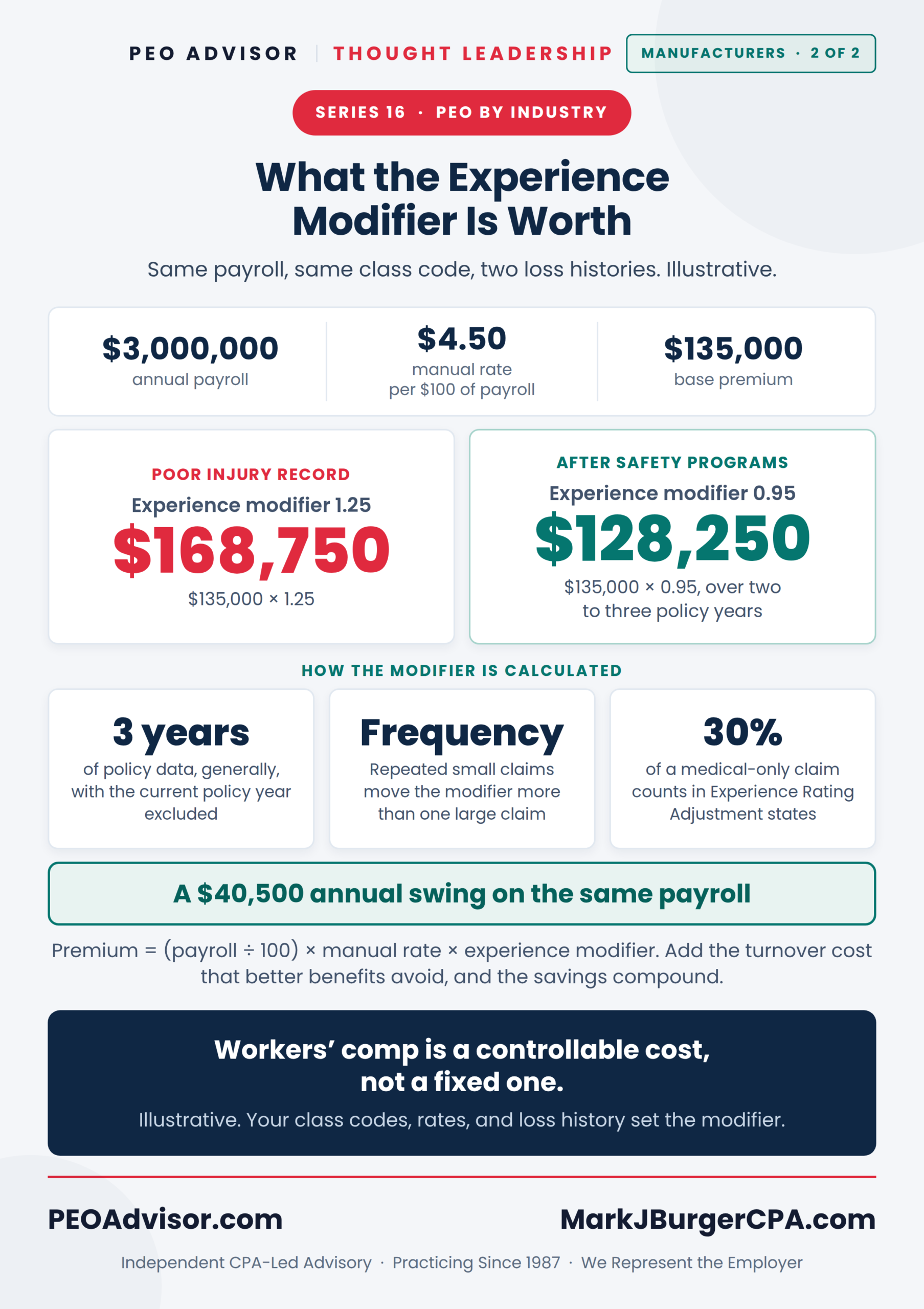
How the modifier is calculated. The experience modifier compares a manufacturer’s actual losses with the losses expected for its class codes and payroll. It generally draws on about three years of policy data and excludes the current policy year. The formula weights frequency over severity: the first portion of each claim, known as primary loss, counts more heavily than the excess above it. A string of small injuries therefore moves the modifier more than one serious claim. In states that use the Experience Rating Adjustment, a medical-only claim enters the calculation at 30 percent of its value.
Class codes deserve an audit before any renewal. Premium is priced per $100 of payroll in each class code, so payroll assigned to the wrong code is priced at the wrong rate. Office clerical staff and outside salespeople generally qualify for standard exception classifications, which carry far lower rates than shop-floor codes. A manufacturer that reports all payroll under its governing production code overpays on every administrative dollar. A capable PEO reviews classifications at on-boarding and again at each premium audit, which is often the fastest savings available.
What the Experience Modifier Is Worth
Worked example (illustrative). A manufacturer runs $3,000,000 of payroll in a class code with a manual workers’ compensation rate of $4.50 per $100 of payroll. Premium is the base figure multiplied by the experience modifier, which reflects loss history.
| Annual payroll in the class code | $3,000,000 |
| Manual rate per $100 of payroll | $4.50 |
| Base premium ($3,000,000 ÷ 100) × $4.50 | $135,000 |
| Premium at a 1.25 modifier (poor loss history) | $168,750 |
| Premium at a 0.95 modifier (after safety gains) | $128,250 |
| Annual difference on identical payroll | $40,500 |
Add the recruiting and training cost avoided when better benefits reduce turnover – at $10,000 to $40,000 per skilled frontline replacement, a handful of retained operators is real money – and the controllable savings compound on top of the $40,500.
Where the modifier savings actually come from. Because of the lag built into the experience period, safety results reach the premium slowly and then persist. The practices that move the modifier are consistent: reporting every injury promptly so claims are managed early, a return-to-work program with modified duty so lost-time claims close sooner, and supervisor training aimed at the recurring injuries that drive frequency. Prompt reporting matters twice, because the medical-only discount rewards claims that never become lost-time claims. A PEO should show how it manages each of these practices, not only hand over a safety manual.
| Not sure what your modifier is actually costing you? Get a no-cost read on your class codes, experience modifier, and multi-plant exposure through the PEO Advisor assessment. Start the manufacturing PEO assessment |
Benefits and Retention on the Floor
With skilled workers scarce, benefits are a retention lever, not an overhead line. A PEO’s pooled purchasing lets a mid-sized manufacturer offer benefits competitive with far larger firms, improving the ability to attract and keep skilled operators and technicians. Reducing turnover – which compounds recruiting, training, and lost-productivity cost – is where much of the value sits. In a tight labor market, the manufacturer that can offer better benefits and a stable, professional HR experience wins the workers its competitors also want.
Benefits must fit shift and variable-hour work. Manufacturing schedules rarely follow a standard office week. Overtime, rotating shifts, and seasonal peaks complicate benefits eligibility, and an employer with 50 or more full-time-equivalent employees must track which workers average 30 or more hours per week under the Affordable Care Act. A PEO administers the measurement periods and eligibility tracking. It can also offer tiered plans, so a line operator and a plant engineer each receive coverage they value rather than decline.
How Does a PEO Handle Plants in Several States?
Multiple facilities across states multiply the compliance burden. A manufacturer with plants in several states faces different unemployment rates, wage bases, paid-leave mandates, and rules in each, and some states underwrite each co-employer individually for workers’ compensation. A PEO centralizes payroll and compliance across facilities so each is handled correctly rather than plant by plant – the discipline is set out in what multi-state PEO compliance requires of an employer in 2026. For a multi-plant operation, one consistent, compliant platform is a structural upgrade.
Four states work differently for workers’ compensation. Ohio, North Dakota, Washington, and Wyoming require employers to buy coverage from a state fund, so a PEO’s master policy generally cannot insure a plant located there. The manufacturer typically holds that state-fund policy directly and adds employer’s liability, often called stop-gap coverage, through a separate policy. A manufacturer operating or expanding in one of these states should confirm how the PEO coordinates the state-fund account, payroll reporting, and claims before the plant is enrolled.
Plan the transition date around wage bases. Unemployment tax applies only up to each state’s taxable wage base, and in some states a mid-year move restarts the count, so wages already taxed earlier in the year are taxed again. Federal rules give certified PEOs successor-employer treatment for federal employment-tax wage bases, but state treatment varies. For a multi-plant manufacturer, a January 1 start, or written confirmation of wage-base credit in each state, prevents a duplicate tax that no one budgeted.

Case in Point
Case in point (illustrative). A mid-sized fabricator ran two plants in different states, each administered separately, with a workers’ compensation modifier that had crept above 1.2 after a run of preventable injuries and turnover that kept the shop floor short-handed. A generalist payroll vendor had already declined to write the comp risk. The company engaged a specialty PEO built for physical industries: it corrected several miscoded class codes, installed a safety program that cut recordable injuries, centralized payroll and multi-state compliance across both plants, and moved workers into a large-group benefits catalog. Over the next two policy years the modifier trended down, the benefits helped stabilize the skilled crew, and the two plants ran on one compliant platform. This scenario is illustrative and does not describe an identifiable manufacturer.
Choosing a Manufacturing-Ready PEO: A Step-by-Step
- Confirm it writes manufacturing workers’ comp. High class codes lead some generalists to decline – require a PEO that writes physical-industry risk.
- Verify safety programs that move modifiers. Ask for evidence of injury reduction and modifier improvement at comparable plants.
- Require multi-plant, multi-state capability across every state where you operate.
- Weigh benefits depth. Confirm the catalog is competitive enough to retain skilled operators and technicians.
- Evaluate independently. Because some generalists decline the risk, an independent search reaches the right specialty providers.
Run a manufacturing operation? Have Mark J. Burger, CPA match a manufacturing-ready PEO on comp, retention, and compliance.
Sources and basis. Workforce projections are from The Manufacturing Institute and Deloitte, Taking Charge: Manufacturers Support Growth with Active Workforce Strategies, which projects 3.8 million manufacturing job openings through 2033 with as many as 1.9 million potentially unfilled, approximately 2.8 million of them arising from retirements. The replacement-cost range is from Deloitte’s 2025 Manufacturing Industry Outlook, in which 60 percent of manufacturing HR leaders surveyed estimated $10,000 to $40,000 to replace a skilled frontline employee. The contractor figures are from the Associated General Contractors of America 2026 Construction Hiring and Business Outlook, January 2026. Structural facts are also real: the experience modifier draws on roughly three years of policy data excluding the current policy year and weights claim frequency over severity; in states using the Experience Rating Adjustment a medical-only claim enters at 30 percent of value; Ohio, North Dakota, Washington, and Wyoming are monopolistic state-fund jurisdictions; the Affordable Care Act applicable-large-employer threshold is 50 full-time-equivalent employees with full-time defined at 30 hours per week; and certified PEOs receive successor-employer treatment for federal employment-tax wage bases. The $3,000,000 payroll, $4.50 manual rate, 1.25 and 0.95 modifiers, and the two-plant fabricator are illustrative and do not describe an identifiable manufacturer. This content is educational, not legal or tax advice.
Frequently Asked Questions
How does a PEO help a manufacturer?
A PEO built for manufacturing provides workers’ compensation and safety programs that help lower premiums, competitive benefits that improve retention of scarce skilled workers, multi-state compliance for multi-plant operations, and payroll and HR administration. Because turnover, comp, and compliance drive manufacturing workforce cost more than base wages, a PEO targets exactly the controllable expenses.
How long does it take for fewer injuries to lower a manufacturer’s experience modifier?
Longer than most owners expect. The modifier is built from roughly three years of policy data, and the current policy year is excluded, so an injury prevented today generally begins to help the modifier a year or more later and keeps helping for three rating years. Safety investment is therefore a multi-year commitment, and a PEO should be judged on the direction of the modifier, not the first renewal.
Do manufacturers face a labor shortage in 2026?
Yes. The Manufacturing Institute and Deloitte project 3.8 million manufacturing job openings through 2033, with as many as 1.9 million potentially going unfilled and approximately 2.8 million arising from retirements. Turnover compounds the problem: in Deloitte’s 2025 Manufacturing Industry Outlook, 60 percent of manufacturing HR leaders surveyed put the cost of replacing one skilled frontline employee at $10,000 to $40,000. Retention is a profit lever, not only an HR objective.
Does joining a PEO change a manufacturer’s state unemployment tax rate?
It depends on the state. Some states require the PEO to report each client under the client’s own unemployment account and rate; others permit reporting under the PEO’s account and rate. The answer affects cost, and it affects what happens to the account if the manufacturer later leaves the PEO. A manufacturer with plants in several states should obtain the treatment for each state in writing.
Why do some PEOs decline manufacturers?
High workers’ compensation class codes and elevated experience modifiers common in physical industries lead some generalist PEOs to decline the risk. A decline signals the wrong market segment, not uninsurability. Specialty PEOs that write physical-industry risk will consider manufacturers generalists reject and offer comp structures suited to the exposure.
What should a manufacturer look for in a PEO?
Look for a PEO that writes manufacturing workers’ compensation, brings safety programs proven to move modifiers, handles multi-plant multi-state operation, and offers benefits that retain skilled workers. Ask how it has reduced comp cost and turnover for comparable manufacturers. An independent evaluation reaching the right specialty and multi-state providers is the reliable way to match.
About the author. Mark J. Burger, CPA · Practicing Since 1987. Mark advises small and mid-sized businesses on strategic workforce and co-employment decisions through GuidePoint PEO LLC. His analysis draws on hundreds of industry cost assessments.


