
Executive Summary
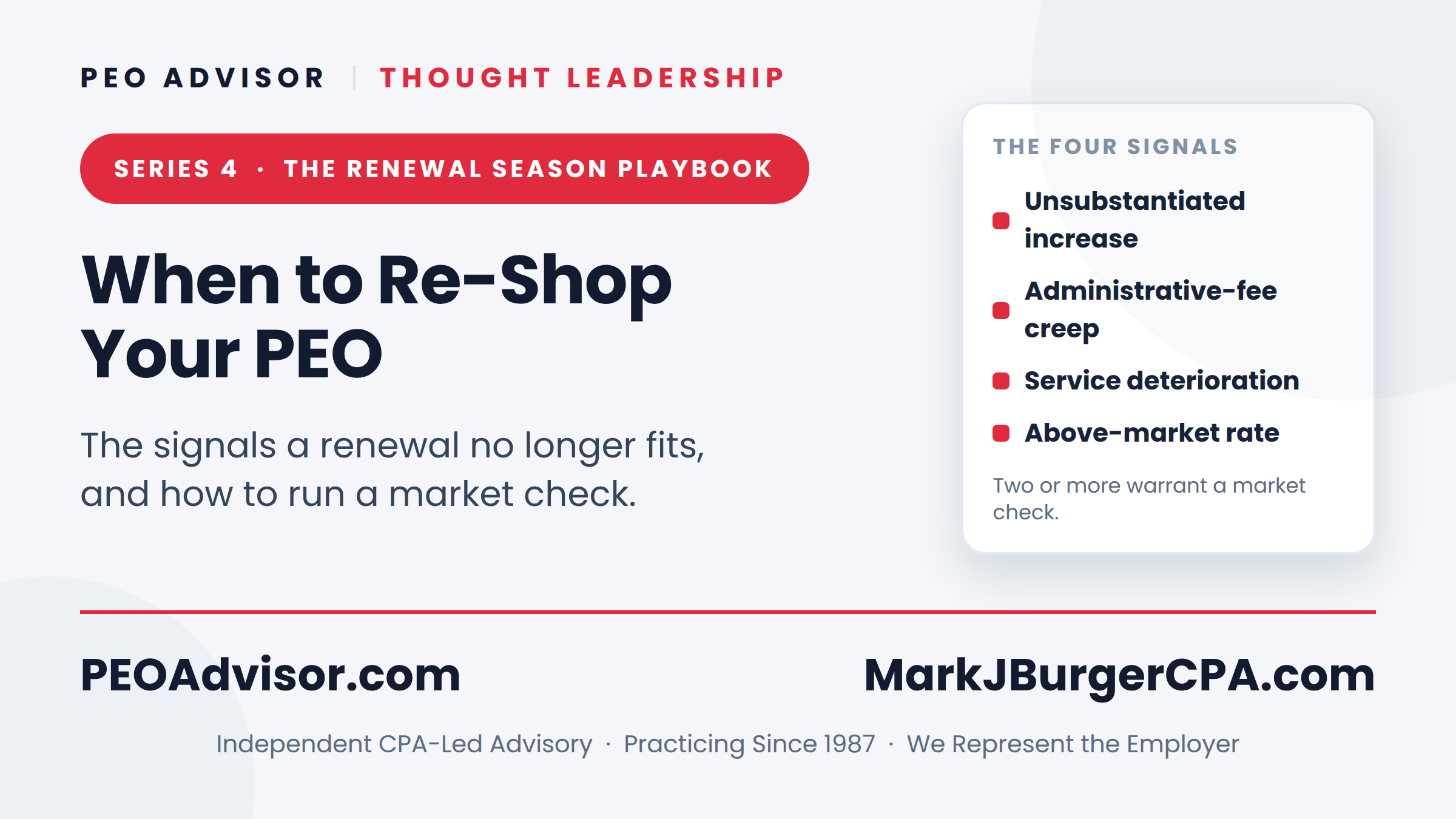
Not every renewal deserves a re-shop, but some demand one. A double-digit increase with no claims justification, administrative-fee creep, deteriorating service, or a rate that has drifted above market are the signals worth acting on. With 2026 small-group increases averaging 8 to 12 percent – and some regions far higher – a disciplined market check, run quietly and on the right timeline, is how you confirm whether to renew or move without disrupting your employees or triggering avoidable transition costs.
Renewing Is the Default; Re-Shopping Is a Decision
Continuity has value, so the burden of proof sits with moving. Staying with a working PEO avoids transition effort, preserves relationships, and keeps your employees’ experience stable. That is why re-shopping should be a considered decision rather than an automatic response to an unwelcome renewal. The goal is not to move for its own sake; it is to know, with evidence, whether your current PEO remains competitive and well-suited. Before concluding that a renewal cannot be fixed, work through the four levers that move a PEO renewal without leaving – many renewals that look like grounds for a move are simply un-negotiated. The signals below are what shift the decision from renew to re-shop.
The Signals a Renewal No Longer Fits
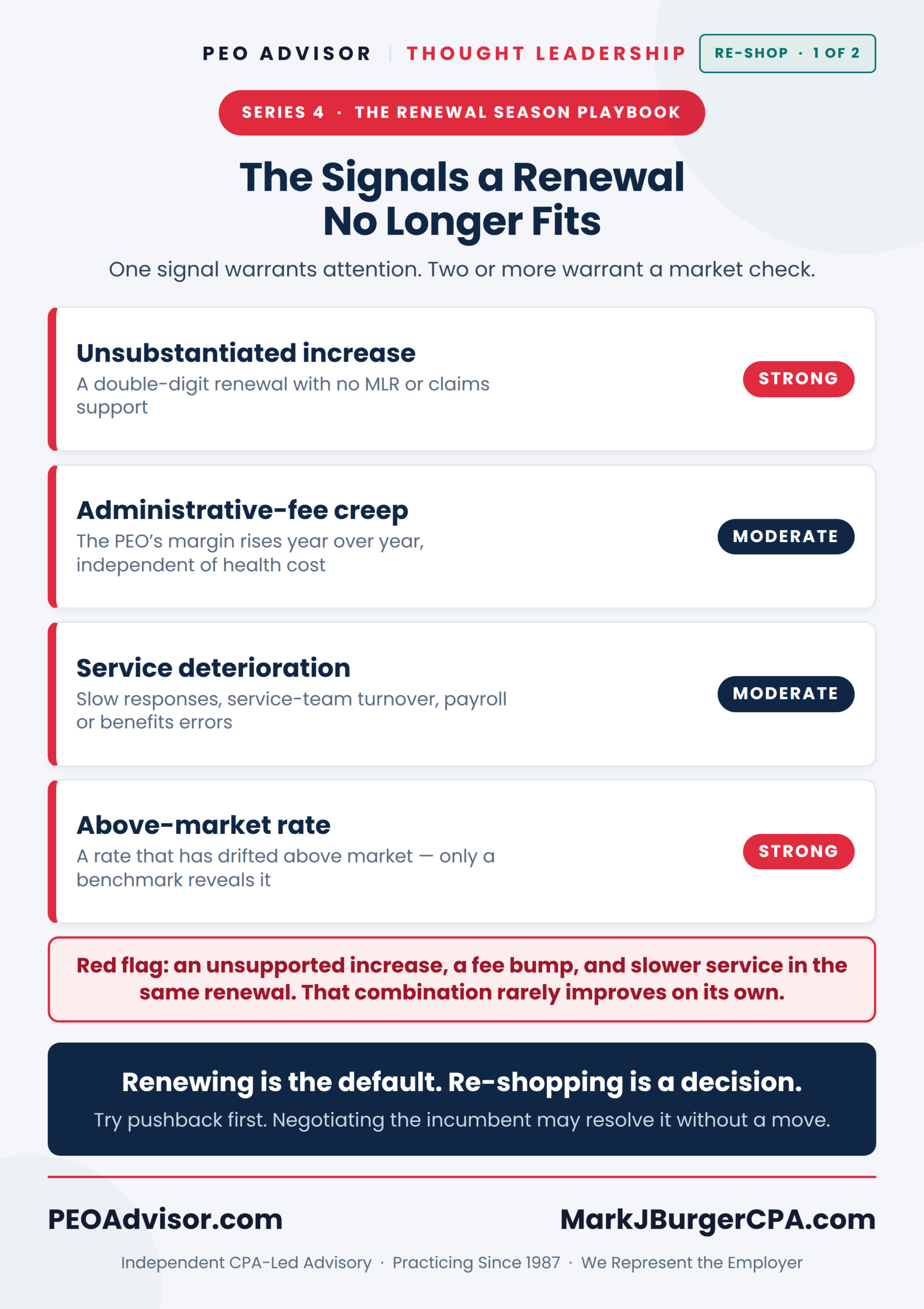
| Signal | What it looks like | Weight |
|---|---|---|
| Unsubstantiated increase | Double-digit renewal with no MLR or claims support | Strong |
| Administrative-fee creep | The PEO’s margin rises year over year, independent of health cost | Moderate |
| Service deterioration | Slow responses, service-team turnover, payroll or benefits errors | Moderate |
| Above-market rate | A rate that has drifted above market – only a benchmark reveals it | Strong |
Red flag: a renewal that combines an unsupported increase with a fee bump and slower service. That combination rarely improves on its own, and it is the clearest case for testing the market.
Timing the Market Check
Run the check on the market’s calendar, not only your own. Give yourself enough runway before your renewal date to gather data and evaluate alternatives – starting months ahead, not weeks. Practitioners note that windows around September can be favorable, as PEOs price toward quarterly targets, while second quarter is often a weaker time to expect competitive endorsable pricing. Aligning your market check with both your renewal date and the broader pricing calendar produces better alternatives and stronger leverage with your incumbent at the same time.
| Not sure whether to renew or move? Get a no-cost, confidential read on where your current PEO sits against the market, and what a move would actually net, through the PEO Advisor assessment. Start the PEO market check assessment |
Running It Without Disrupting Employees
A market check should be invisible to your team until a decision is made. You can gather competitive quotes using a current census and plan summary without announcing anything to employees or disrupting coverage. Keep the process confidential, request proposals on a common basis so they are comparable, and ensure any transition you ultimately choose is timed to avoid a gap in benefits. Employees should experience continuity throughout; the evaluation happens at the ownership and advisory level, and only a final decision to move needs to reach the broader team.
The Cost of Moving
Weigh the switching costs before you commit, because they are real. Leaving a PEO can involve deconversion and record-migration work, and a mid-year move to a new employer identification number can restart Social Security and unemployment wage bases unless the successor-employer rules apply – the mechanism is set out in detail in the tax-cap trap and how to confirm your wage bases carry over. Align a move with a January 1 effective date where possible, or confirm a Certified PEO, which the IRS vets and holds legally responsible for employment tax filings, will carry the wage bases over. Anticipate the exit charges too: deconversion and other fees a PEO quote does not advertise, and precisely when you leave. A better rate is only better after these costs are netted against it.
What a Move Actually Nets
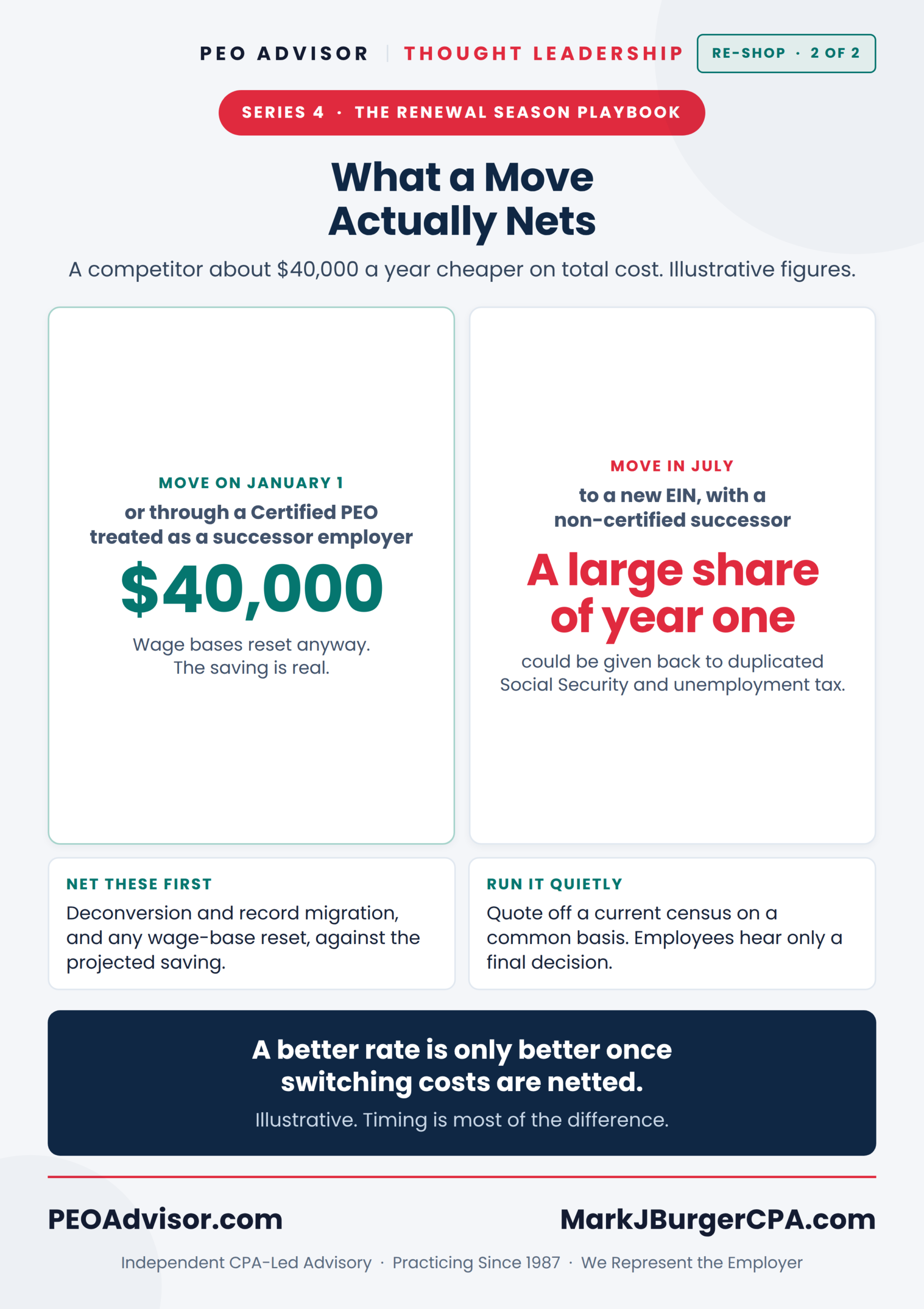
Worked example (illustrative). A market check surfaces a competitor about $40,000 a year cheaper on total cost. Whether that $40,000 is real depends almost entirely on when you move. Assume three employees earning above the 2026 Social Security wage base of $184,500, and a mid-year move to a new employer identification number with a non-certified successor, so year-to-date wages restart.
| Projected annual saving from the move | $40,000 |
| 2026 Social Security wage base | $184,500 |
| Employer rate | 6.2% |
| Duplicated employer tax, per capped employee | $11,439 |
| Capped employees affected | 3 |
| Move on January 1, or via a Certified PEO successor | $0 reset cost – the full $40,000 is real |
| Move in July to a new EIN, non-certified | $34,317 given back; about $5,683 left of year one |
The better rate is only better after these costs are netted – and timing is most of the difference. The same move, made six months apart, is either a $40,000 win or a rounding error.

Case in Point
Case in point (illustrative). A company hit three signals in one renewal: a double-digit increase the PEO would not substantiate, an administrative-fee bump, and a service team that had turned over twice in a year. It ran a quiet market check off a current census, kept the process away from employees, and found a better-fitting provider at a lower total cost. Rather than move immediately, it timed the transition to January 1 so the wage bases reset naturally and no duplicated tax arose, and employees experienced uninterrupted coverage. The signals justified the check; the timing protected the saving. This scenario is illustrative and does not describe an identifiable client.
The Re-Shop Checklist: A Step-by-Step
- Count the signals. Unsubstantiated increase, fee creep, service decline, above-market rate – one is attention, two or more is a re-shop.
- Try pushback first. Confirm whether negotiating the incumbent resolves the issue without moving.
- Benchmark total cost. Request comparable proposals on a common basis, and compare total cost, not headline rate.
- Net the switching costs. Deconversion, record migration, and any wage-base reset, against the projected saving.
- Protect the wage bases. Prefer a January 1 move, or a Certified PEO treated as a successor employer, and schedule the transition to avoid any coverage gap.
Deciding whether to renew or move? Run a confidential PEO market check with Mark J. Burger, CPA on the right timeline.
The real figures are attributed: 2026 small-group renewal increases commonly running 8 to 12 percent; the 2026 Social Security wage base of $184,500 and the 6.2 percent employer rate per the Social Security Administration; Certified PEO successor-employer treatment for wage-base carryover under IRS certification; and pricing windows around September reported by brokers and practitioners working these renewals. The $40,000 saving, the three-employee scenario, and the three-signal case in point are illustrative and do not describe an identifiable client. This content is educational, not legal or tax advice.
Frequently Asked Questions
When should I re-shop my PEO?
Re-shop when the signals justify it: a double-digit increase your PEO will not substantiate with claims data, administrative-fee creep independent of health costs, deteriorating service, or a rate that has drifted above market. One signal warrants attention; two or more warrant a market check. Because moving has real costs, treat re-shopping as a deliberate decision rather than a reflex to a bad renewal.
How do I run a PEO market check without disrupting employees?
Gather competitive quotes using a current census and plan summary without announcing anything to staff. Keep the process confidential, request proposals on a common basis so they are comparable, and time any eventual transition to avoid a gap in coverage. Employees experience continuity throughout; only a final decision to move needs to reach the broader team.
What does it cost to switch PEOs?
Switching can involve deconversion and record-migration work, and a mid-year move to a new employer identification number can restart Social Security and unemployment wage bases unless successor-employer rules apply. There may also be deconversion or early-termination fees. Net these switching costs against the projected saving, and prefer a January 1 move or a Certified PEO to protect wage-base carryover.
Is it better to negotiate with my current PEO or switch?
Try negotiation first. Requesting the medical loss ratio, securing a rate cap, and asking for credits can resolve many renewals without the cost of moving. Re-shop when pushback fails, the increase is unsubstantiated, or multiple signals – fee creep, service decline, above-market rate – appear together. A market check also strengthens your leverage with the incumbent.
When is the best time of year to re-shop a PEO?
Start months before your renewal date, and align with the market’s calendar. Practitioners note windows around September can be favorable, as PEOs price toward quarterly targets, while second quarter is often weaker for competitive, endorsable pricing. Timing the market check to both your renewal and the broader pricing cycle yields better alternatives and stronger leverage.
How do I avoid double taxation when switching PEOs mid-year?
A mid-year move to a new employer identification number can restart the Social Security and unemployment wage bases, taxing capped wages twice on the employer side. Avoid it by timing the move to January 1, when bases reset anyway, or by choosing a Certified PEO, which is treated as a successor employer so year-to-date wages carry over. Confirm the treatment in writing before switching.
About the author. Mark J. Burger, CPA, advises small and mid-sized businesses on strategic workforce and co-employment decisions through GuidePoint PEO LLC. His analysis draws on a CPA practice dating to 1987 and hundreds of PEO cost assessments.


