
Executive Summary
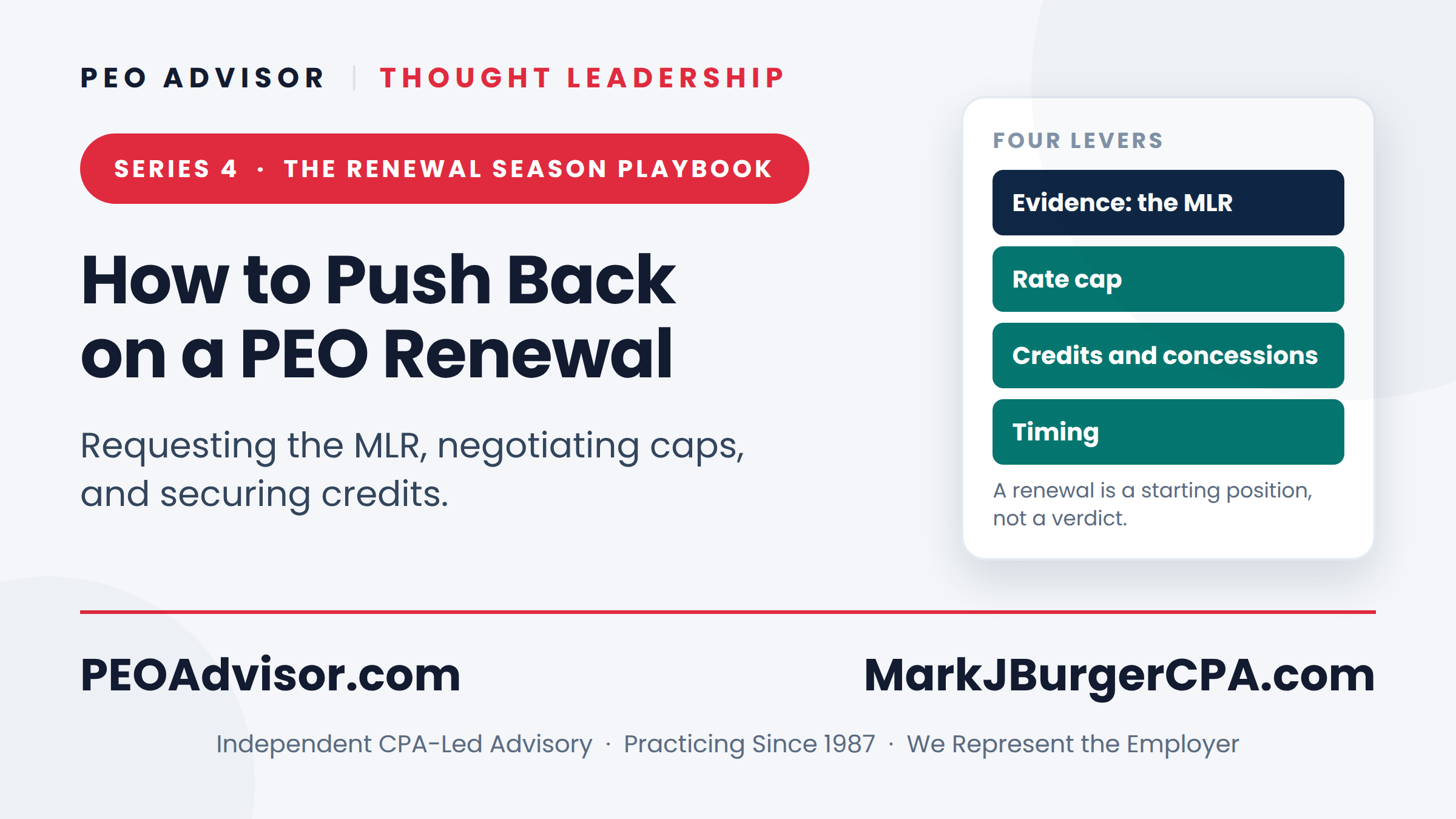
A PEO renewal is a starting position, not a verdict. Request the medical loss ratio to test whether the increase matches your group’s claims, negotiate a rate cap to limit the increase, and ask for credits or fee concessions. Brokers routinely secure caps in the range of 10 percent and have persuaded a PEO to cover half of an administrative-fee increase. With 2026 small-group increases commonly running 8 to 12 percent, the gap between the first offer and the negotiated one is real, recurring money.
Start by Requesting the Medical Loss Ratio
Before you argue the number, get the data that explains it. The medical loss ratio – your group’s claims paid against premium collected – tells you whether a proposed increase reflects your own employees’ utilization or something else. A group running a low loss ratio has a strong case that a steep renewal is unjustified by its own experience. Requesting the MLR is the first move in any serious pushback, because it converts the conversation from opinion to evidence. Ask for it in writing, for the current plan year, as early in the renewal cycle as possible. If you have not yet broken the renewal into its parts, start with the anatomy of a PEO renewal and what the single number actually bundles – the pushback below assumes you know which component you are challenging.
The Four Levers of a Renewal Pushback
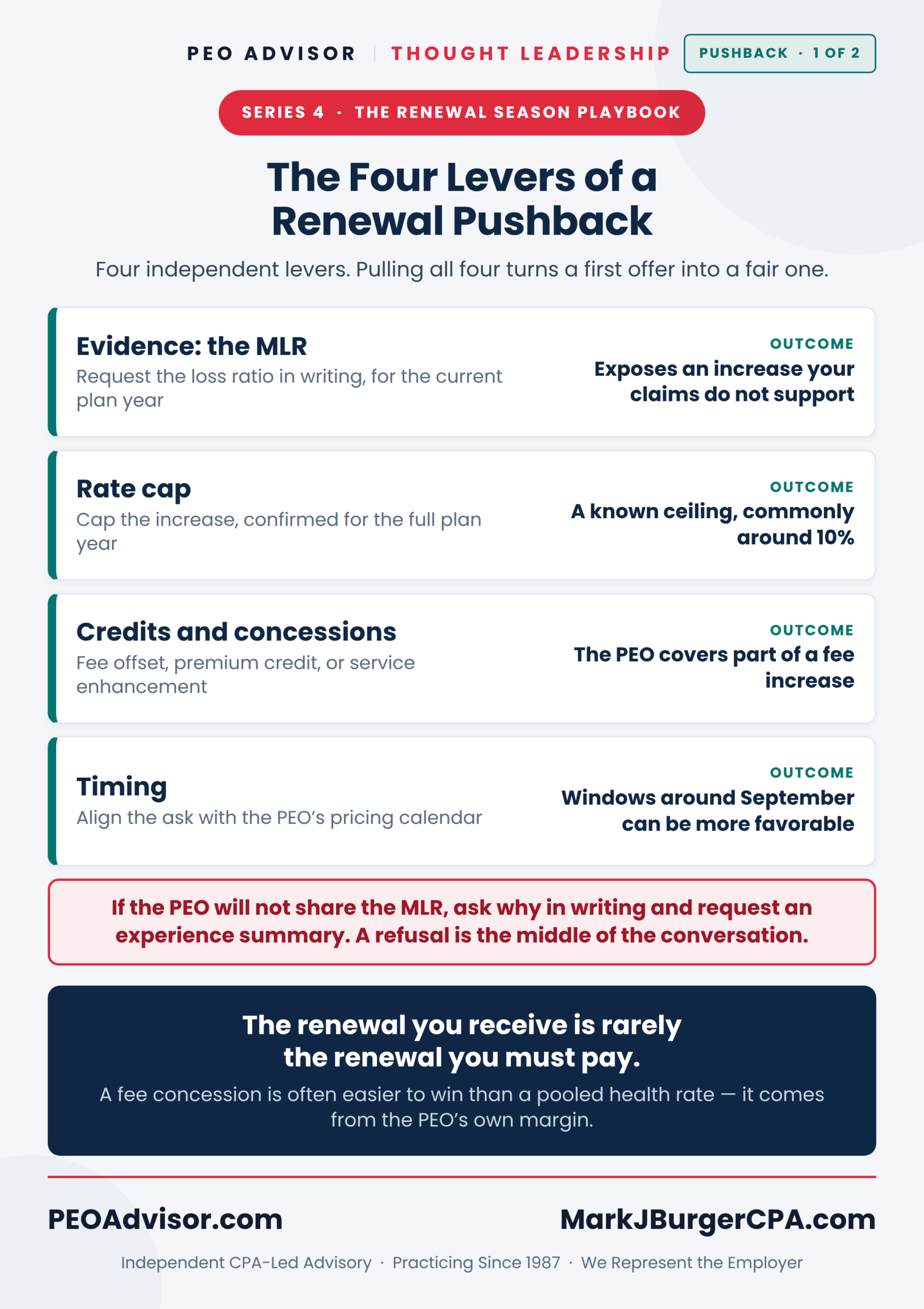
| Lever | The ask | Typical outcome |
|---|---|---|
| Evidence (MLR) | Request the loss ratio in writing, current plan year | Exposes an increase your claims do not support |
| Rate cap | Cap the increase, confirmed for the full plan year | A known ceiling, commonly around 10% |
| Credits / concessions | Fee offset, premium credit, service enhancement | PEO covers part of a fee increase; credit sometimes locked a year |
| Timing | Align the ask with the PEO’s pricing calendar | Windows around September can be more favorable |
When the PEO Will Not Give the MLR
Resistance to sharing the loss ratio is common, and it is not the end of the conversation. Some PEOs decline to release a medical loss ratio, particularly on a large-group master plan where your employees are pooled. When that happens, press. Ask specifically why the figure is unavailable, request whatever claims or experience summary the PEO will provide, and make clear that an unsupported increase is difficult to accept. Persistence matters here – brokers regularly report that a firm, repeated request produces information a first ask did not. If the PEO genuinely will not substantiate the increase, that refusal itself becomes a reason to consider re-shopping.
Negotiate a Rate Cap
If you cannot eliminate an increase, cap it. A rate cap limits how much the renewal can rise, and it is one of the most reliably winnable concessions. Brokers commonly secure caps in the neighborhood of 10 percent, converting an open-ended increase into a known ceiling. A cap is especially valuable in a volatile year like 2026, when regional increases vary widely: it protects you from the worst of the market while you decide whether to stay. Ask for the cap explicitly, in writing, and confirm whether it holds for the full plan year. The cap belongs in the agreement itself, alongside the service specifications, performance metrics, and termination provisions worth customizing in a PEO contract, rather than living as a verbal assurance from one account manager.
| Renewal on the table and no idea what to ask for? Get a no-cost read on your renewal and the specific concessions your position supports, through the PEO Advisor assessment. Start the PEO renewal negotiation assessment |
What Pushing Back Actually Recovers
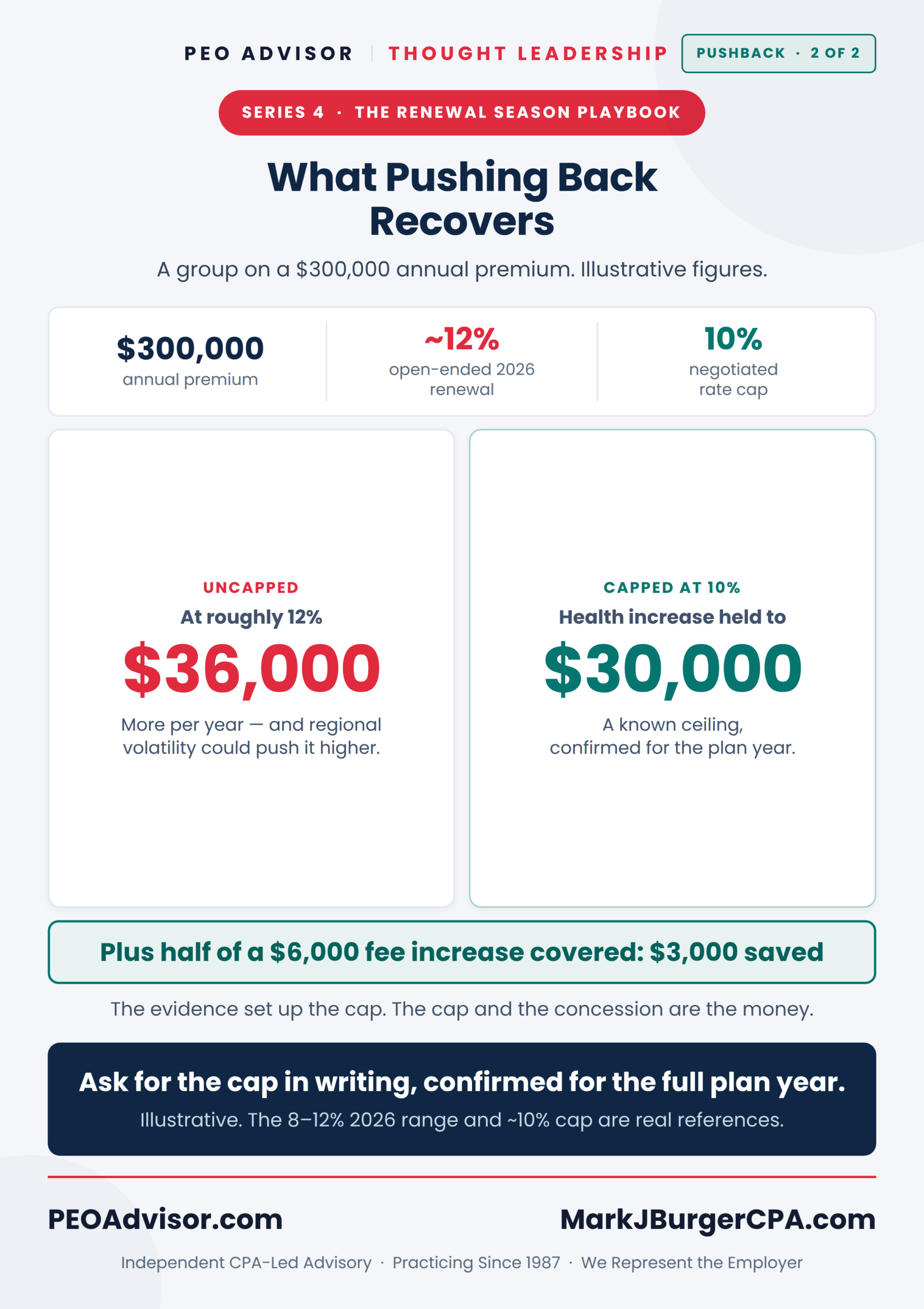
Worked example (illustrative). A group faces an open-ended renewal that, at the top of the 2026 market, could land near 12 percent on a $300,000 annual premium. The employer requests its loss ratio, finds claims running below premium, negotiates a 10 percent cap, and secures the PEO covering half of a $6,000 administrative-fee increase.
| Annual health premium | $300,000 |
| Uncapped renewal at 12% | $36,000 |
| Renewal at the negotiated 10% cap | $30,000 |
| Saved by the cap | $6,000 |
| Administrative-fee increase | $6,000 |
| PEO covers half | $3,000 |
| Total recovered in year one | $9,000 |
The evidence set up the cap; the cap and the concession are the money. And because the cap resets the base the following year rather than the increase alone, the saving recurs – a capped renewal is worth more than one year of the difference.

Ask for Credits and Fee Concessions
The renewal number is not the only lever; the surrounding costs are negotiable too. Beyond the health rate, ask for credits and concessions. Brokers have secured commitments such as a PEO covering half of an administrative-fee increase, and carriers negotiating a premium credit for a client, sometimes locked for a year. Each of these lowers the effective cost without necessarily changing the headline rate. When a PEO cannot or will not move the health increase itself, it can often offset it – through a fee concession, a credit, or a service enhancement – and those offsets are worth asking for by name. Renewal is also the moment to revisit the charges that never appeared in the original pitch, including the setup, enrollment, and deconversion fees a PEO quote does not advertise.
Time Your Pushback
When you negotiate is nearly as important as how. Renewal leverage shifts through the year. Practitioners note that PEOs often price to catch up with quarterly financial targets, and that certain windows – particularly around September – can be more favorable for re-shopping and for pressing a renewal. Second-quarter results are frequently not the moment to expect concessions. Understanding your PEO’s pricing calendar, and aligning your pushback with the point in the year when it is most motivated to keep your business, materially improves the outcome. And do not let the health renewal absorb an administrative-fee increase unchallenged – a fee concession is often easier for a PEO to grant than a change to the pooled health rate, because it comes directly from the PEO’s own margin.
Case in Point
Case in point (illustrative). A company received a double-digit renewal and, on the first request, was told its medical loss ratio was unavailable because the plan was pooled. Rather than accept the number, it repeated the request in writing, asked for any experience summary the PEO could share, and made clear an unsubstantiated increase was hard to accept. The second ask produced enough experience detail to show the group’s claims did not justify the full increase; the employer then secured a 10 percent cap and a partial fee offset. The refusal had not been the end of the conversation – it had been the middle of it. This scenario is illustrative and does not describe an identifiable client.
The Pushback Script: A Step-by-Step
- Request the evidence. Ask for the medical loss ratio or claims experience for the plan year, in writing.
- Press on a refusal. Ask why, request an alternative experience summary, and note that an unsupported increase is hard to accept.
- Ask for a rate cap. State it as a percentage and confirm it holds for the full plan year.
- Name the concessions. Ask for specific credits or fee offsets, including whether the PEO will cover part of a fee increase.
- Time the ask. Align your pushback with the PEO’s pricing calendar rather than its quarter-end.
The renewal you receive is rarely the renewal you must pay. Evidence, a cap, credits, and timing are four independent levers, and pulling all four is how an informed employer turns a first offer into a fair one.
Staring down a steep renewal? Build and run your pushback with Mark J. Burger, CPA before you accept the number.
The market references are real and attributed: 2026 small-group renewal increases commonly running 8 to 12 percent, rate caps commonly secured in the neighborhood of 10 percent, a PEO covering half of an administrative-fee increase, and pricing windows around September reported by brokers and practitioners working these renewals. The $300,000-premium example and the pooled-plan case in point are illustrative and do not describe an identifiable client. This content is educational, not legal or tax advice.
Frequently Asked Questions
Can you negotiate a PEO renewal?
Yes. A PEO renewal is an opening position backed by a pool average and a trend assumption, and it is negotiable on several fronts: requesting the medical loss ratio to test the increase, securing a rate cap, asking for credits or fee concessions, and timing the ask to the PEO’s pricing calendar. Pulling these levers together often turns a first offer into a materially lower one.
How do I request a medical loss ratio from my PEO?
Ask in writing, early in the renewal cycle, for your group’s claims-to-premium experience for the current plan year. A low loss ratio supports the argument that a steep increase is unjustified by your own utilization. If the PEO declines, ask why, request an alternative experience summary, and make clear that an unsupported increase is difficult to accept.
What is a PEO rate cap?
A rate cap limits how much a renewal can increase, converting an open-ended rise into a known ceiling. Brokers commonly secure caps around 10 percent. A cap is especially valuable in a volatile year with wide regional variation, because it protects you from the worst of the market while you decide whether to stay. Request it in writing and confirm it holds for the full plan year.
What if my PEO refuses to share the medical loss ratio?
Resistance is common, especially on a pooled large-group master plan. Press: ask specifically why the figure is unavailable, request whatever experience summary the PEO will provide, and repeat the request firmly. Persistence often produces information a first ask did not. If the PEO genuinely will not substantiate the increase, that refusal is itself a reason to consider re-shopping.
What credits or concessions can I ask a PEO for?
Beyond the health rate, ask for credits and concessions that lower the effective cost: a PEO covering part of an administrative-fee increase, a premium credit sometimes locked for a year, or a service enhancement. These offsets reduce your total cost even when the headline health rate does not move, and they are frequently easier for a PEO to grant because they come from its own margin.
When is the best time to negotiate a PEO renewal?
Timing matters because PEO pricing shifts with quarterly financial targets. Practitioners note that windows around September can be more favorable for pressing a renewal or re-shopping, while second-quarter results are often not the moment to expect concessions. Align your pushback with the point in the year when the PEO is most motivated to retain your business.
About the author. Mark J. Burger, CPA, advises small and mid-sized businesses on strategic workforce and co-employment decisions through GuidePoint PEO LLC. His analysis draws on a CPA practice dating to 1987 and hundreds of PEO cost assessments.


