
Executive Summary
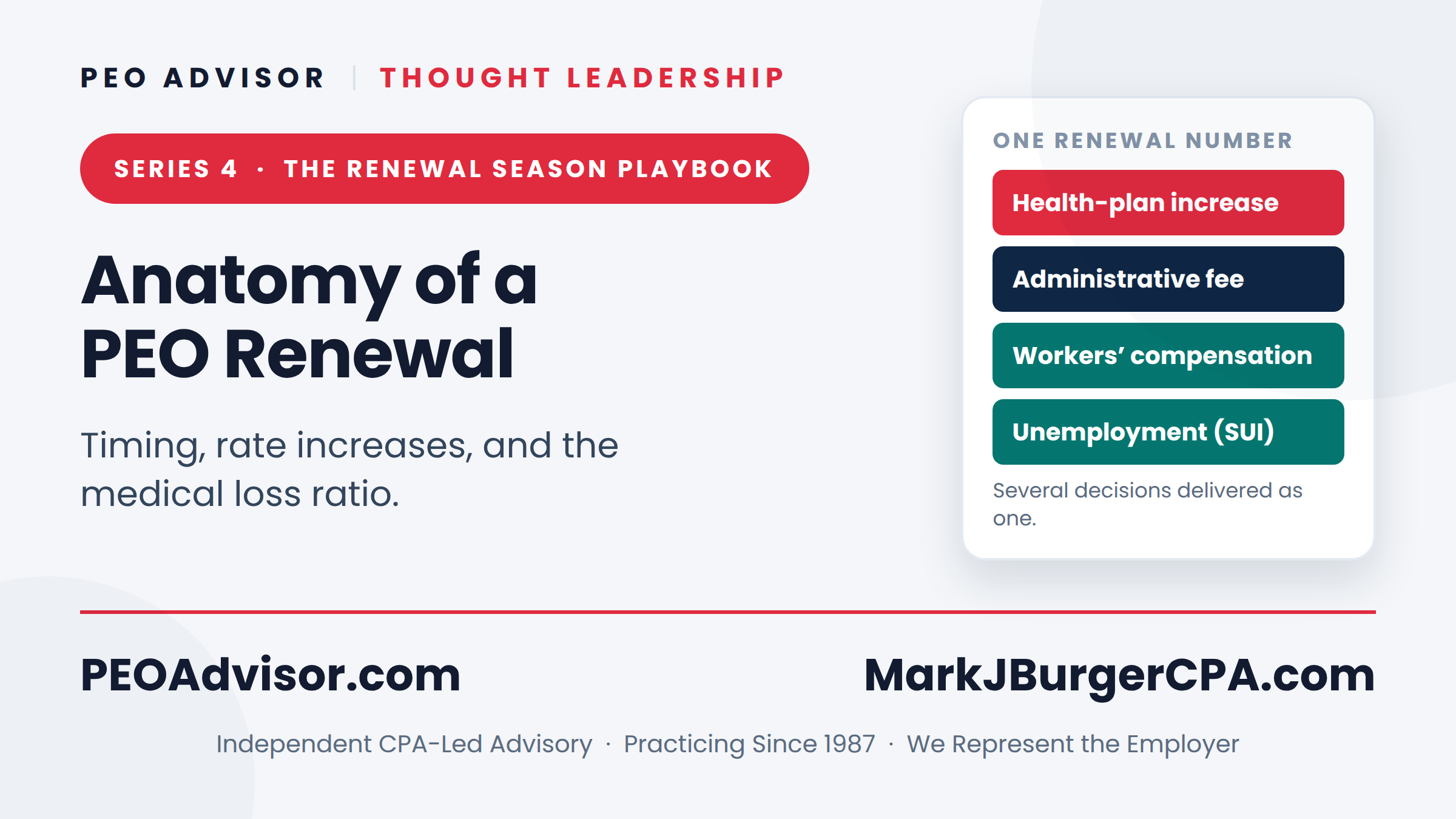
PEO renewals in 2026 arrive against a hard market. The median proposed premium increase in the small-group health market is about 11 percent, and roughly one in ten insurers is seeking 20 percent or more, according to KFF analysis. A PEO renewal bundles that health increase together with any administrative-fee change and workers’ compensation and unemployment adjustments into a single number, often delivered on a compressed timeline. Understanding each component – and the medical loss ratio behind the health piece – is what separates an informed renewal from an accepted one.
What a PEO Renewal Actually Bundles
A renewal is not one price; it is several decisions delivered as one. The health-plan increase is usually the largest component, but it arrives alongside any change to the administrative fee, adjustments to workers’ compensation, and movement in your unemployment charge. Because a PEO consolidates all of this, the headline renewal number can obscure which piece actually moved. The first job of a renewal review is disaggregation: pull the single figure back into its parts so you can see whether the increase is health, fee, insurance, or some combination – and challenge the right one. The same discipline applies every month, not just at renewal, which is why it is worth separating the three layers inside your PEO invoice before the renewal conversation begins.
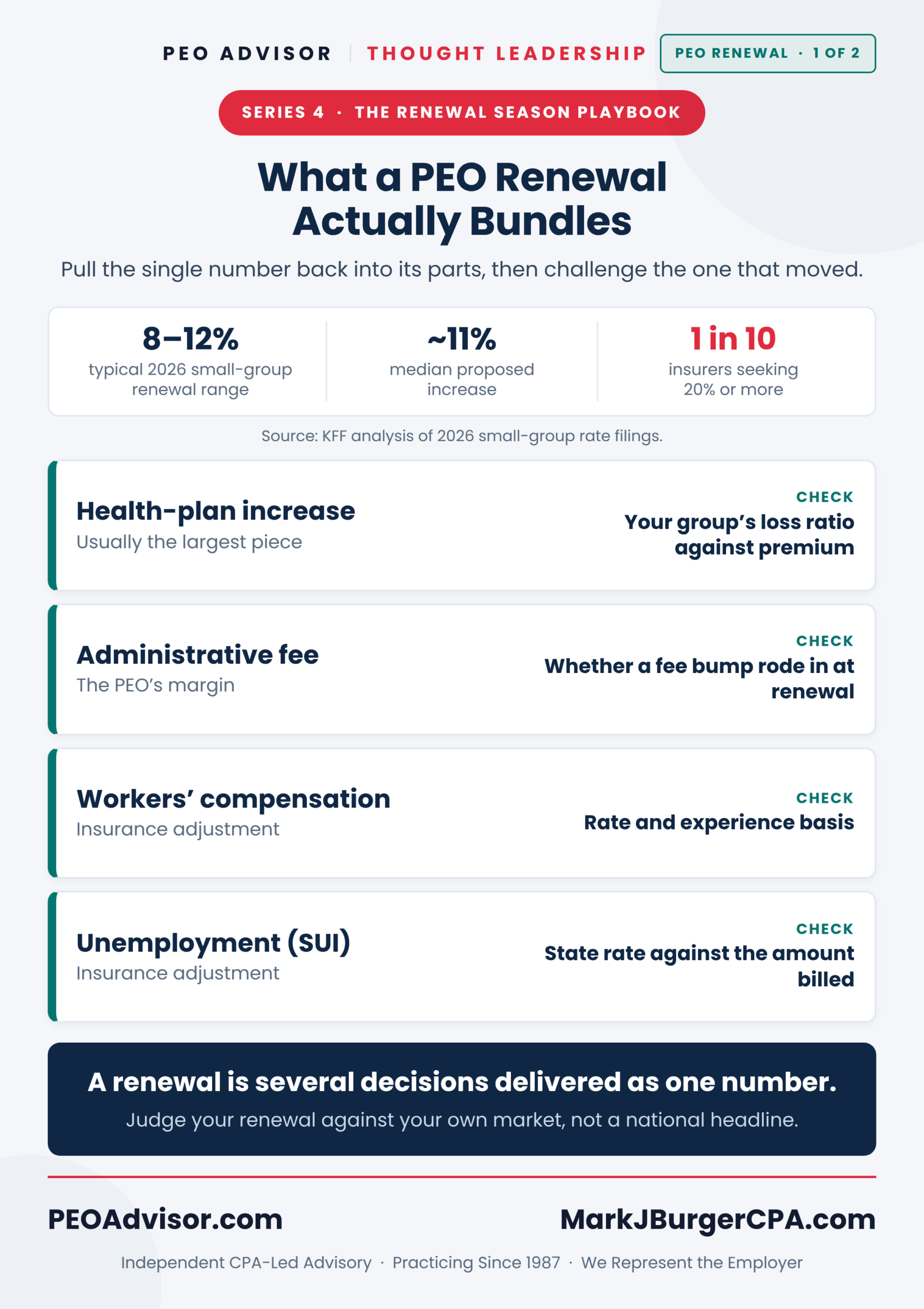
| Renewal component | What it is | What to check |
|---|---|---|
| Health-plan increase | Usually the largest piece | Your group’s MLR / claims vs. premium |
| Administrative fee | The PEO’s margin | Whether a fee bump rode in at renewal |
| Workers’ compensation | Insurance adjustment | Rate and experience basis |
| Unemployment (SUI) | Insurance adjustment | State rate vs. amount billed |
The 2026 Rate Environment
Context sets your expectations before the first number is discussed. For 2026, small-group renewals are commonly landing in the 8 to 12 percent range, with a median proposed increase near 11 percent across hundreds of small-group insurers, according to KFF analysis. About one in ten insurers is seeking 20 percent or more, and some proposed increases reach into the low thirties. Insurers attribute the pressure to a medical cost trend of roughly 9 percent, higher prescription costs including GLP-1 utilization, and general inflation. Regional variation is severe – some states are seeing increases far above the national median – so a renewal should be judged against your market, not a national headline. Group purchasing is part of why employers use a PEO in the first place: co-employment gives smaller employers access to health plans priced on a far larger risk pool, which is exactly the pool your renewal is being drawn from.
Renewal Timing, and Why It Is So Tight
The calendar is often the hardest part of a renewal. Many groups renew on common dates such as October 1 or January 1, and PEOs frequently will not finalize rates until the renewal is close, sometimes not releasing figures until August or September for an October start. Some hold pricing contingent on seeing the underlying renewal at all. That compression leaves owners little time to analyze, negotiate, or run a market check. Knowing your renewal date months ahead – and starting the review before the PEO forces the timeline – is the single most effective way to regain leverage.
| Renewal landing before you are ready for it? Get a no-cost read on your renewal – health, fee, workers’ compensation, and unemployment, separated – through the PEO Advisor assessment. Start the PEO renewal review assessment |
The Medical Loss Ratio, and Its Two Meanings
The term MLR carries two related meanings, and both matter at renewal. In the regulatory sense, the medical loss ratio is the share of premium an insurer spends on care. Federal rules require a minimum of 80 percent in the small-group and individual markets and 85 percent in the large-group market; when a carrier falls below the threshold, it owes rebates, typically issued in late summer or early fall. In the practical renewal sense, the medical loss ratio is your group’s own claims experience – the ratio of claims paid to premium collected – which is the number that either justifies a renewal increase or exposes it as unsupported.
Why the MLR Is Your Leverage
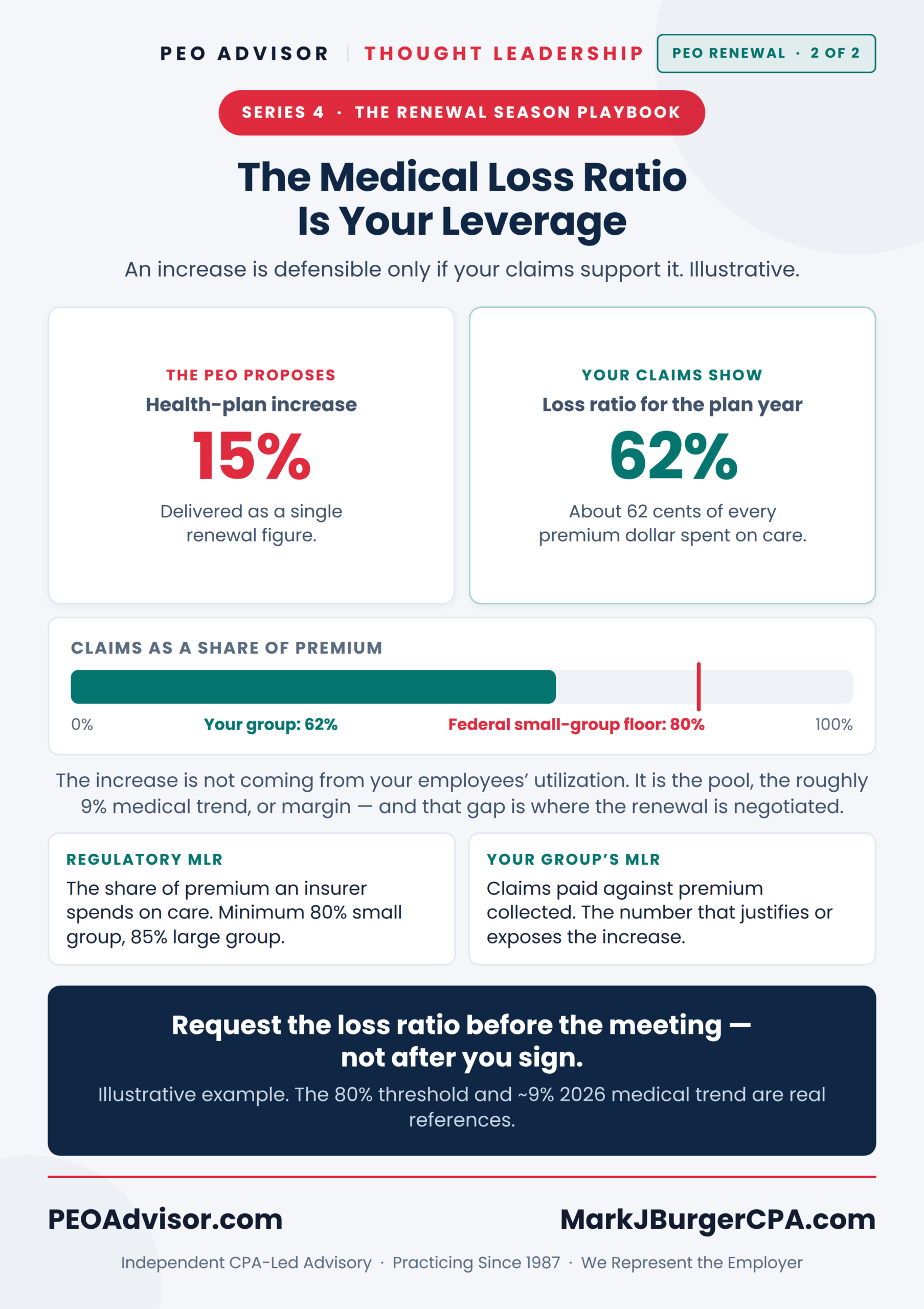
An increase is defensible only if your group’s claims support it. If your renewal proposes a 15 percent increase but your group’s loss ratio shows claims running well below premium, the increase is not coming from your employees’ utilization – it is coming from the pool, the trend, or the PEO’s margin. That gap is exactly where a renewal is negotiated. Requesting the medical loss ratio turns a renewal from an announcement into a conversation. If the answer keeps coming back unsatisfying year after year, that is a different question entirely, and the signs that a PEO relationship has run its course are worth reading alongside this one.
What the MLR Gap Looks Like
Worked example (illustrative). Your PEO proposes a 15 percent health increase. You request your group’s medical loss ratio and find claims ran at about 62 percent of premium for the plan year – well under the 80 percent federal floor for the small-group market.
| Annual premium paid by the group | $1,000,000 |
| Claims paid for the plan year | $620,000 |
| Group medical loss ratio | 62% |
| Federal small-group MLR floor | 80% |
| Proposed renewal increase | 15% ($150,000) |
| Gap between the group’s experience and the ask | 18 points below the floor, against a 15% increase |
If your own employees’ claims consumed only about 62 cents of every premium dollar, a 15 percent increase is not being driven by your utilization; it is the pool, the roughly 9 percent medical trend, or margin. That gap is the whole basis for negotiation, and the reason to request the number before the meeting rather than after you have signed.

The Administrative-Fee Line
Watch for a fee increase riding along with the health renewal. PEOs periodically raise the administrative fee, and renewal is when the change often appears. Announced increases frequently take effect for a given client only at that client’s renewal, so the health renewal and a fee bump can arrive together and blur into one number. Separate them. The administrative fee is negotiable on its own terms, and a fee increase buried inside a health renewal is easy to concede by accident if it is never pulled into the light.
Case in Point
Case in point (illustrative). A company received a renewal quoting a single double-digit increase and nearly accepted it. Broken into components, the number told a different story: the health piece was in line with the 2026 market, but an administrative-fee increase had been folded in at the same time, and the workers’ compensation line had moved without explanation. Once separated, the health increase was accepted as market, the fee bump was negotiated back on its own terms, and the workers’ compensation change was documented. Nothing improper had occurred; the components had simply been delivered as one number that discouraged questions. This scenario is illustrative and does not describe an identifiable client.
What to Assemble Before the Renewal Meeting: A Step-by-Step
- Fix the dates. Your renewal date and the date the PEO will release final numbers – established months ahead.
- Break out the components. Health, administrative fee, workers’ compensation, and unemployment, separated.
- Pull your loss ratio. Your group’s medical loss ratio or claims experience for the plan year.
- Line up last year. The prior year’s figures for each component, to measure the true change.
- Benchmark your region. A market benchmark for your area, given the wide 2026 variation.
Facing a PEO renewal this season? Have Mark J. Burger, CPA break the number down before you accept it.
The 2026 market figures are real and attributed: the median proposed small-group premium increase of about 11 percent, roughly one in ten insurers seeking 20 percent or more, and a medical cost trend near 9 percent, per KFF analysis of small-group rate filings. The federal medical loss ratio floors of 80 percent for the small-group and individual markets and 85 percent for the large-group market are statutory. The 15 percent renewal against a 62 percent group loss ratio, and the renewal-components case in point, are illustrative and do not describe an identifiable client. This content is educational, not legal or tax advice.
Frequently Asked Questions
What is included in a PEO renewal?
A PEO renewal bundles several components into one figure: the health-plan increase (usually the largest), any administrative-fee change, and adjustments to workers’ compensation and unemployment insurance. Because they arrive together, the headline number can hide which piece actually moved. The first step in any renewal review is to break the single number back into its parts and challenge the right one.
How much are health insurance renewals increasing in 2026?
For 2026, small-group renewals are commonly in the 8 to 12 percent range, with a median proposed increase near 11 percent and about one in ten insurers seeking 20 percent or more, per KFF analysis. Insurers cite a medical cost trend around 9 percent, higher prescription costs, and inflation. Regional variation is large, so judge a renewal against your local market, not the national median.
What is a medical loss ratio (MLR)?
The medical loss ratio is the share of premium spent on care. Federal rules require at least 80 percent in the small-group market and 85 percent in the large-group market, with rebates owed when a carrier falls short, typically paid in late summer or fall. In a renewal, MLR also refers to your group’s own claims-to-premium experience, which justifies or undercuts an increase.
When do PEO renewals come out?
Many groups renew on October 1 or January 1, and PEOs often finalize rates close to the date, sometimes not releasing figures until August or September for an October start. Some hold pricing contingent on seeing the underlying renewal. This compression limits time to analyze or negotiate, so knowing your renewal date months ahead is essential to keeping leverage.
Why did my PEO administrative fee go up at renewal?
PEOs periodically raise the administrative fee, and announced increases frequently take effect for each client at renewal. As a result, a fee increase can arrive alongside the health renewal and blend into one number. Separate the two: the administrative fee is negotiable on its own terms, and a fee bump hidden inside a health renewal is easy to concede unintentionally.
What should I prepare before a PEO renewal meeting?
Assemble your renewal date and the PEO’s number-release date, the renewal broken into health, fee, workers’ compensation, and unemployment components, your group’s medical loss ratio or claims experience, the prior year’s figures for each component, and a regional market benchmark. Preparing these ahead of the compressed renewal timeline is what makes negotiation possible.
About the author. Mark J. Burger, CPA, advises small and mid-sized businesses on strategic workforce and co-employment decisions through GuidePoint PEO LLC. His analysis draws on a CPA practice dating to 1987 and hundreds of PEO cost assessments.


