

Executive Summary
Every PEO invoice blends three very different things: your own payroll and taxes, which simply pass through; the PEO’s administrative fee, which is its margin; and bundled costs such as workers’ compensation and unemployment insurance, where the PEO may earn a spread you cannot see. Separating these three layers is the single most valuable audit a business owner can run — and the one most likely to reveal money left on the table. With the 2026 Social Security wage base at $184,500, even the pass-through layer rewards a careful reconciliation.
The Three Layers of Every PEO Invoice
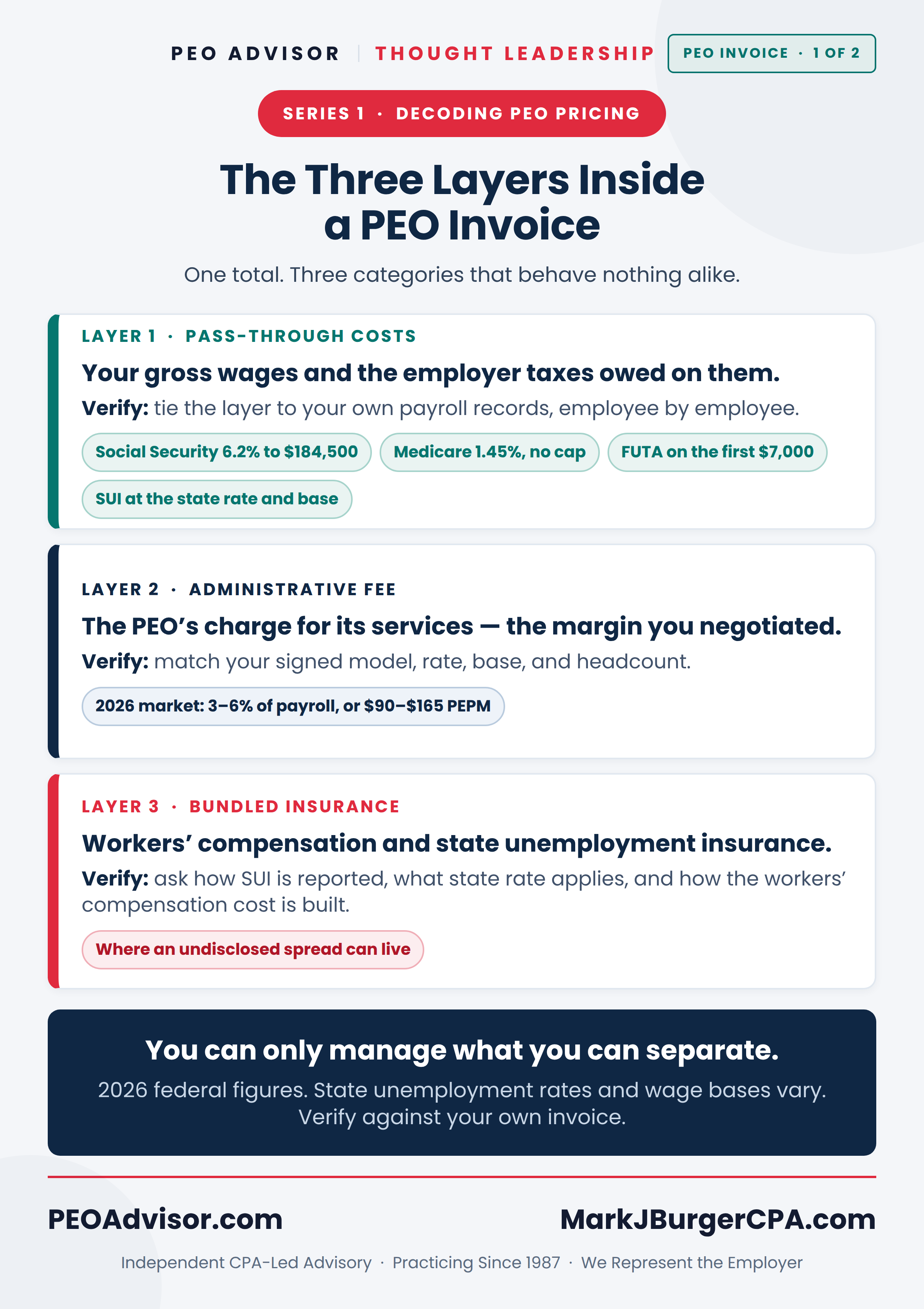
A PEO invoice looks like a single consolidated charge. In reality it stacks three categories that behave nothing alike, and confusing them is how businesses overpay without noticing. You can only manage what you can separate — once these three layers are pulled apart, the pass-through is verifiable, the fee is comparable, and the bundled costs become the place to ask hard questions. This is the third step in reading a PEO relationship honestly: the first article compared the pricing models, the second catalogued the setup, enrollment, and deconversion fees a quote does not advertise, and this one takes apart the bill that arrives every month.
| Invoice layer | What it is | How to verify it |
|---|---|---|
| Pass-through costs | Your gross wages and the employer taxes owed on them | Tie to your own payroll records, employee by employee |
| Administrative fee | The PEO’s charge for its services (the margin you negotiated) | Match your signed model, rate, base, and headcount |
| Bundled insurance | Workers’ compensation and state unemployment insurance | Ask how SUI is reported, the state rate, and the WC build-up |
Pass-Through Costs: What Is Simply Yours
Begin by confirming the money that was always going to be yours. Gross wages plus employer taxes — Social Security at 6.2 percent up to the 2026 wage base of $184,500, Medicare at 1.45 percent with no cap, federal unemployment tax on the first $7,000 of wages, and state unemployment insurance — are costs you would carry directly if you ran payroll in-house. A PEO does not save you these; it remits them on your behalf. Verifying that the pass-through layer matches your actual payroll is the foundation of every invoice audit, because an error here quietly inflates the total under the cover of a consolidated charge.
| Employer tax (2026) | Rate | Base / cap |
|---|---|---|
| Social Security | 6.2% | Up to $184,500 |
| Medicare | 1.45% | No cap |
| Federal unemployment (FUTA) | Statutory | First $7,000 of wages |
| State unemployment (SUI) | State rate | State wage base |
The Administrative Fee: The PEO’s Margin
Isolate the fee and hold it against your quote. This is the layer the first article in this series taught you to negotiate. On the invoice, confirm it matches the model and rate you agreed to — a percentage applied to the correct payroll base, or a per-employee-per-month figure multiplied by the correct headcount. In 2026 competitive full-service fees run 3 to 6 percent of payroll, or roughly $90 to $165 per employee per month. If the effective fee on your invoice drifts above what you signed, the drift is usually hiding in the base the percentage is applied to, or in a headcount that includes employees who have left.
The Arbitrage Layer: Workers’ Compensation and Unemployment Insurance
This is where margin lives that you never explicitly approved. PEOs frequently report state unemployment insurance on a file-by-PEO basis, meaning your workers roll up under the PEO’s unemployment account and its experience rating rather than your own. The PEO is charged a state rate and may bill you a different one, keeping the spread. The same dynamic appears in workers’ compensation, where group purchasing produces a real, legitimate saving, but the portion passed to you versus retained by the PEO is rarely disclosed. Brokers describe this candidly as an arbitrage game — not improper on its face, but invisible unless you ask. It is also why a percentage-of-payroll fee tends to run higher in high-risk industries, where workers’ compensation exposure is built into the rate. The CPA approach: ask whether SUI is reported file-by-PEO or at the client level, what state rate the PEO is actually charged, and how the workers’ compensation cost is built. A PEO unwilling to explain the spread is a signal in itself.
| Not sure which layer your money is actually going to? Get a no-cost, three-layer read on your current PEO invoice — pass-through, administrative fee, and insurance markup — through the PEO Advisor assessment. Start the PEO invoice audit assessment |
The Tax-Cap Trap: Are Your Wage Bases Being Honored?
Switching PEOs mid-year can quietly double-tax your highest earners. When an employee changes payroll systems mid-year, year-to-date wages must carry over so that annual wage bases — the $184,500 Social Security cap in 2026, and state unemployment wage bases — are respected. Not every PEO honors those caps correctly on a mid-year transition, and the field has raised real concern about providers that restart the clock. The result is employer and employee Social Security tax charged twice on the same capped wages. Red flag: a mid-year PEO change with no explicit written confirmation that year-to-date wages and tax caps carry over. Ask the question before the transition, and verify it on the first post-transition invoice.
What the Tax-Cap Trap Actually Costs
Worked example (illustrative). Consider a professional-services firm with 20 employees who each earn above the 2026 Social Security wage base of $184,500, switching PEOs in July. If the new PEO restarts year-to-date wages instead of carrying them over, Social Security tax is charged again on wages already capped.
| 2026 Social Security wage base | $184,500 |
| Employer rate | 6.2% |
| Duplicated employer tax, per capped employee | $11,439 |
| Capped employees affected | 20 |
| Total duplicated employer Social Security tax | $228,780 |
Caught before the transition, the fix costs nothing: written confirmation that year-to-date wages carry over. Caught in January, it becomes a payroll-correction and refund exercise across every affected employee.

Case in Point
Case in point (illustrative). A firm with a highly paid professional team moved PEOs at midyear without confirming wage-base carryover. The pass-through layer looked normal month to month, so no one questioned it — until year-end, when W-2s showed Social Security wages restarted from zero at the new provider and the firm faced duplicated employer tax plus over-withholding to reconcile and refund. The error was entirely preventable with one written confirmation before the switch and one check of the first post-transition invoice. This scenario is illustrative and does not describe an identifiable client; it shows why the pass-through layer deserves an audit precisely when it looks routine.
A Line-by-Line Audit Framework: Step-by-Step
Run this quarterly, and always in the first month after any PEO change. For how invoice discipline fits the wider decision, see our overview of PEO solutions for small and mid-sized businesses.
- Split the bill into three. Separate the invoice into pass-through, administrative fee, and bundled insurance.
- Tie the pass-through to payroll. Match gross wages and employer taxes to your own records, employee by employee where feasible.
- Recompute the fee. Check it against your signed model and confirm the base or headcount used.
- Question the SUI line. Ask how SUI is reported and what state rate underlies your unemployment charge.
- Open up workers’ compensation. Confirm the cost build-up and whether any experience-rating credit reaches you.
- Verify carryover on any transition. On a mid-year move, confirm Social Security and state wage bases carried over.
- Reconcile at year-end. Tie W-2s and quarterly filings to the pass-through totals you verified through the year.
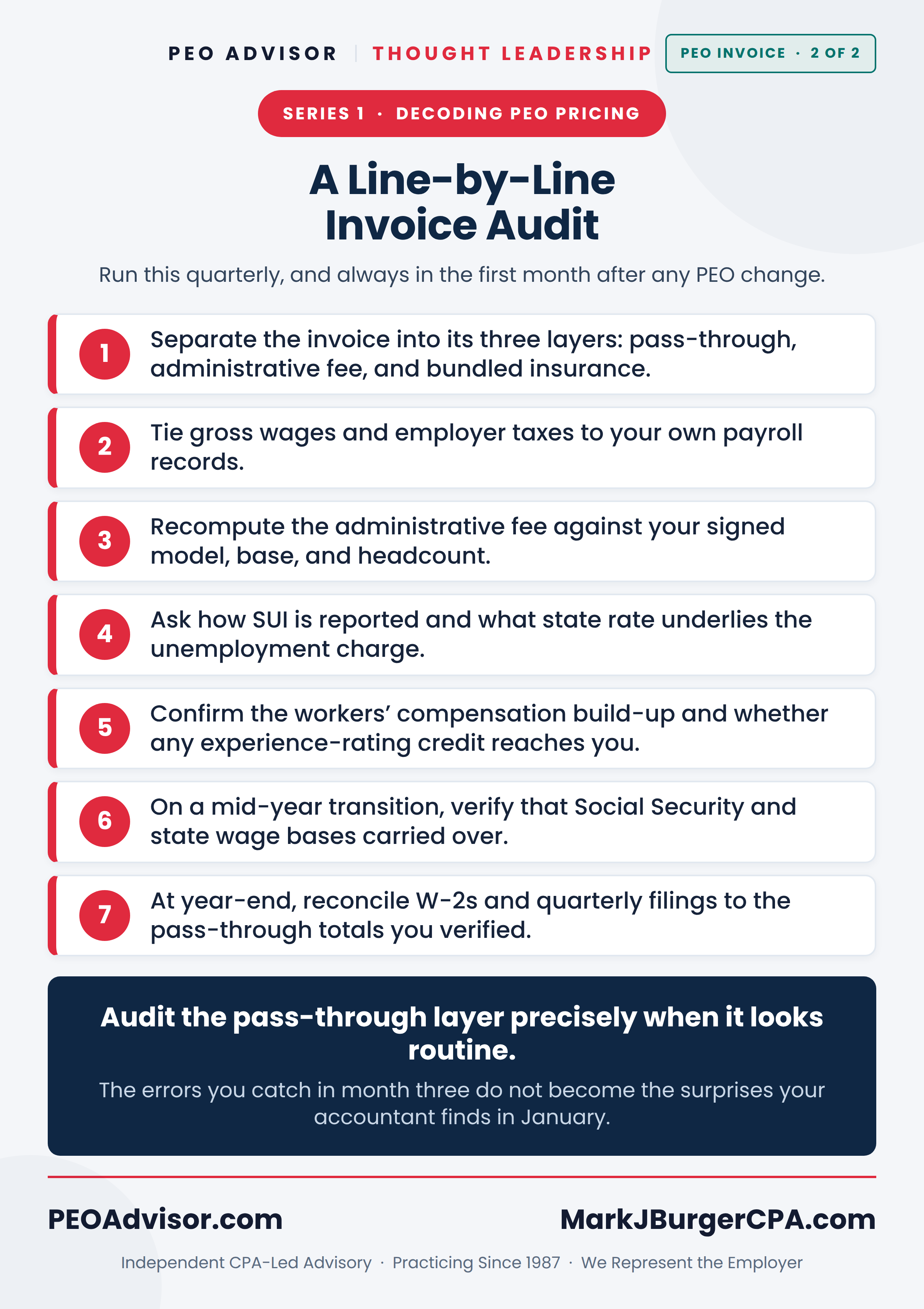
The discipline pays off where it is least visible: the errors you catch in month three do not become the surprises your accountant finds in January.
Want a second set of eyes on your PEO invoice? Request a Confidential Three-Layer Invoice Audit from Mark J. Burger, CPA.
The 2026 employer tax figures are real and attributed: the Social Security wage base of $184,500 and the 6.2 percent employer rate per the Social Security Administration, Medicare at 1.45 percent with no cap, and federal unemployment tax on the first $7,000 of wages per the IRS. Competitive 2026 PEO administrative fees of 3 to 6 percent of payroll, or roughly $90 to $165 per employee per month, reflect current market pricing data. The 20-employee double-taxation example and the year-end case in point are illustrative and do not describe an identifiable client, though the math uses the real 2026 cap. This content is educational, not legal or tax advice.
Frequently Asked Questions
What is included in a PEO invoice?
A PEO invoice bundles three layers: pass-through costs (your gross wages and employer taxes), the administrative fee (the PEO’s charge for its services), and bundled insurance costs such as workers’ compensation and unemployment insurance. Separating these three is essential, because only then can you verify the pass-through, compare the fee, and question any undisclosed markup on insurance.
What is PEO SUI arbitrage?
Many PEOs report state unemployment insurance on a file-by-PEO basis, so your employees roll up under the PEO’s account and experience rating. The PEO is charged a state rate and may bill you a different one, keeping the spread. It is not inherently improper, but it is rarely itemized. Ask how SUI is reported and what underlying state rate applies.
Can switching PEOs mid-year cause double taxation?
Yes, if year-to-date wages do not carry over. Annual wage bases — the $184,500 Social Security cap in 2026 and state unemployment wage bases — must transfer so caps are respected. If a PEO restarts the clock mid-year, Social Security tax can be charged twice on the same capped wages. Confirm carryover in writing before any mid-year transition.
How do I audit my PEO bill?
Separate the invoice into pass-through, administrative fee, and bundled insurance. Tie wages and employer taxes to your payroll records, recompute the fee against your signed model, and ask how SUI and workers’ compensation costs are built. Run this quarterly and always in the first month after any PEO change. Reconcile against W-2s and quarterly filings at year-end.
What employer taxes pass through a PEO in 2026?
The core employer taxes are Social Security at 6.2 percent on wages up to the 2026 base of $184,500, Medicare at 1.45 percent with no cap, federal unemployment tax on the first $7,000 of wages, and state unemployment insurance. These pass through to you; the PEO remits them but does not absorb them. Verifying this layer against payroll records anchors any invoice audit.
Is a PEO markup on workers’ compensation normal?
Group purchasing through a PEO can genuinely lower workers’ compensation cost, and a PEO may retain part of the saving as margin. That is a normal business model when disclosed. The concern is transparency: the portion passed to you versus retained is rarely itemized. Ask how the workers’ compensation cost is built and whether any experience-rating credit reaches your account.
About the author. Mark J. Burger, CPA, advises small and mid-sized businesses on strategic workforce and co-employment decisions through GuidePoint PEO LLC. His analysis draws on a CPA practice dating to 1987 and hundreds of PEO cost assessments.


