
Executive Summary
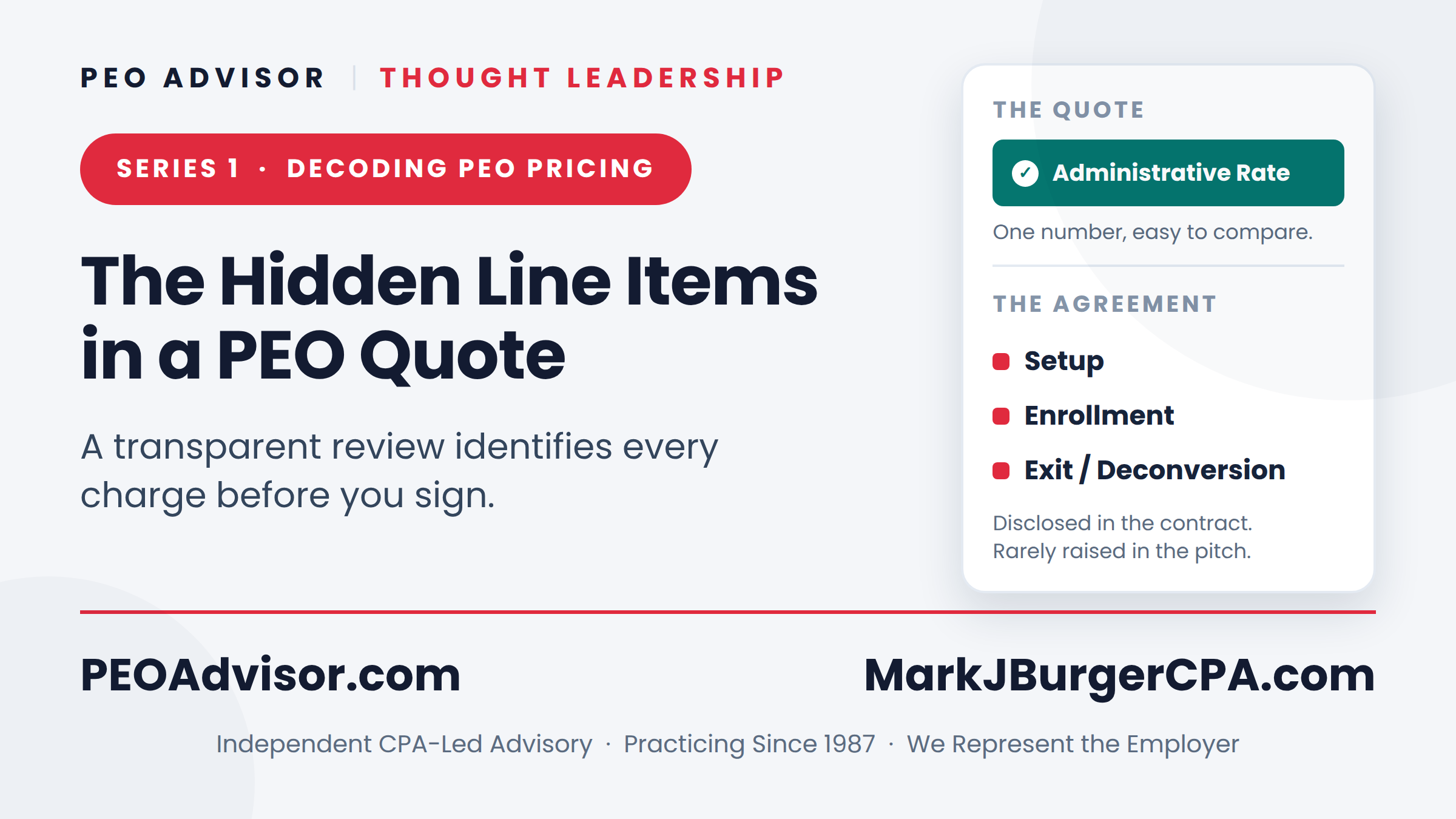
Most PEO fees are disclosed somewhere in the contract; few are ever surfaced in the sales conversation. In 2026, setup fees commonly run $500 to $2,000 — and exceed $5,000 for complex groups — while per-hire charges of $25 to $150, per-termination charges of $50 to $200, and 401(k) deconversion fees have all appeared in real transactions. The headline rate is rarely the whole price, and the fees that surprise business owners are almost always the ones nobody mentioned out loud.
Why the Headline Rate Is Not the Price
A PEO proposal is engineered to be compared on one number. That number — the administrative fee, whether expressed as a percentage of payroll or a per-employee-per-month figure — is genuinely important, and the first article in this series explains how percentage-of-payroll and per-employee-per-month pricing actually compare. But the administrative fee is only the part of the price designed to be shopped. The remainder of the cost lives in ancillary fees that are technically disclosed, usually deep in the agreement, and almost never volunteered.
What this means for you: comparing two PEOs on administrative fee alone is like comparing two mortgages on interest rate while ignoring origination points, closing costs, and prepayment penalties. The rate starts the conversation. The line items below decide what you actually pay. For how pricing fits the wider decision, see our overview of PEO solutions for small and mid-sized businesses.
The Fees That Live in the Contract
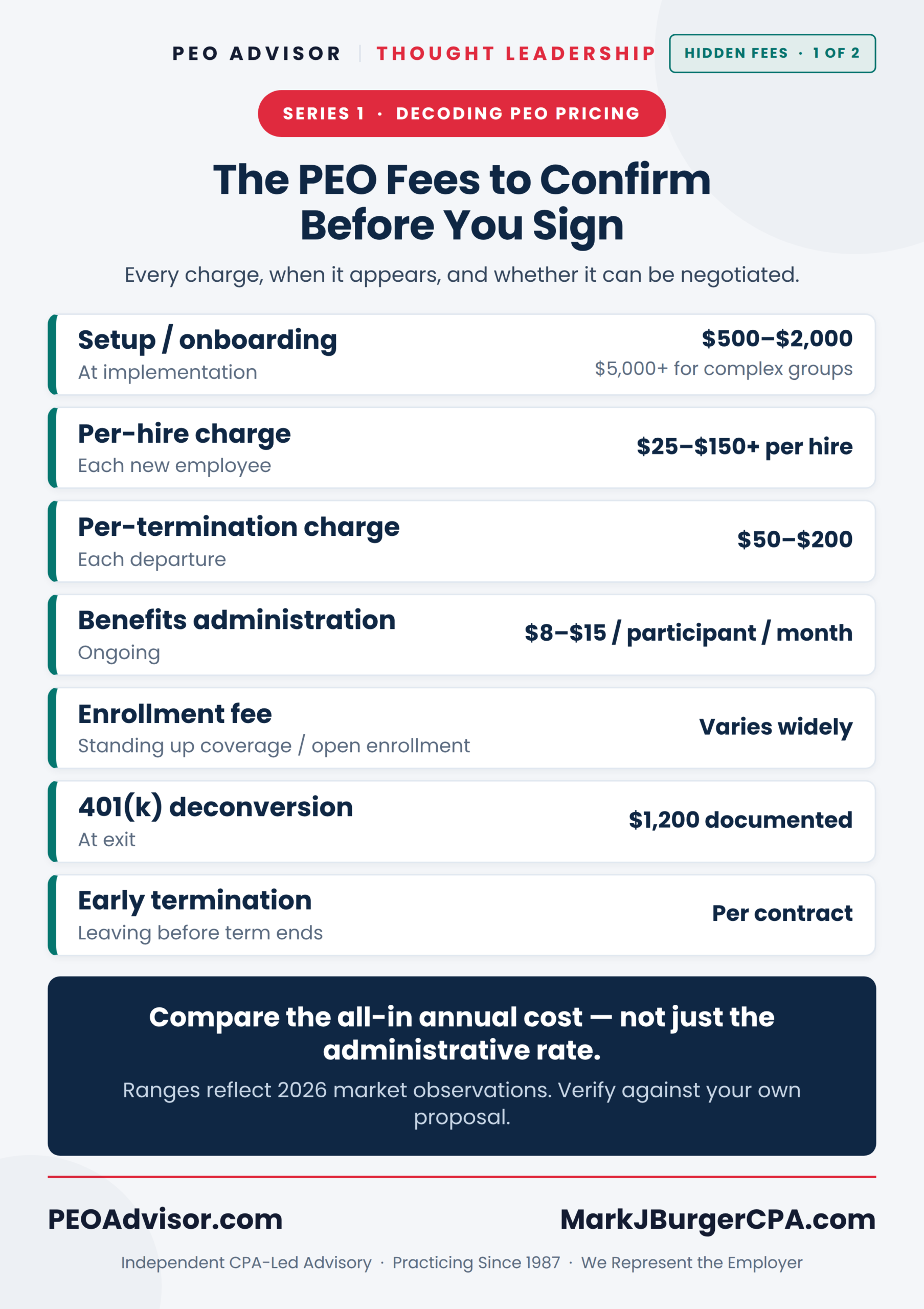
Every fee below is typically disclosed in the agreement and rarely surfaced in the pitch. The table gives the 2026 ranges and, just as important, when each one appears — because a fee you only meet at a new hire, an open enrollment, or an exit is a fee that never shows up in a side-by-side of headline rates. Even a straightforward per-employee flat-fee PEO model can carry licensing and add-on charges layered on top of the base rate.
| Fee | Typical 2026 range | When it appears |
|---|---|---|
| Setup / onboarding | $500–$2,000 (>$5,000 for complex groups) | At implementation |
| Per-hire charge | $25–$150+ per hire | Each new employee |
| Per-termination charge | $50–$200 | Each departure |
| Benefits administration | $8–$15 per participant / month | Ongoing |
| Enrollment fee | Varies widely (field cases: $50,000 quoted, $350,000 paid) | Standing up coverage / open enrollment |
| 401(k) deconversion | e.g., $1,200 documented | At exit |
| Early termination | Per contract | Leaving before term ends |
Setup and Onboarding Fees
Expect a setup fee, and expect it to be negotiable. In 2026, one-time setup or onboarding fees commonly range from $500 to $2,000, and reach $5,000 or more for larger or more complex groups. Some providers waive the fee to win a competitive deal; others fold it quietly into the first month or two of service without itemizing it. Neither approach is improper, but only one is transparent. The CPA approach: ask for the setup fee as a separate line, ask whether it is waivable, and ask what it specifically covers.
Per-Hire and Per-Termination Charges
Some PEOs bill for the routine act of adding or removing an employee. Per-hire charges for processing new-employee paperwork and system setup commonly run $25 to $150 or more per hire. Separate per-termination charges — distinct from any unemployment claim — often sit at $50 to $200 and are easy to miss because they appear only when someone leaves. Red flag: a low administrative rate paired with aggressive per-transaction fees can cost a high-turnover employer more than a higher rate with no such charges. Model these against your actual annual hires and departures, not against zero.
When a Low Rate Costs More
Worked example (illustrative). A 60-employee company with high turnover — about 30 hires and 30 departures a year — compares two PEOs on a $3,000,000 payroll. PEO X quotes a low 3.2 percent administrative rate ($96,000) plus $125 per hire and $175 per termination. PEO Y quotes 3.5 percent ($105,000) with no per-transaction fees.
| 60 employees · $3,000,000 payroll | PEO X — lower rate | PEO Y — higher rate |
|---|---|---|
| Administrative rate | 3.2% = $96,000 | 3.5% = $105,000 |
| Per-hire fees (30 × $125) | $3,750 | $0 |
| Per-termination fees (30 × $175) | $5,250 | $0 |
| All-in annual cost | $105,000 | $105,000 |
Raise turnover further and PEO X becomes the costlier choice despite the lower headline rate. The per-transaction fees only surface when you model them against your actual hiring and turnover, not against zero.
Benefits Administration and Enrollment Fees
Enrollment and benefits-administration fees are where the largest surprises live. Benefits administration is sometimes billed at $8 to $15 per participant per month on top of the base fee. Enrollment fees, charged to stand up group coverage, can be far larger. Brokers in the field have seen an enrollment fee of $50,000 quoted to a nonprofit — stopped only because someone caught it — and a $350,000 enrollment fee that a 300-person private-equity-backed group actually paid. These are not typical figures, but they are real, and they show how far an unexamined enrollment fee can travel. For any benefits-eligible group, ask specifically whether an enrollment fee applies, how it is calculated, and whether it recurs at each open enrollment — a question that matters most when you are timing a PEO transition around open enrollment.
| Not sure what your PEO proposal really costs all-in? Get a no-cost, line-by-line read on the setup, per-transaction, enrollment, and exit fees in your actual quote through the PEO Advisor assessment. Start the PEO fee review assessment |
The 401(k) Deconversion Fee
Leaving a retirement plan can carry its own charge. When a client moved from one large PEO to another, the departing plan issued a 401(k) deconversion fee of $1,200 simply to unwind the plan. Deconversion and record-migration fees of this kind are easy to overlook because they appear at exit, long after the sales conversation, and they can affect both the retirement plan and the payroll and benefits records you need to carry forward. If your PEO relationship includes a retirement plan under a multiple-employer structure, ask at the outset what it costs to leave, not only what it costs to join.
Contract Lock-Ins and Auto-Renewal
The most expensive term is often the one that governs your exit. Many PEO agreements run 12 to 36 months, frequently with auto-renewal clauses and early-termination fees, and per-employee-per-month arrangements are commonly locked for 18 months. A lock protects your rate, which can be a benefit, but it also removes your leverage if service deteriorates or a renewal disappoints. Red flag: an auto-renewal paired with a narrow notice window and an early-termination fee. Calendar the notice date the day you sign, and confirm in writing what leaving early actually costs — the same discipline applied in this CPA framework for evaluating a PEO partner.

Case in Point
Case in point (illustrative). A 300-person organization signed a PEO on an attractive administrative rate and did not ask about enrollment fees. At the first open enrollment, a five-figure benefits-enrollment charge appeared that no one had modeled — the kind of fee that, in real field cases, has ranged from a $50,000 quote to a $350,000 charge actually paid. Because it was disclosed in the agreement, there was little recourse after signing. A single line-item review beforehand would have surfaced it and made it negotiable. This scenario is illustrative and does not describe an identifiable client; the extreme figures reflect real cases brokers have reported.
The Questions That Surface Every Fee: A Step-by-Step
Bring these to the proposal review. Each one forces a disclosed-but-unspoken fee into the open, in the order they tend to arise.
- Ask for the setup fee as a line. Is there a setup or onboarding fee, is it waivable, and what does it cover?
- Separate the per-transaction charges. Is there a per-hire charge and a distinct per-termination charge?
- Price benefits administration per head. Is it billed per participant, and at what monthly rate?
- Surface the enrollment fee. Does one apply, how is it calculated, and does it recur each open enrollment?
- Price the exit before you enter. If a retirement plan is included, what is the deconversion or exit cost?
- Calendar the notice window. What is the contract term, is there auto-renewal, and how long is the notice period?
- Get the early-exit number in writing. What is the total cost of terminating early?
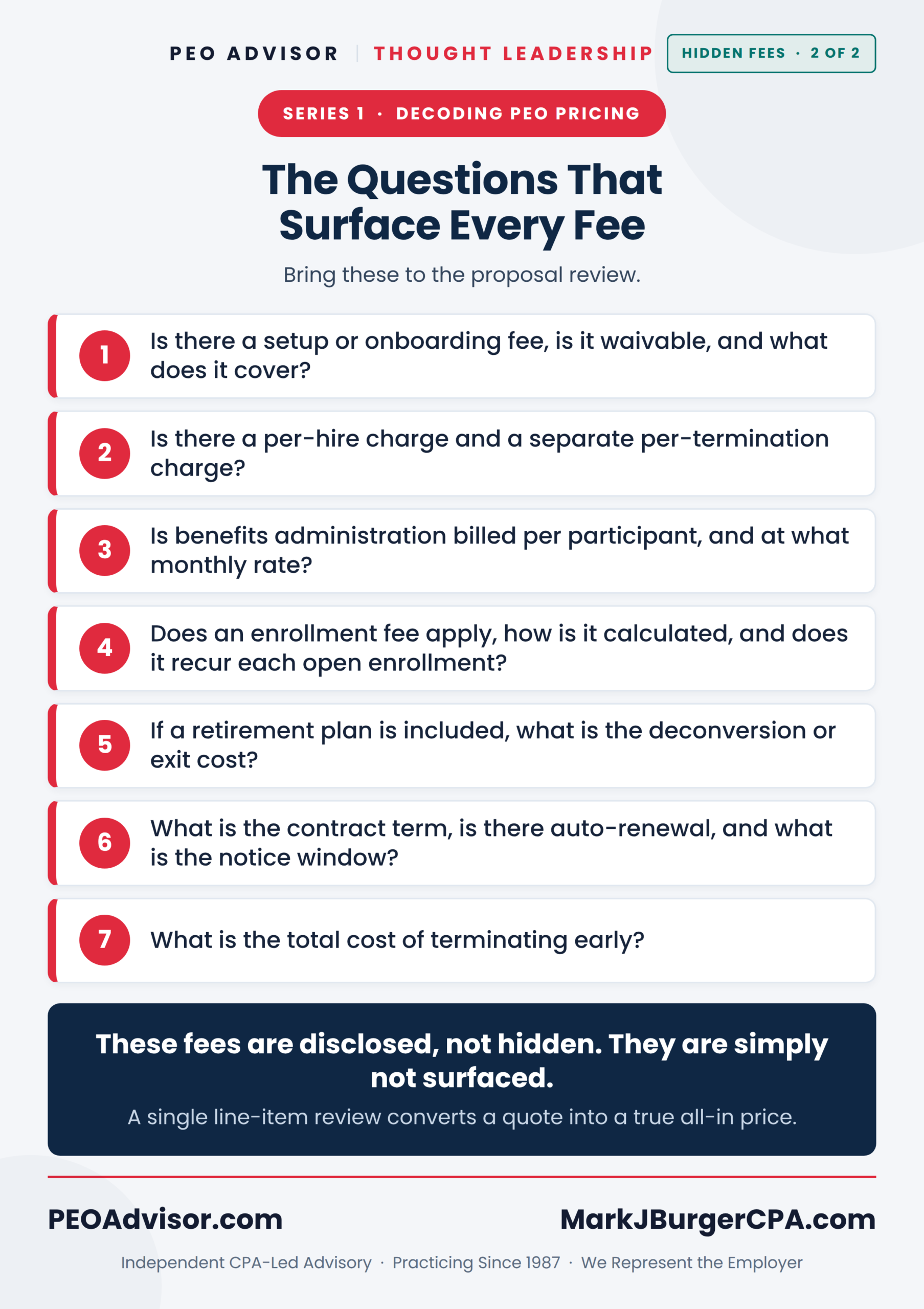
The pattern is consistent: these fees are disclosed, not hidden in the legal sense. They are simply not surfaced. A single review conversation, driven by the questions above, converts a quote into a true all-in price — and that is the number worth comparing.
Ready to see what your PEO proposal actually costs all-in? Book Your PEO Fee Review with Mark J. Burger, CPA.
The 2026 fee ranges (setup $500–$2,000; per-hire $25–$150; per-termination $50–$200; benefits administration $8–$15 per participant per month) and the documented field cases — a $50,000 enrollment fee quoted, a $350,000 enrollment fee paid, and a $1,200 401(k) deconversion fee — are real and reported from broker practice. The two-PEO comparison and the 300-person case in point are illustrative and do not describe an identifiable client. This content is educational, not legal or tax advice.
Frequently Asked Questions
What hidden fees do PEOs charge?
Beyond the administrative fee, common ancillary charges in 2026 include setup or onboarding fees of $500 to $2,000, per-hire charges of $25 to $150, per-termination charges of $50 to $200, benefits-administration fees of $8 to $15 per participant monthly, enrollment fees, and early-termination or deconversion fees. Most are disclosed in the contract but rarely mentioned during the sales process.
What is a PEO setup or onboarding fee?
It is a one-time charge to implement your account — configuring payroll, benefits, and systems. In 2026 it commonly runs $500 to $2,000, and more for complex groups. Some PEOs waive it to win business; others fold it into the first months of service without itemizing. Ask for it as a separate, clearly defined line and confirm whether it is waivable.
What is a PEO deconversion fee?
A deconversion fee is charged when you leave a PEO, covering the unwinding of plans and migration of records. Retirement plans can carry their own charge; one documented 401(k) deconversion fee was $1,200. Because these costs appear at exit, ask what leaving will cost before you join, not after you decide to switch.
Are PEO enrollment fees negotiable?
Frequently, yes. Enrollment fees to stand up group coverage vary widely and, in extreme real cases, have been quoted at $50,000 and even $350,000. Many are negotiable or waivable, but only if you raise them before signing. Ask whether an enrollment fee applies, how it is calculated, and whether it recurs at each open enrollment.
How long are PEO contracts, and can I leave early?
PEO agreements typically run 12 to 36 months, and per-employee-per-month arrangements are often locked for 18 months. Many include auto-renewal and early-termination fees. You can usually leave, but the cost and notice window are defined in the contract. Calendar the cancellation notice date at signing and confirm the early-exit cost in writing.
How can I avoid surprise PEO fees?
Ask for every fee as a separate line item before signing: setup, per-hire, per-termination, benefits administration, enrollment, deconversion, and early termination. Convert the quote into a true all-in annual cost using your actual hiring, turnover, and headcount. The fees are disclosed in the contract; a single structured review conversation surfaces them.
About the author. Mark J. Burger, CPA, advises small and mid-sized businesses on strategic workforce and co-employment decisions through GuidePoint PEO LLC. His analysis draws on a CPA practice dating to 1987 and hundreds of PEO cost assessments.


